
Ankle Sprains in Baseball: Bags, Slides, and the Rehab Step Everyone Skips
 Baseball
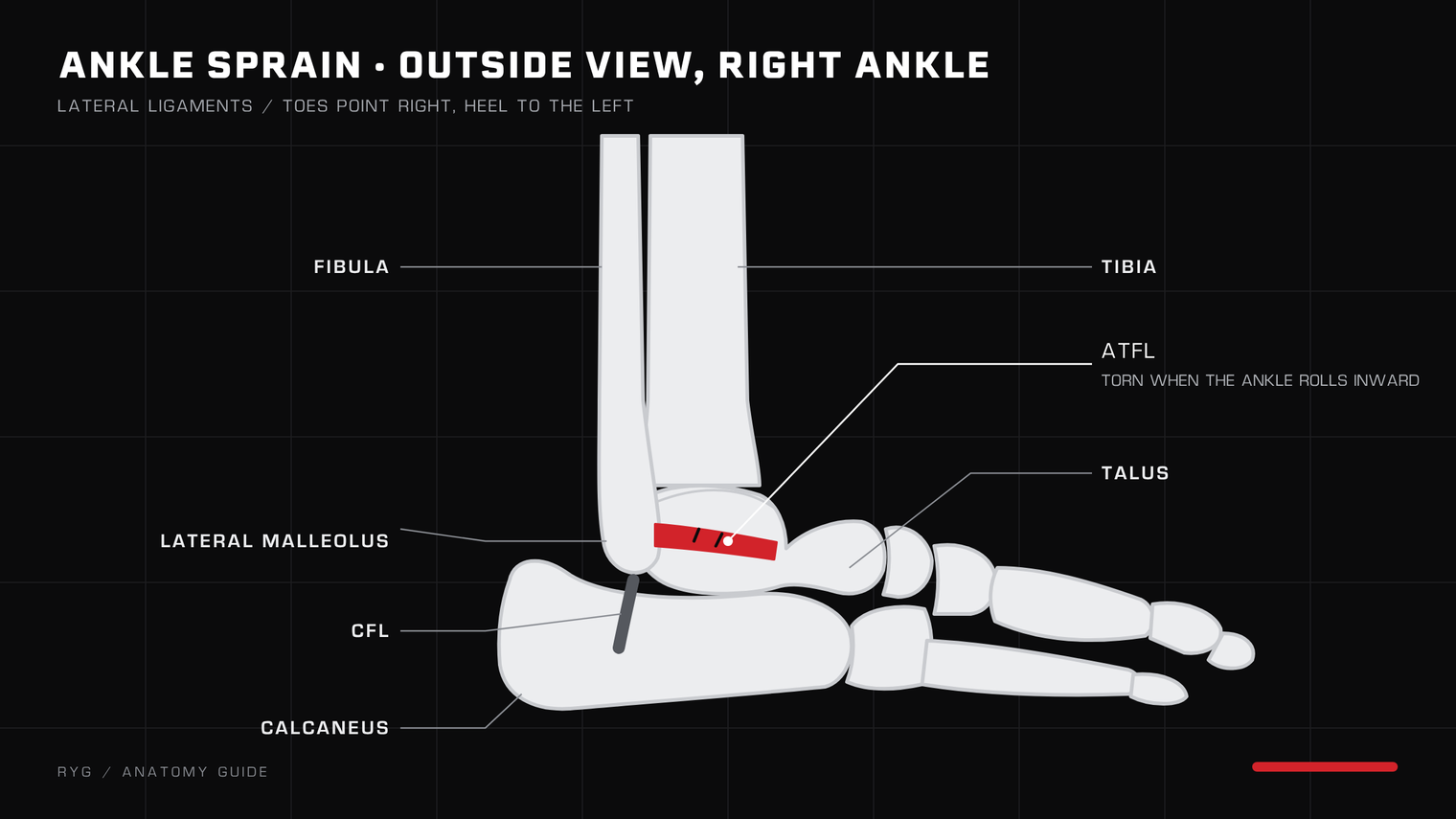
Ask around any dugout and you will find the same stories. An ankle rolled on the corner of the bag, a slide that stuck, a bad landing chasing a fly ball. Ankle sprains are among the most common injuries in baseball, usually the lateral type where the foot rolls inward and stretches the ligaments on the outside of the ankle. Anyone who has watched a hitter hobble through a postseason on a badly sprained ankle knows how much these injuries matter and how much it takes to play through one.
What's actually going on
Most players get the first part of care roughly right. Early protection, controlling swelling, getting moving again. The problem is what happens next, which is usually nothing. The ligaments on the outside of the ankle do more than hold the joint together. They house the sensors that tell your brain where your foot is, and a sprain scrambles that signal. When rehab stops the day the limp does, the ligament may be healing but the balance system is not, and the next uneven patch of outfield finds the gap.
That is why the research on ankle sprains spends so much time on the second sprain rather than the first.
What the research says
- Under usual care, about 1 in 3 athletes re-sprained the same ankle within a year; adding an 8-week home balance program cut that to 22 percent, a 35 percent reduction, in a randomized trial of 522 athletes1.
- Current guidelines favor a brace or tape plus a supervised exercise program over rest and passive treatments, with surgery reserved for sprains that fail thorough rehab2,3.
- Early movement beats RICE. People who started exercise in the first week after a sprain had better function at weeks 1 and 2 than those who rested, iced, compressed, and elevated, with the same 4 percent reinjury rate4.
- The severity of a sprain is judged most reliably by a hands-on exam 4 to 5 days after injury, once the initial swelling has settled, and guidelines caution that anti-inflammatories may suppress the natural healing process2.
- Trouble shows early. Being unable to do a single-leg drop landing or a drop jump 2 weeks after a first sprain predicted who would go on to chronic ankle instability5.
- Bracing has strong evidence and neuromuscular training moderate evidence for preventing a repeat sprain, and up to 40 percent of first-time sprains progress to chronic instability, which is why exercise-based rehab rather than rest is the recommendation3,6.
What we do about it
The first week looks like the guideline: external support, progressive weight bearing, and structured exercise rather than a boot and a couch, with a proper grading exam a few days in once the swelling allows6,2. Ice gets only a weak recommendation, so it is optional, not the plan6.
Then comes the part everyone skips. Balance and neuromuscular training, single-leg stance progressing to hops, landings, and cutting, is what cut recurrence by a third in the trial, so it is the core of the middle phase1. We also test the drop landing and drop jump at 2 weeks, since failing them is the early signal of a chronically unstable ankle5. Strength for the calf and the muscles on the outside of the ankle runs alongside.
Baseball movements return in order: straight running, cutting, base running with the turn at the bag, and sliding. A lace-up brace for the rest of the season is a reasonable insurance policy. This is the progression we run in the clinic, with a test at every phase before you move on.
When to get it looked at
- Inability to bear weight for four steps right after the injury, or bone tenderness at the back edge of either ankle bone, which call for an X-ray.
- Pain above the ankle between the shin bones, which can be a high ankle sprain with a longer timeline.
- Numbness, a cold foot, or an obvious deformity.
- Swelling and pain that are not clearly improving after a week of movement and support.
- A second or third sprain of the same ankle, or an ankle that gives way on routine plays.
Bottom line
An ankle sprain is a balance injury as much as a ligament injury, and the research says the way to stop the next one is to train the balance system rather than wait for the swelling to leave. If your ankle rolled on a bag or a slide, an in-person evaluation can grade it, rule out a fracture, and build the plan that lowers the odds of a repeat.
References
- Hupperets MD, Verhagen EA, van Mechelen W. Effect of unsupervised home based proprioceptive training on recurrences of ankle sprain: randomised controlled trial. BMJ. 2009;339:b2684. PubMed
- Vuurberg G, Hoorntje A, Wink LM, et al. Diagnosis, treatment and prevention of ankle sprains: update of an evidence-based clinical guideline. Br J Sports Med. 2018;52(15):956. PubMed
- Doherty C, Bleakley C, Delahunt E, et al. Treatment and prevention of acute and recurrent ankle sprain: an overview of systematic reviews with meta-analysis. Br J Sports Med. 2017;51(2):113-125. PubMed
- Bleakley CM, O'Connor SR, Tully MA, et al. Effect of accelerated rehabilitation on function after ankle sprain: randomised controlled trial. BMJ. 2010;340:c1964. PubMed
- Doherty C, Bleakley C, Hertel J, et al. Recovery From a First-Time Lateral Ankle Sprain and the Predictors of Chronic Ankle Instability: A Prospective Cohort Analysis. Am J Sports Med. 2016;44(4):995-1003. PubMed
- Martin RL, Davenport TE, Fraser JJ, et al. Ankle Stability and Movement Coordination Impairments: Lateral Ankle Ligament Sprains Revision 2021. J Orthop Sports Phys Ther. 2021;51(4):CPG1-CPG80. PubMed
Had an amazing time this summer rehabbing my ankle with Dr. Shuchuk. He is very knowledgeable in any area of PT and always willing and able to help any ailment you have! I thought my ankle could never be fixed, but after getting on a plan and staying consistent I have regained my game!
Thanks Shu
Alex worked with our son on his ankle after a bad sprain and was able to help him strengthen his ankle to be back on the field in a shorter time frame. Alex was great at communication with our family and his coaching staff throughout the whole process. Definitely recommend.
This article is for education and does not replace an evaluation. If you're dealing with an active injury, see a licensed medical provider.