
High Hamstring Strain in Baseball: The Sit Bone Pain That Sprinters and Stealers Know Too Well
 Baseball
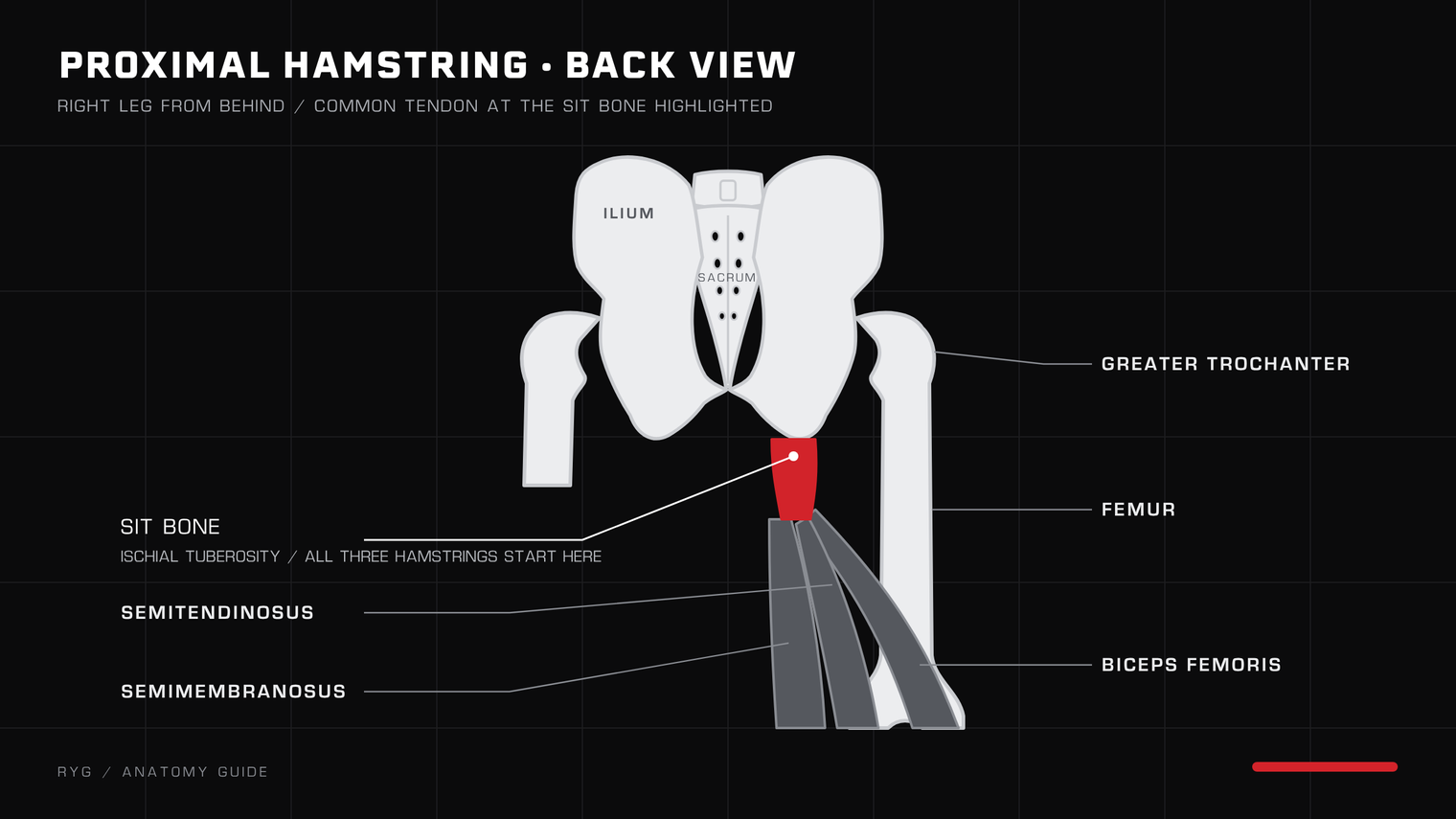
Hamstring strains are the classic sprinting injury, and the high version, up near the sit bone where all three hamstring muscles attach, is the most stubborn of the family. Players feel it right at the crease of the glute, aggravated by sprinting, bending forward with a straight knee, and sometimes just sitting on hard dugout benches. It matters for baseball because the sport is built on repeated maximum effort sprints from a dead stop, which is precisely the hamstring's hardest job.
What's actually going on
During the late swing phase of sprinting, just before your foot hits the ground, your hamstring is lengthening rapidly while contracting hard to slow the shin down. That combination, maximum force at long muscle length, is where hamstrings fail, and the fibers near the upper tendon see the most strain. Baseball adds a cruel twist. Players stand around for innings, muscles cooling, then explode to full sprint in under two seconds on a steal or a dropped third strike.
When the pain lives at the sit bone and lingers for weeks, it is usually proximal hamstring tendinopathy rather than a muscle tear: a tendon that has been overloaded and has become sensitive and disorganized. Biopsies of operated tendons show degeneration, not inflammation, which is why anti-inflammatory approaches rarely solve it1.
What the research says
- High hamstring tendinopathy shows up as deep buttock pain right at the sit bone; it is common in sprinters, distance runners, and field-sport athletes and tends to linger for months2,3.
- Three simple exam tests, the Puranen-Orava, bent-knee stretch, and modified bent-knee stretch, are highly reliable between examiners and moderately to highly valid for chronic proximal hamstring tendinopathy in athletes4.
- MRI findings at the hamstring origin are common in people with no symptoms: 52 percent had changes on both sides and 15 percent had bilateral partial tears, so a scan has to be matched to the exam5.
- There are no randomized trials of rehab exercise specifically for this tendon; treatment is built on the progressive loading principles proven in Achilles and patellar tendinopathy2,3.
- In 40 professional athletes with chronic proximal hamstring tendinopathy, 4 weeks of shockwave therapy gave at least 50 percent pain relief in 85 percent at 3 months, versus 10 percent with anti-inflammatories plus standard physiotherapy6.
- Surgery is the last resort, but it works when needed: surgical release returned 80 of 90 athletes to their previous level of sport at an average of 5 months1.
What we do about it
The exam separates a tendinopathy at the sit bone from a muscle tear lower down, from sciatic nerve irritation near the hamstring origin, and from pain referred from the spine, because each gets a different plan4,7.
The rehab follows the tendon playbook. Early on, isometric hamstring holds reduce pain and keep the tendon loaded without stretching it, and we remove the compressive positions that irritate it, such as deep hip flexion stretches and long periods on hard seats. The middle phase is heavy slow resistance for the hamstrings in positions that build tendon capacity, progressing to energy-storage work and sprint mechanics. Pain is a guide, not a stop sign: training up to a tolerable threshold after hamstring strain produced 15 percent better strength recovery with the same return time and reinjury count as pain-free rehab8.
Sprinting returns in a progression that rebuilds acceleration and top speed before base-stealing intensity. This is the progression we run in the clinic, with a test at every phase before you move on.
When to get it looked at
- A sudden pop at the sit bone with bruising, which can be a tendon avulsion and needs imaging.
- Pain that radiates down the back of the leg, or numbness and tingling.
- Buttock pain that makes sitting for 30 minutes impossible.
- Weakness bending the knee or extending the hip against resistance.
- Sit bone pain that has not improved after 8 to 12 weeks of a progressive loading program.
Bottom line
High hamstring pain is a tendon that needs load, not rest, and the research says the roadmap borrows from other tendons because trials specific to this one are missing. Most athletes improve with a patient loading program, and the stubborn cases have further options. If your sit bone pain is outlasting the season, an in-person evaluation can confirm the diagnosis and set the loading plan.
References
- Lempainen L, Sarimo J, Mattila K, et al. Proximal hamstring tendinopathy: results of surgical management and histopathologic findings. Am J Sports Med. 2009;37(4):727-734. PubMed
- Goom TS, Malliaras P, Reiman MP, et al. Proximal Hamstring Tendinopathy: Clinical Aspects of Assessment and Management. J Orthop Sports Phys Ther. 2016;46(6):483-493. PubMed
- Nasser AM, Vicenzino B, Grimaldi A, et al. Proximal Hamstring Tendinopathy: A Systematic Review of Interventions. Int J Sports Phys Ther. 2021;16(2):288-305. PubMed
- Cacchio A, Borra F, Severini G, et al. Reliability and validity of three pain provocation tests used for the diagnosis of chronic proximal hamstring tendinopathy. Br J Sports Med. 2012;46(12):883-887. PubMed
- Thompson SM, Fung S, Wood DG. The prevalence of proximal hamstring pathology on MRI in the asymptomatic population. Knee Surg Sports Traumatol Arthrosc. 2017;25(1):108-111. PubMed
- Cacchio A, Rompe JD, Furia JP, et al. Shockwave therapy for the treatment of chronic proximal hamstring tendinopathy in professional athletes. Am J Sports Med. 2011;39(1):146-153. PubMed
- Park JW, Lee YK, Lee YJ, et al. Deep gluteal syndrome as a cause of posterior hip pain and sciatica-like pain. Bone Joint J. 2020;102-B(5):556-567. PubMed
- Hickey JT, Timmins RG, Maniar N, et al. Pain-Free Versus Pain-Threshold Rehabilitation Following Acute Hamstring Strain Injury: A Randomized Controlled Trial. J Orthop Sports Phys Ther. 2020;50(2):91-103. PubMed
My son was dealing with a lingering hamstring injury, and while other clinics had long wait times, Regain Your Game got him in quickly. Alex identified the root cause, provided a simple at-home therapy plan, and was always available as a resource throughout the recovery process.
What stood out most was the focus on my son's recovery, not on scheduling additional appointments. After following the treatment plan, he's now back on the field and playing pain-free. We're grateful for Alex's expertise and genuinely caring approach, and we'll definitely return if we ever need PT again.
Alex did a great job helping me with my hamstring. You can tell Alex really cares about the athletes he’s working with and really takes into consideration the athletes goals/interests while also making sure the athlete makes the best decision in the long run. He helped me get back to playing in no time with exercises and stretches that made a huge differences. Once I was back playing he would check up over the phone or in person almost daily to make sure everything was going well, along with updating my pt plan so I could continue to make progress. I really thank Alex for what he’s done for me.
This article is for education and does not replace an evaluation. If you're dealing with an active injury, see a licensed medical provider.