
Neck Pain in Baseball: What Throwers and Hitters Need to Know Before It Steals Your Season
 Baseball
Neck pain might not sound like a baseball injury, but ask any pitcher who has tried to throw with a stiff neck. Every pitch starts with your head rotated hard toward the plate while your body coils the other direction. Every at bat asks your neck to turn and track a pitch. When your neck hurts, your whole game gets quieter, and players often change their mechanics without even realizing it.
The encouraging part is that neck pain in athletes is common, mostly mechanical, and responds well to active care. The research on what to do about it is clearer than most people expect.
What's actually going on
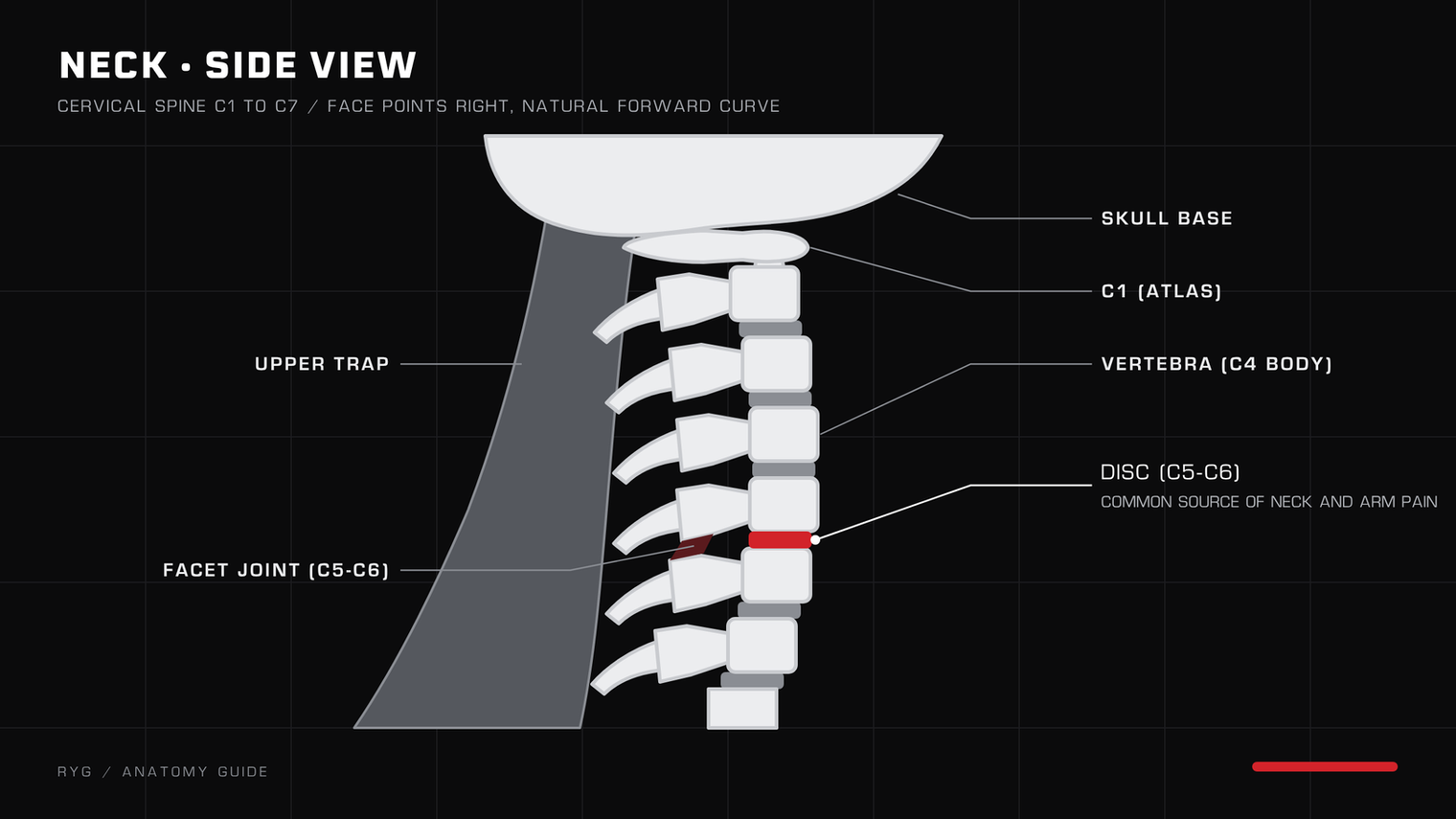
Your neck is the anchor point for muscles that run down into your shoulder blade and upper back, so the neck and the throwing shoulder are roommates who share a wall. Stiffness in the joints of the lower neck can refer pain into the top of the shoulder, and irritation of the nerves that exit the neck can send symptoms all the way down the arm. That is why some shoulder problems in throwers do not get better until someone looks a little higher up.
Most neck pain in athletes is mechanical, meaning joints and muscles that are stiff, sore, or deconditioned rather than damaged. A smaller group comes from a collision, a dive, or a hit by pitch, and those follow a whiplash-type pattern that also has its own well-established playbook1.
What the research says
- Neck pain is not rare in sport. Across the studies in one systematic review, 38 to 73 percent of athletes had neck pain in a given year depending on the sport, and about 48 percent had experienced it at some point2.
- For a fresh mechanical neck strain, the physical therapy clinical practice guideline recommends thoracic manipulation plus a neck range-of-motion program and strengthening of the shoulder blade and arm, not rest1.
- Strength beats stretching. A Cochrane review of 27 trials found that strengthening the neck, shoulder blade, and upper limb produced a moderate-to-large improvement in chronic neck pain, while stretching alone, breathing exercises, and general fitness training did not change pain or function3.
- Neck pain that radiates into the arm is treated with intermittent traction combined with stretching, strengthening, and spinal mobilization, along with encouragement to keep exercising and working1.
- After a whiplash-type injury such as a collision at the plate, the guideline is to return to normal non-provocative activities as soon as possible, minimize collar use, and expect recovery within 2 to 3 months1.
- Overhead athletes with shoulder symptoms show higher upper trap activity and lower middle and lower trap activity than healthy athletes, which is why neck rehab for throwers usually includes the shoulder blade4.
What we do about it
First we sort the neck from the shoulder. A thrower with neck stiffness, a sore upper trap, and a shoulder that feels off needs someone to check all three and find the driver4,1.
For a stiff, mechanical neck, we pair hands-on treatment for the mid back and neck with range-of-motion work and early strengthening of the scapular muscles, which is the approach the guideline grades highest for acute pain1. For pain that has lingered, the program broadens to a mix of neck and shoulder girdle strengthening, endurance, and conditioning, because that combination is what reduced chronic neck pain in the trials, and stretching on its own did not3.
Throwing and hitting come back in stages once you can rotate fully and hold your head position under load. This is the progression we run in the clinic, with a test at every phase before you move on.
When to get it looked at
- Numbness, tingling, or weakness in the arm or hand, especially if it is getting worse.
- Neck pain after a collision, a dive, or a hit by pitch, particularly with headache, dizziness, or trouble concentrating.
- Pain that wakes you at night or does not change with movement or position.
- Difficulty walking, balance problems, or changes in bowel or bladder control, which need same-day medical care.
- Neck pain that lasts longer than a couple of weeks or keeps changing how you throw.
Bottom line
Most neck pain in baseball is mechanical, and the fix is active: restore motion, strengthen the neck and shoulder blade, and keep playing within tolerance. Stretching by itself is not enough. If your neck has been stiff for more than a few weeks or is sending symptoms into your arm, an in-person evaluation can map out the plan.
References
- Blanpied PR, Gross AR, Elliott JM, et al. Neck Pain: Revision 2017 (Clinical Practice Guidelines Linked to the International Classification of Functioning, Disability and Health From the Orthopaedic Section of the American Physical Therapy Association). J Orthop Sports Phys Ther. 2017;47(7):A1-A83. PubMed
- Noormohammadpour P, Farahbakhsh F, Farahbakhsh F, et al. Prevalence of Neck Pain among Athletes: A Systematic Review. Asian Spine J. 2018;12(6):1146-1153. PubMed
- Gross A, Kay TM, Paquin JP, et al. Exercises for mechanical neck disorders. Cochrane Database Syst Rev. 2015;1(1):CD004250. PubMed
- Cools AM, Declercq GA, Cambier DC, et al. Trapezius activity and intramuscular balance during isokinetic exercise in overhead athletes with impingement symptoms. Scand J Med Sci Sports. 2007;17(1):25-33. PubMed
It was such a great time, and with the exercises and stretching, my neck felt a lot better afterward. Will definitely recommend it.
This article is for education and does not replace an evaluation. If you're dealing with an active injury, see a licensed medical provider.