
Showcase Season and Young Arms: How to Get Seen Without Getting Hurt
 Baseball
Showcase season has changed youth baseball. Fall and winter events, velocity boards, recruiting camps, and the constant feeling that one big number in front of the right coach changes everything. Here is what sports medicine sees from the same events, a wave of arm injuries that follows showcase season as reliably as pitchers and catchers reporting in the spring. The problem is not showcases themselves. It is when they land and what they ask.
What's actually going on
Think about the design from the arm's perspective. A showcase asks for absolute maximum effort, throw as hard as you can for the gun, often with a short warm-up, in cold weather, on a random Saturday. And it usually lands in the fall, exactly when an arm has just finished a long season and is at its most fatigued, or in mid winter when it has been shut down and is at its most detrained. Max intent on a tired arm or a cold arm is the single worst combination in throwing, and showcase season serves both.
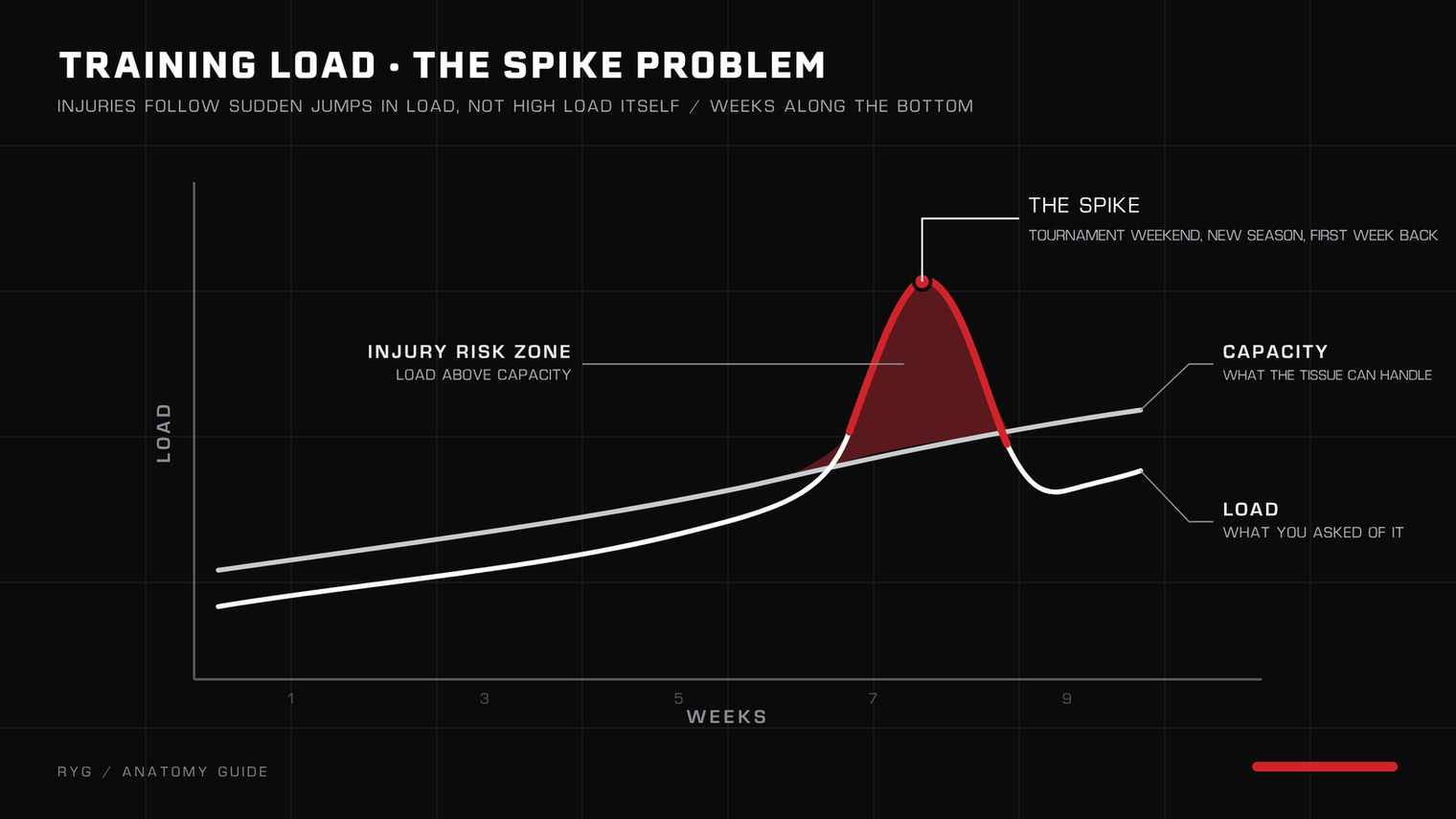
The training-load research has a name for what a showcase does to an arm: a spike. The arm's capacity is set by what it has been doing for the past several weeks, and a showcase asks for far more than that in a single afternoon.
What the research says
- Showcases show up in the surgery data. Adolescent pitchers who ended up needing shoulder or elbow surgery had pitched in more showcases, thrown harder, and pitched more often with arm pain and fatigue than uninjured peers; overuse and fatigue were the strongest risk factors, with high velocity and showcase participation also associated1.
- Spikes, not volume, do the damage. Non-contact injuries are rarely caused by training itself; excessive and rapid increases in load relative to recent weeks are responsible for a large share of soft-tissue injuries, and athletes accustomed to high chronic loads get hurt less than under-trained ones2.
- Under-training is also a risk, which is why a mid-winter showcase on a shut-down arm is its own problem: reducing workload is not always the best way to protect an athlete2.
- A single day's spike matters. In adolescent soccer players tracked daily, a spike in that day's training load roughly doubled the odds of injury, and worse mood that day was an independent predictor as well3.
- The season total compounds it: youth pitchers who threw more than 100 innings in a calendar year were 3.5 times more likely to need surgery or quit from a throwing injury over 10 years, and high school athletes who played a sport year-round reported 42 percent more overuse injuries than those who played three seasons or fewer4,5.
- Chasing the number has a cost. A 6-week weighted-ball velocity program raised pitch velocity by 3.3 percent in teenage pitchers, but 24 percent of them were injured versus none of the controls6.
What we do about it
The plan is scheduling first, training second. We help families pick showcases that land when the arm is built up, not burned out or shut down: after a deliberate ramp of several weeks of progressive throwing, never on the heels of a long season without a break, and never cold out of a winter shutdown2. One well-timed event beats four scattered ones.
The ramp itself is a mini return-to-throwing program: chronic throwing load built gradually over 4 to 6 weeks so the showcase day is only a modest step above what the arm has been doing, with bullpens and warm-up throws counted toward the total. On the day, a full warm-up that runs from the legs and trunk to the arm, a gradual throwing build, and a hard stop if the arm feels fatigued or sore, since pitching through fatigue is the strongest predictor of surgery in the data1.
Underneath that sits the off-season strength and arm care work that raises the arm's capacity in the first place. This is the progression we run in the clinic, with a test at every phase before you move on.
When to get it looked at
- Inside elbow or shoulder pain that started at or after a showcase.
- A pop on a max-effort throw, which can be a ligament or growth plate injury.
- Velocity that dropped across the event rather than climbed, a sign of fatigue the arm did not recover from.
- Soreness that is still present a week after the event.
- Numbness or tingling into the ring and little fingers.
Bottom line
A showcase is a load spike on purpose, and the research says spikes on a fatigued or detrained arm are how arms get hurt, and that showcase participation sits in the surgery data alongside velocity and fatigue. Schedule the event when the arm is built up, ramp into it, and respect fatigue on the day. If your athlete's arm is sore after showcase season, an in-person evaluation can sort out what it is before the spring.
References
- Olsen SJ, Fleisig GS, Dun S, et al. Risk factors for shoulder and elbow injuries in adolescent baseball pitchers. Am J Sports Med. 2006;34(6):905-912. PubMed
- Gabbett TJ. The training-injury prevention paradox: should athletes be training smarter and harder?. Br J Sports Med. 2016;50(5):273-280. PubMed
- Watson A, Brickson S, Brooks A, et al. Subjective well-being and training load predict in-season injury and illness risk in female youth soccer players. Br J Sports Med. 2017;51(3):194-199. PubMed
- Fleisig GS, Andrews JR, Cutter GR, et al. Risk of serious injury for young baseball pitchers: a 10-year prospective study. Am J Sports Med. 2011;39(2):253-257. PubMed
- DiFiori JP, Benjamin HJ, Brenner J, et al. Overuse injuries and burnout in youth sports: a position statement from the American Medical Society for Sports Medicine. Clin J Sport Med. 2014;24(1):3-20. PubMed
- Reinold MM, Macrina LC, Fleisig GS, et al. Effect of a 6-Week Weighted Baseball Throwing Program on Pitch Velocity, Pitching Arm Biomechanics, Passive Range of Motion, and Injury Rates. Sports Health. 2018;10(4):327-333. PubMed
This article is for education and does not replace an evaluation. If you're dealing with an active injury, see a licensed medical provider.