
High Hamstring Pain in Basketball: Why That Ache Under Your Sit Bone Won't Quit
 Basketball
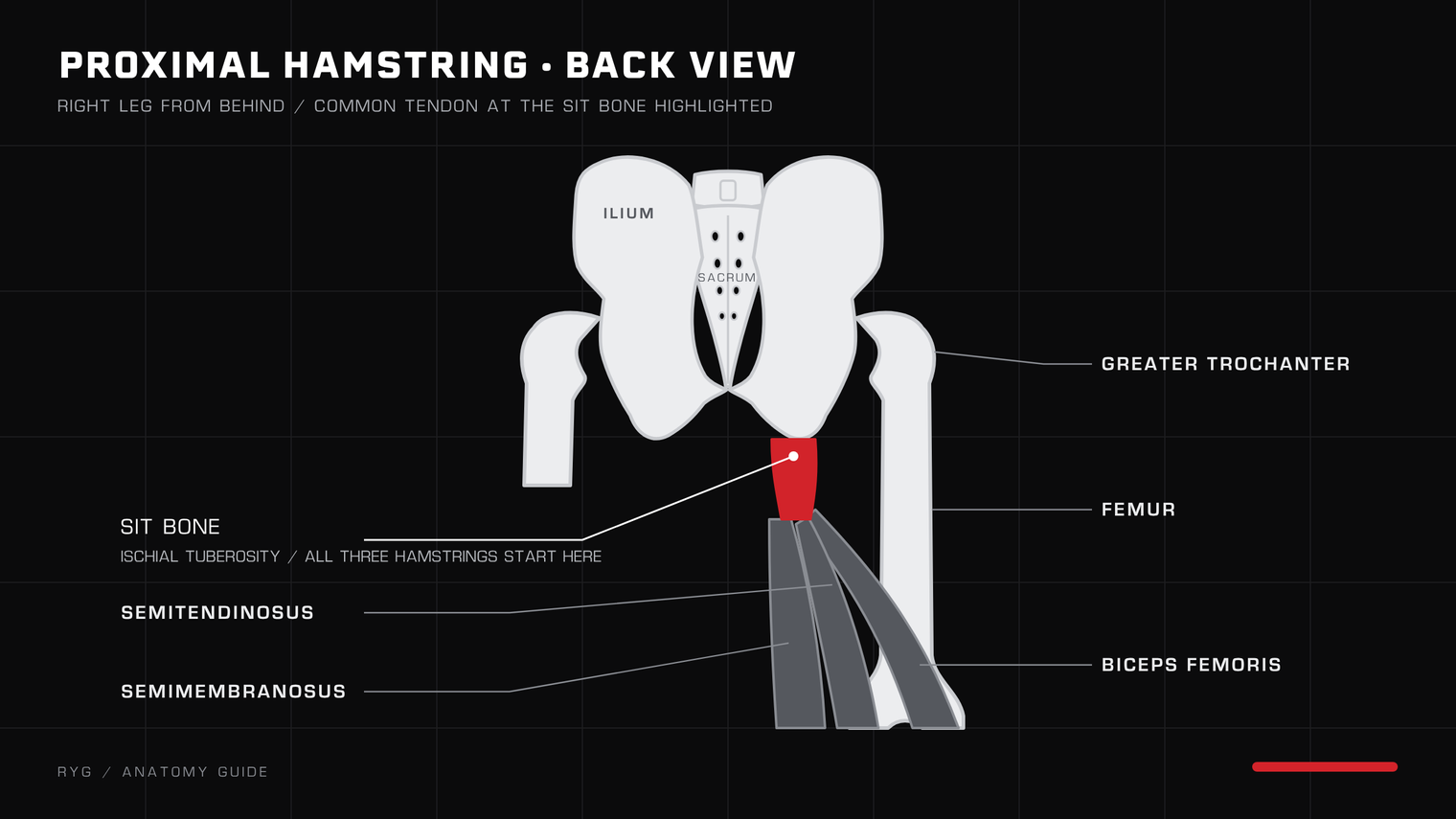
Hamstring injuries come in two locations, and the high one is the stubborn one. Proximal hamstring pain sits right where the muscle anchors to your sit bone, the bony point you feel when you sit on a hard bench. It flares with sprinting, deep lunging, and bending forward, and in its tendon form it has a signature move: aching during long sitting, like car rides and school desks, because sitting compresses the tendon directly against the bone.
What's actually going on
Basketball loads this spot two ways. Acutely, a full-stride sprint on a fast break stretches the hamstring while it is pulling hard, which can strain fibers near the top attachment. Chronically, months of sprint volume and deep defensive positions can irritate the tendon itself into proximal hamstring tendinopathy, an overload condition rather than a tear.
The distinction matters because the tear version needs graded healing time while the tendon version needs a long, patient strength progression. Both get worse with the classic mistake, aggressive stretching. Stretching a proximal hamstring problem compresses and yanks the exact tissue that is irritated, which is why players who stretch it daily often feel looser for an hour and worse for a week.
What the research says
- High hamstring tendinopathy shows up as deep buttock pain at the sit bone where the hamstrings attach; it is common in sprinters, distance runners and field-sport athletes and tends to linger for months1.
- Three simple exam tests (Puranen-Orava, bent-knee stretch and modified bent-knee stretch) are highly reliable between examiners and moderately to highly valid for chronic proximal hamstring tendinopathy in athletes2.
- MRI findings at the hamstring origin are common in people with no symptoms: 52% had changes on both sides and 15% had bilateral partial tears, so a scan has to be matched to the exam3.
- Biopsies of operated proximal hamstring tendons show degeneration rather than inflammation, which fits the picture of an overuse tendon problem rather than an acute 'itis'4.
- There are no randomized trials of rehab exercise specifically for proximal hamstring tendinopathy; treatment is built on the progressive loading principles proven in Achilles and patellar tendinopathy5.
- Those principles are strong. Heavy slow resistance and eccentric loading gave equally good, lasting results for Achilles tendinopathy, with better adherence and satisfaction for heavy slow resistance6, and athletes who kept training with pain capped at 5 out of 10 recovered as well at 12 months as those who rested7.
- Systematic review of 12 studies found insufficient evidence to recommend any single treatment (injections, shockwave or surgery) over another for proximal hamstring tendinopathy1. When conservative care fails, surgical release returned 80 of 90 athletes to their previous level of sport at an average of 5 months4.
What we do about it
Diagnosis first: the exam tests above, a check of the lumbar spine and sciatic nerve, and a scan only when something does not fit, because the research says a scan alone will mislead you.
Then loading with position control. Early on, that means isometric holds like a bridge with the feet far away, which build tendon tolerance without deep hip flexion and settle pain. Then progressively heavier work, Romanian deadlifts, hamstring curls and hip thrusts, with the range deepened over weeks as the tendon tolerates it. Finally, fast, lengthened work like sprint build-ups, because the end goal is a hamstring that tolerates full-stride speed, not just gym exercises. We use the pain-monitoring rule from the tendon literature: pain up to about 5 out of 10 is acceptable if it settles by the next morning and is not trending up week to week7.
Patience is the price of admission. Tendon cases commonly take two to four months to settle, and rushing the timeline is the main reason this injury gets a reputation for lingering all season. Picture a 22-year-old rec league guard who has sat on that ache for eight months, stretching it daily and getting nowhere. Once he starts a real loading plan, twelve weeks is a realistic window to be sprinting again without the ache, which sounds long until you compare it to the eight months already lost. This is the progression we run in the clinic, with a test at every phase before you move on.
When to get it looked at
- A pop at the sit bone with sudden weakness or bruising, which can mean an avulsion.
- Sciatica-like pain, numbness or tingling down the leg, since the sciatic nerve runs right past the hamstring origin8.
- Pain that has not changed after twelve weeks of a structured loading program.
- Deep buttock pain with difficulty sitting that the back has not been checked for.
- Pain that wakes you at night.
Bottom line
High hamstring pain is a tendon problem that rewards loading and punishes stretching and waiting. The research is thin on this specific tendon but strong on the principles, and the timeline is months, not weeks. If your sit bone ache sounds familiar, an in-person evaluation can help you tell strain from tendinopathy and get the plan started.
References
- Nasser AM, Vicenzino B, Grimaldi A, et al. Proximal Hamstring Tendinopathy: A Systematic Review of Interventions. Int J Sports Phys Ther. 2021;16(2):288-305. PubMed
- Cacchio A, Borra F, Severini G, et al. Reliability and validity of three pain provocation tests used for the diagnosis of chronic proximal hamstring tendinopathy. Br J Sports Med. 2012;46(12):883-887. PubMed
- Thompson SM, Fung S, Wood DG. The prevalence of proximal hamstring pathology on MRI in the asymptomatic population. Knee Surg Sports Traumatol Arthrosc. 2017;25(1):108-111. PubMed
- Lempainen L, Sarimo J, Mattila K, et al. Proximal hamstring tendinopathy: results of surgical management and histopathologic findings. Am J Sports Med. 2009;37(4):727-734. PubMed
- Goom TS, Malliaras P, Reiman MP, et al. Proximal Hamstring Tendinopathy: Clinical Aspects of Assessment and Management. J Orthop Sports Phys Ther. 2016;46(6):483-493. PubMed
- Beyer R, Kongsgaard M, Hougs Kjær B, et al. Heavy Slow Resistance Versus Eccentric Training as Treatment for Achilles Tendinopathy: A Randomized Controlled Trial. Am J Sports Med. 2015;43(7):1704-1711. PubMed
- Silbernagel KG, Thomeé R, Eriksson BI, et al. Continued sports activity, using a pain-monitoring model, during rehabilitation in patients with Achilles tendinopathy: a randomized controlled study. Am J Sports Med. 2007;35(6):897-906. PubMed
- Park JW, Lee YK, Lee YJ, et al. Deep gluteal syndrome as a cause of posterior hip pain and sciatica-like pain. Bone Joint J. 2020;102-B(5):556-567. PubMed
Alex helped me recover from a hamstring injury with dry needling and I was very happy with the results and would highly recommend Alex and Regain your Game. Very knowledgeable, very professional and my hamstring feels like new! Thanks Alex
I went to Alex after multiple Hamstring injuries. After dealing with tightness and pain over and over again Alex helped me get back and get better than I was before. Very grateful to work with him!
This article is for education and does not replace an evaluation. If you're dealing with an active injury, see a licensed medical provider.