
Neck Pain in Basketball: What's Behind It and When to Take It Seriously
 Basketball
 does not look like a neck sport until you watch what the neck does for 32 minutes. You crane upward to track rebounds, absorb contact on drives, hit the floor diving for loose balls, and hold your head steady while sprinting and cutting. That is a lot of demand on a structure most players never train.
Most basketball neck pain falls into one of two buckets. The first is overload, where the small muscles that steady your head get fatigued and achy, often paired with the upper trap tightness players know so well. The second is a quick strain from contact: taking a screen you did not see, or landing hard after a rebound and having your head whip. That is the same basic mechanism as whiplash in a car, just smaller.
What's actually going on
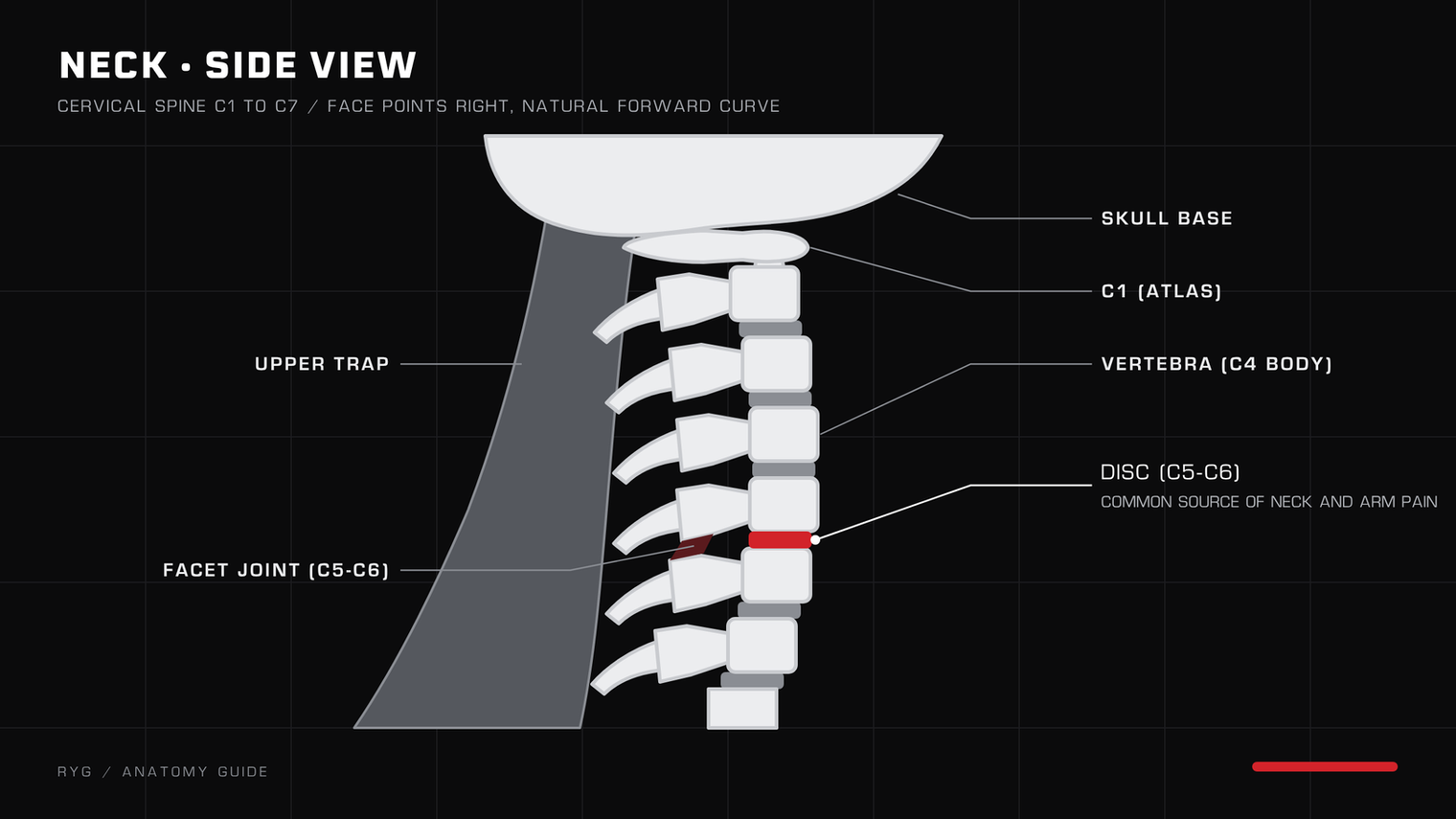
Your neck is seven small vertebrae, the joints between them, and layers of muscle. The deep muscles at the front and back of the neck act like guy wires for the head. The bigger muscles on top, including the upper trap and the muscles along the side of the neck, are built for movement, not for holding a position for hours.
When the deep stabilizers tire out, the bigger muscles take over, stay switched on, and develop tender, pain-reproducing spots. A sudden whip adds a second problem: the joints and muscles get stretched faster than they can protect themselves, so everything guards and stiffens for a few days.
Pain that starts in the neck does not always stay there. Irritated joints and nerves can refer pain into the shoulder blade region or down the arm, which is why we always ask about arm symptoms.
What the research says
- Neck pain is common in athletes: between 38% and 73% have it in a given year depending on the sport, and about half have had it at some point1.
- People with mechanical neck pain carry an average of 1.8 active trigger points in the upper trapezius and nearby muscles, while pain-free people have none that are active2.
- For a fresh mechanical neck strain, the physical therapy guideline recommends upper-back manipulation plus a neck range-of-motion program and shoulder blade and arm strengthening, not rest3.
- After a whiplash-type injury, the same guideline says to return to normal, non-provocative activities as soon as possible, minimize collar use, and expect recovery within 2 to 3 months3.
- Strengthening the neck, shoulder blade and upper-limb muscles reduces chronic neck pain by a moderate-to-large amount, while stretching alone produces no measurable benefit4.
- Neck strength matters for head safety in this sport specifically. In 6,704 high school soccer, basketball and lacrosse athletes, weaker necks predicted concussion, and every 1-pound gain in neck strength lowered the odds of concussion by 5%5.
- Both a stronger neck and bracing the neck muscles before an impact independently reduced how fast the head snapped in every direction tested, in athletes from age 8 to 306.
What we do about it
For the routine, achy variety, the fix looks a lot like the fix for most basketball overuse problems: build capacity. We start with gentle range of motion and hands-on work through the upper back, which the guideline supports for acute mechanical neck pain3. Then we train the deep neck flexors (think chin nods, not aggressive stretching), the shoulder blade muscles, and the upper back, progressing from isometric holds to banded and loaded work.
The last phase is the one basketball players actually need: neck strength and bracing under contact-like conditions, because the research says a stronger neck that is ready for impact moves less when it gets hit6. For a whiplash-type strain after a collision, we keep you moving, skip the collar, and progress loading over weeks rather than waiting for it to feel perfect. This is the progression we run in the clinic, with a test at every phase before you move on.
When to get it looked at
- Neck pain plus numbness, tingling or weakness in the arm or hand.
- Neck pain after a hard fall or collision that comes with dizziness, headache, nausea or fogginess, which needs a concussion screen as well.
- Pain that is severe, constant, or wakes you at night.
- Difficulty turning your head enough to track play after a week of sensible care.
- Any neck injury with loss of coordination in the arms or legs, which is an emergency.
Bottom line
Most basketball neck pain is mechanical and responds to active care, and the evidence is clear that strengthening beats stretching and rest. A stronger neck also appears to protect your head. If your neck has been barking for more than a few weeks, or any of the flags above apply, an in-person evaluation is the right next step.
References
- Noormohammadpour P, Farahbakhsh F, Farahbakhsh F, et al. Prevalence of Neck Pain among Athletes: A Systematic Review. Asian Spine J. 2018;12(6):1146-1153. PubMed
- Fernández-de-las-Peñas C, Alonso-Blanco C, Miangolarra JC. Myofascial trigger points in subjects presenting with mechanical neck pain: a blinded, controlled study. Man Ther. 2007;12(1):29-33. PubMed
- Blanpied PR, Gross AR, Elliott JM, et al. Neck Pain: Revision 2017 (Clinical Practice Guidelines Linked to the International Classification of Functioning, Disability and Health From the Orthopaedic Section of the American Physical Therapy Association). J Orthop Sports Phys Ther. 2017;47(7):A1-A83. PubMed
- Gross A, Kay TM, Paquin JP, et al. Exercises for mechanical neck disorders. Cochrane Database Syst Rev. 2015;1(1):CD004250. PubMed
- Collins CL, Fletcher EN, Fields SK, et al. Neck strength: a protective factor reducing risk for concussion in high school sports. J Prim Prev. 2014;35(5):309-319. PubMed
- Eckner JT, Oh YK, Joshi MS, et al. Effect of neck muscle strength and anticipatory cervical muscle activation on the kinematic response of the head to impulsive loads. Am J Sports Med. 2014;42(3):566-576. PubMed
It was such a great time, and with the exercises and stretching, my neck felt a lot better afterward. Will definitely recommend it.
This article is for education and does not replace an evaluation. If you're dealing with an active injury, see a licensed medical provider.