
Osgood-Schlatter in Young Basketball Players: Growth Spurt Knee Pain Explained for Parents
 Basketball
If your 11 to 15 year old basketball player is complaining about pain on the bump just below the kneecap, and they have grown two shoe sizes this year, you are probably looking at Osgood-Schlatter. It is one of the most common causes of knee pain in growing athletes, it looks alarming when a tender bump forms, and the first thing parents should hear is that it is a growth-phase problem, not damage that threatens the knee's future. The second thing they should hear is that the old advice to rest and wait has little evidence behind it.
What's actually going on
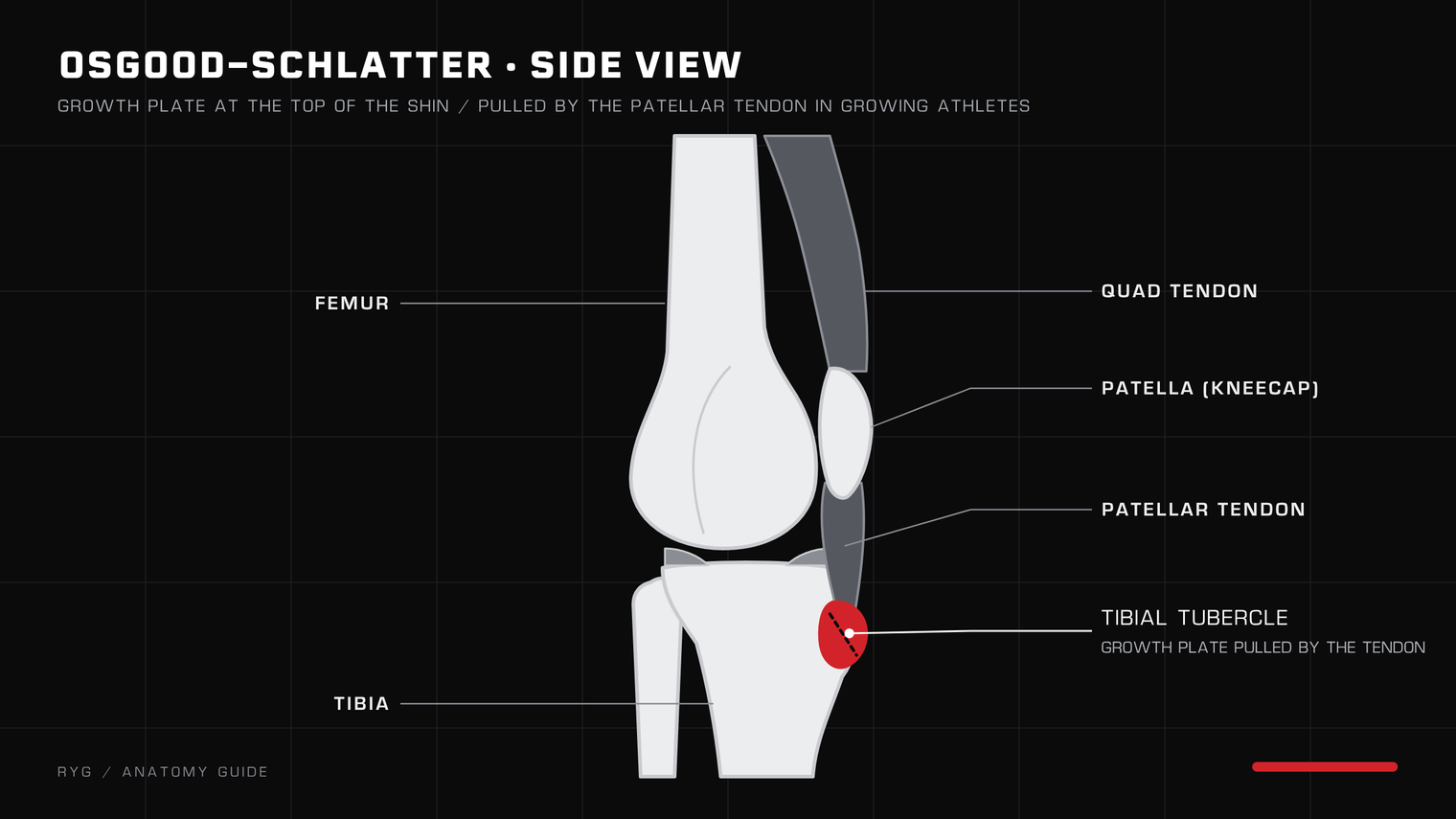
The powerful quad muscles pull on the kneecap, which pulls on the patellar tendon, which anchors to a spot on the shin bone that, in a growing kid, is still soft cartilage rather than solid bone. During a growth spurt, bones lengthen before muscles catch up, so the quads pull tighter than usual on that soft anchor point, and thousands of basketball jumps tug on it over and over. The anchor gets irritated, and the body responds by laying down extra bone, which is the bump. Once growth finishes and the area fuses into solid bone, the condition resolves, though the bump often stays as a souvenir.
What the research says
- Osgood-Schlatter affects about 1 in 10 adolescents (9.8% in a population sample; 11% of boys and 8% of girls aged 12 to 15)1.
- Peak age of onset is 12 in boys and 11 in girls, and boys are diagnosed nearly twice as often as girls2.
- Playing sport regularly roughly doubles the odds of Osgood-Schlatter, and a tight rectus femoris (front of thigh) raises the odds 7-fold1.
- The pain is real and costly: adolescents with Osgood-Schlatter score 22 to 56 points lower than pain-free peers on knee function, sport and quality-of-life scales and have measurably weaker quadriceps, yet they are still logging over 2 hours of vigorous activity a day3.
- Most kids get 'advice' or 'rest' from their doctor; only 13% are referred to physiotherapy and 1 in 5 is sent for imaging2.
- A 12-week program of pain-guided activity modification, progressive knee strengthening and graded return to sport led to a successful outcome in 80% at 12 weeks and 90% at 12 months, in adolescents who had already been in pain for an average of 21 months. Quad strength rose 32% and jump height 19% in the first 12 weeks4.
- Return to sport takes patience with that program: 16% were back at 12 weeks and 69% at 12 months4. The research base is thin overall; a 2021 systematic review found only 2 randomized trials5.
- A young athlete who spends more hours per week in organized sport than their age in years has about twice the odds of a serious overuse injury6.
What we do about it
The management question is really about the season, and the research supports managing the dose rather than shutting the athlete down for a year. We use a pain-guided activity ladder, the same idea as the study program: keep activity at a level where pain stays mild, around a two or three out of ten, and settles by the next day. Trim jumping volume during flares, keep practicing in modified form, and step back up the ladder as the knee allows.
Alongside that, strength. The data say kids with Osgood-Schlatter have weaker quads than their peers and that a structured strengthening program raised strength and jump height substantially in 12 weeks, so we build the quads and hips with comfortable exercises like wall sits, split squats and hip work, progressed over weeks. Supervised strength training is safe for growing athletes; the fear that it harms growth plates is not supported by the evidence7. We also address the tight rectus femoris the research flags, and we look at total weekly hours, because a schedule that exceeds the athlete's age in hours is a known driver. Kneeling directly on the bump will always be the sorest thing, which says little about severity.
When to get it looked at
- Pain that is forcing a limp or stealing whole practices.
- Pain that is not settling with sensible activity modification over a few weeks.
- Swelling inside the knee joint, locking, or pain that is not at the bump.
- Sudden severe pain at the bump after a jump, which can mean the growth plate has pulled away and needs imaging.
- A kid who has quietly stopped playing or started avoiding sport because of the knee.
Bottom line
Osgood-Schlatter is common, self-resolving once growth finishes, and more disruptive to a kid's sport and quality of life than most families are told. The research says a pain-guided plan plus strengthening produces a good outcome in the large majority within three months, while rest-and-wait has little behind it. An in-person evaluation explains what to watch for at each stage and sets up the activity ladder.
References
- de Lucena GL, dos Santos Gomes C, Guerra RO. Prevalence and associated factors of Osgood-Schlatter syndrome in a population-based sample of Brazilian adolescents. Am J Sports Med. 2011;39(2):415-420. PubMed
- van Leeuwen GJ, de Schepper EI, Rathleff MS, et al. Incidence and management of Osgood-Schlatter disease in general practice: retrospective cohort study. Br J Gen Pract. 2022;72(717):e301-e306. PubMed
- Rathleff MS, Winiarski L, Krommes K, et al. Pain, Sports Participation, and Physical Function in Adolescents With Patellofemoral Pain and Osgood-Schlatter Disease: A Matched Cross-sectional Study. J Orthop Sports Phys Ther. 2020;50(3):149-157. PubMed
- Rathleff MS, Winiarski L, Krommes K, et al. Activity Modification and Knee Strengthening for Osgood-Schlatter Disease: A Prospective Cohort Study. Orthop J Sports Med. 2020;8(4):2325967120911106. PubMed
- Neuhaus C, Appenzeller-Herzog C, Faude O. A systematic review on conservative treatment options for OSGOOD-Schlatter disease. Phys Ther Sport. 2021;49:178-187. PubMed
- Jayanthi NA, LaBella CR, Fischer D, et al. Sports-specialized intensive training and the risk of injury in young athletes: a clinical case-control study. Am J Sports Med. 2015;43(4):794-801. PubMed
- Lloyd RS, Faigenbaum AD, Stone MH, et al. Position statement on youth resistance training: the 2014 International Consensus. Br J Sports Med. 2014;48(7):498-505. PubMed
This article is for education and does not replace an evaluation. If you're dealing with an active injury, see a licensed medical provider.