
Rest Is Not Rehab: Why Waiting Out an Injury Usually Backfires
 Any sport
It's the most common injury plan in youth sports. Something hurts, so the athlete sits out until it doesn't, then jumps straight back in. Two weeks later the same thing hurts again and everyone is confused. Nobody did anything wrong on purpose. Rest just quietly failed, the way it usually does.
What's actually going on
Muscle, tendon and bone are living tissue that constantly remodel based on what you ask of them. Load them regularly and they build. Take the load away and they start breaking down within days, not months. So total rest does two things at once. It lets the pain calm down, and it makes the injured tissue and everything around it weaker. The athlete comes back feeling fine, with less capacity than they had the day they got hurt, and goes straight back into the sport that overloaded them in the first place. That's the re-injury cycle in one sentence.
Healing tissue also organizes itself along the lines of stress it experiences, which is why modern rehab for almost every sports injury starts loading early. The skill is in the dose. Enough stress to signal "rebuild," not so much that things flare. That's the entire job of a rehab program, and it's the piece that resting skips completely.
What the research says
- Five days in a leg cast cost healthy young men 3.5 percent of their quadriceps size and 9 percent of their strength; two weeks cost 8.4 percent and 23 percent1.
- Recreational athletes with a severe thigh or calf strain who started the same rehab program 2 days after injury returned to sport almost 3 weeks sooner than those who started on day 9, with similar strength recovery and only one reinjury in the whole trial2.
- After a grade 1 or 2 ankle sprain, people who started exercise in the first week had better function at weeks 1 and 2 than those who rested, iced, compressed and elevated, and the reinjury rate at 16 weeks was the same 4 percent in both groups3.
- About 40 percent of first-time ankle sprains go on to chronic ankle instability, which is a big reason the current clinical guideline gives its strongest grade to progressive weight bearing and structured exercise and only a weak grade to ice4.
- It holds for concussion too. Adolescents assigned to 5 days of strict rest had no benefit over 1 to 2 days of rest, and they reported more symptoms and recovered more slowly5. Teens who did about 20 minutes of light aerobic exercise daily in the first week after a concussion recovered in a median of 13 days versus 17 days with stretching alone6.
- The current soft-tissue injury framework limits protection to 1 to 3 days and then adds load early; it also notes there is no high-quality evidence that ice helps soft tissue heal, and that anti-inflammatory drugs may impair long-term healing7.
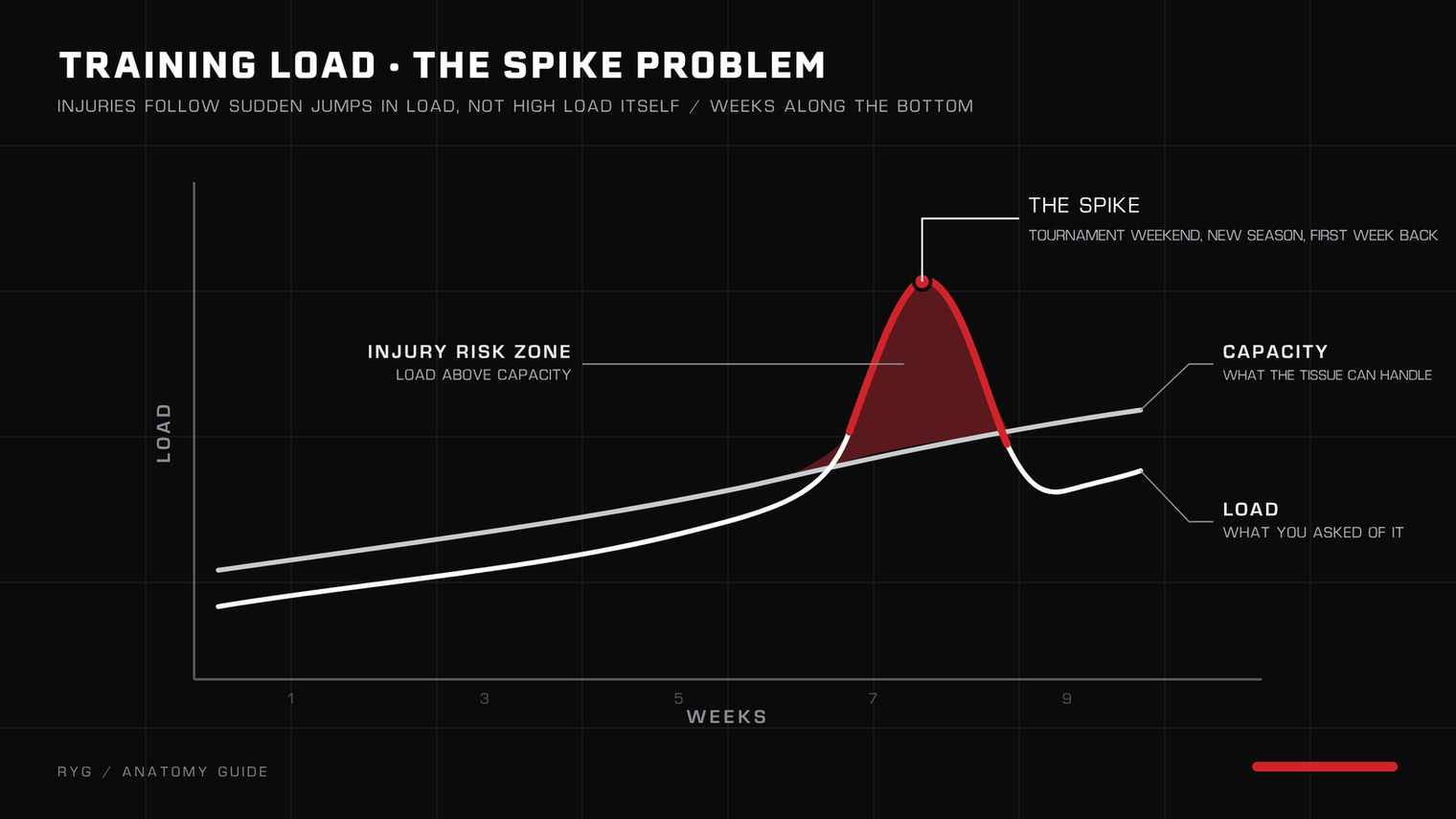
One more piece worth knowing. Athletes who are used to high training loads get hurt less than athletes who train less, and under-training can itself raise injury risk, so cutting load to zero is not the safe choice it looks like8.
What we do about it
- Protect for days, not weeks. For most strains and sprains the protection window is a few days with pain as the guide, then normal daily activity resumes as symptoms allow.
- Load early, load light. Isometrics and easy range-of-motion work start as soon as they're tolerable. They calm pain and tell the tissue which direction to rebuild.
- Then make it heavy and slow. Progressive resistance is the main event for muscle and tendon. This is the phase rest skips entirely.
- Chase symmetry. We test the injured side against the other side and don't call it done until the gap closes.
- Finish in the sport. Sprinting, cutting, landing or throwing get rebuilt on purpose, at increasing speed, before the first game does it for you.
When to get it looked at
- A pop or tearing sensation followed by rapid swelling or an inability to bear weight
- A joint that feels unstable or gives way
- Numbness, tingling or weakness below the injury
- Pain that is clearly worse after two to three weeks of sensible activity, or that wakes you at night
- A young athlete with back pain or bone pain that lasts more than a couple of weeks
Bottom line
Rest lets pain settle, and that's all it does. The tissue that got hurt needs load to get back to full strength, and the studies above show early, graded rehab gets athletes back sooner without more reinjuries. If someone in your house is stuck in the rest, return, re-injure loop, an in-person evaluation is a fast way to replace waiting with a plan.
References
- Wall BT, Dirks ML, Snijders T, et al. Substantial skeletal muscle loss occurs during only 5 days of disuse. Acta Physiol (Oxf). 2014;210(3):600-611. PubMed
- Bayer ML, Magnusson SP, Kjaer M, et al. Early versus Delayed Rehabilitation after Acute Muscle Injury. N Engl J Med. 2017;377(13):1300-1301. PubMed
- Bleakley CM, O'Connor SR, Tully MA, et al. Effect of accelerated rehabilitation on function after ankle sprain: randomised controlled trial. BMJ. 2010;340:c1964. PubMed
- Martin RL, Davenport TE, Fraser JJ, et al. Ankle Stability and Movement Coordination Impairments: Lateral Ankle Ligament Sprains Revision 2021. J Orthop Sports Phys Ther. 2021;51(4):CPG1-CPG80. PubMed
- Thomas DG, Apps JN, Hoffmann RG, et al. Benefits of strict rest after acute concussion: a randomized controlled trial. Pediatrics. 2015;135(2):213-223. PubMed
- Leddy JJ, Haider MN, Ellis MJ, et al. Early Subthreshold Aerobic Exercise for Sport-Related Concussion: A Randomized Clinical Trial. JAMA Pediatr. 2019;173(4):319-325. PubMed
- Dubois B, Esculier JF. Soft-tissue injuries simply need PEACE and LOVE. Br J Sports Med. 2020;54(2):72-73. PubMed
- Gabbett TJ. The training-injury prevention paradox: should athletes be training smarter and harder?. Br J Sports Med. 2016;50(5):273-280. PubMed
This article is for education and does not replace an evaluation. If you're dealing with an active injury, see a licensed medical provider.