
Proximal Hamstring Strain in Football: High Hamstring Pain Right at the Sit Bone
 Football
Not all hamstring injuries are equal, and the location tells you a lot. A strain high on the hamstring, right where it anchors to the sit bone at the bottom of your pelvis, behaves differently than a mid-thigh pull. It hurts when you sit on hard bleachers, aches deep under the glute, flares with sprinting and hurdle-style stretches, and famously takes its time. Football creates it two ways: a single overstretch, like a leg sliding out during a tackle or an awkward split reaching for a cut, or gradual overload from sprint and lift volume.
What's actually going on
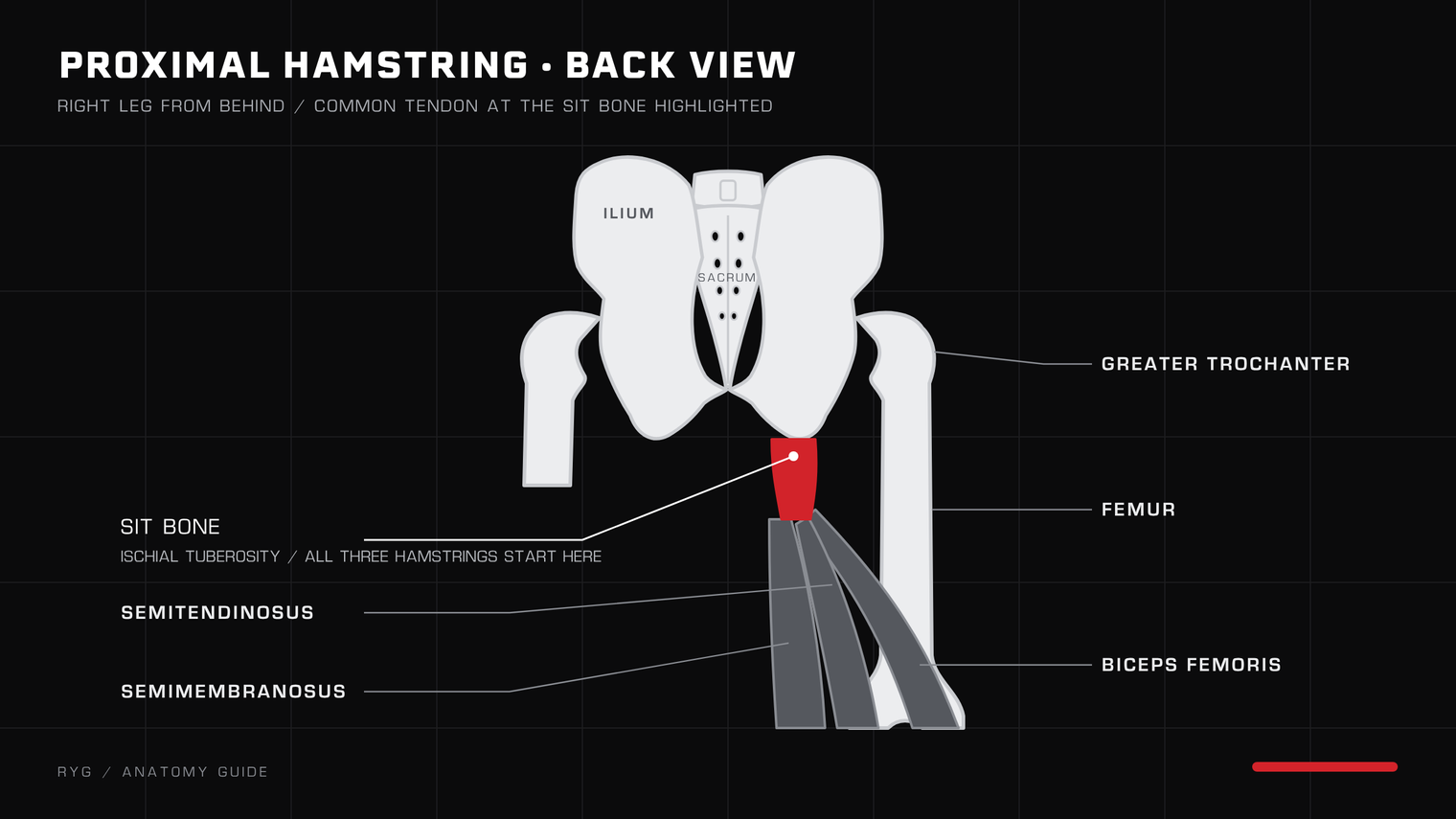
The three hamstring muscles share a thick tendon that attaches to the ischial tuberosity, the sit bone. That tendon takes enormous force when the hip is flexed and the knee is straightening, which is every stride at top speed and the bottom of every Romanian deadlift. An acute tear here is a true strain at the junction of tendon and muscle. The chronic version, proximal hamstring tendinopathy, is a tendon that has been loaded past its capacity and has degenerated rather than inflamed. Because the tendon sits right under the sit bone, sitting compresses it, which is why bleachers and long bus rides hurt. The sciatic nerve runs right next to it, so it can also produce sciatica-like symptoms.
What the research says
- High hamstring tendinopathy shows up as deep buttock pain right at the sit bone; it is common in sprinters and field-sport athletes and tends to linger for months1,2.
- Three simple exam tests (Puranen-Orava, bent-knee stretch and modified bent-knee stretch) are highly reliable between examiners and moderately to highly valid for chronic proximal hamstring tendinopathy in athletes3.
- MRI findings at the hamstring origin are common in people with no symptoms: 52% had changes on both sides and 15% had bilateral partial tears, so a scan has to be matched to the exam4.
- Biopsies of operated proximal hamstring tendons show degeneration rather than inflammation, which fits an overuse tendon problem rather than an acute 'itis'5.
- There are no randomized trials of rehab exercise specifically for this tendon; treatment is built on the progressive loading principles proven in Achilles and patellar tendinopathy1,2. In those tendons, heavy slow resistance training held its gains for a year with higher adherence and satisfaction than eccentric-only work6.
- Hamstring injuries from overstretching, such as slide tackles and splits, take roughly twice as long to heal as sprinting injuries, 43 versus 23 days even with the best protocol7.
- When conservative care fails, surgical release returned 80 of 90 athletes to their previous level at an average of 5 months5.
What we do about it
The exam uses the three provocation tests, clears the spine and the sciatic nerve, and checks hamstring strength at long muscle lengths, which is where this injury hides. If a scan already exists we read it against the exam, not the other way around.
Rehab follows the tendon rules. Phase one is isometric hamstring holds at a hip angle that does not compress the tendon, done daily for pain relief, plus cutting out the compressive positions: deep hamstring stretches, long sitting on hard surfaces, and hip-flexed exercises like hurdle stretches. Phase two is heavy slow resistance, bridges progressing to loaded hip hinges and Nordic curls, at increasing hip flexion as the tendon tolerates. Phase three stores and releases energy: hops, bounds, and sprint progressions building toward top speed. Clearance is strength at long lengths within 10% of the other side and pain-free max-velocity sprinting. This takes months for the chronic version, and This is the progression we run in the clinic, with a test at every phase before you move on.
When to get it looked at
- A pop at the sit bone with sudden weakness and a large bruise on the back of the thigh within a day or two, which can be a complete tendon avulsion.
- Numbness, tingling or pain running below the knee, which means the nerve is involved or the back is the source.
- Sit bone pain in a growing athlete, where the tendon can pull a piece of bone away.
- Pain that has not changed after 8 to 12 weeks of progressive loading.
Bottom line
High hamstring pain is a tendon problem, and tendons respond to progressive load over months rather than rest over weeks. The exam diagnoses it better than the scan, the stretching most players do makes it worse, and heavy slow strength work is the path back to sprinting. If it has been there for weeks, get it tested and start loading.
References
- Goom TS, Malliaras P, Reiman MP, et al. Proximal Hamstring Tendinopathy: Clinical Aspects of Assessment and Management. J Orthop Sports Phys Ther. 2016;46(6):483-493. PubMed
- Nasser AM, Vicenzino B, Grimaldi A, et al. Proximal Hamstring Tendinopathy: A Systematic Review of Interventions. Int J Sports Phys Ther. 2021;16(2):288-305. PubMed
- Cacchio A, Borra F, Severini G, et al. Reliability and validity of three pain provocation tests used for the diagnosis of chronic proximal hamstring tendinopathy. Br J Sports Med. 2012;46(12):883-887. PubMed
- Thompson SM, Fung S, Wood DG. The prevalence of proximal hamstring pathology on MRI in the asymptomatic population. Knee Surg Sports Traumatol Arthrosc. 2017;25(1):108-111. PubMed
- Lempainen L, Sarimo J, Mattila K, et al. Proximal hamstring tendinopathy: results of surgical management and histopathologic findings. Am J Sports Med. 2009;37(4):727-734. PubMed
- Beyer R, Kongsgaard M, Hougs Kjær B, et al. Heavy Slow Resistance Versus Eccentric Training as Treatment for Achilles Tendinopathy: A Randomized Controlled Trial. Am J Sports Med. 2015;43(7):1704-1711. PubMed
- Askling CM, Tengvar M, Thorstensson A. Acute hamstring injuries in Swedish elite football: a prospective randomised controlled clinical trial comparing two rehabilitation protocols. Br J Sports Med. 2013;47(15):953-959. PubMed
Alex has been Amazing! He initially assisted me with the rehabilitation of my hamstring and getting it back to 100%. He diagnosed the issue, and set me up on a path to get it back to full strength. Additionally, when other minor things came up, he’s been fantastic in giving insight and direction. He’s very knowledgeable, willing to accommodate scheduling asap, and an overall super individual. I highly recommend anyone who is an athlete or not and needs PT to go and see Alex! You will very glad you did!
In my previous sport season I pulled my hamstring twice and ever since working with Alex I have had no issues with my lower or upper body. He takes very detailed evaluations of your injuries to help him best determine how he can get you back to 100%. He finds where you are weak and helps you strengthen those areas.
This article is for education and does not replace an evaluation. If you're dealing with an active injury, see a licensed medical provider.