
Neck Pain in Football: When It Is Normal Soreness and When It Is Not
 Football
 asks more of the neck than almost any other sport. Every rep of contact sends force through it, a helmet adds weight your neck has to control all game, and linebackers and linemen collide dozens of times a night. Some next-day neck soreness after a physical game is normal. Pain that lingers past a few days, limits how far you can turn your head, or shows up with headaches deserves real attention.
What's actually going on
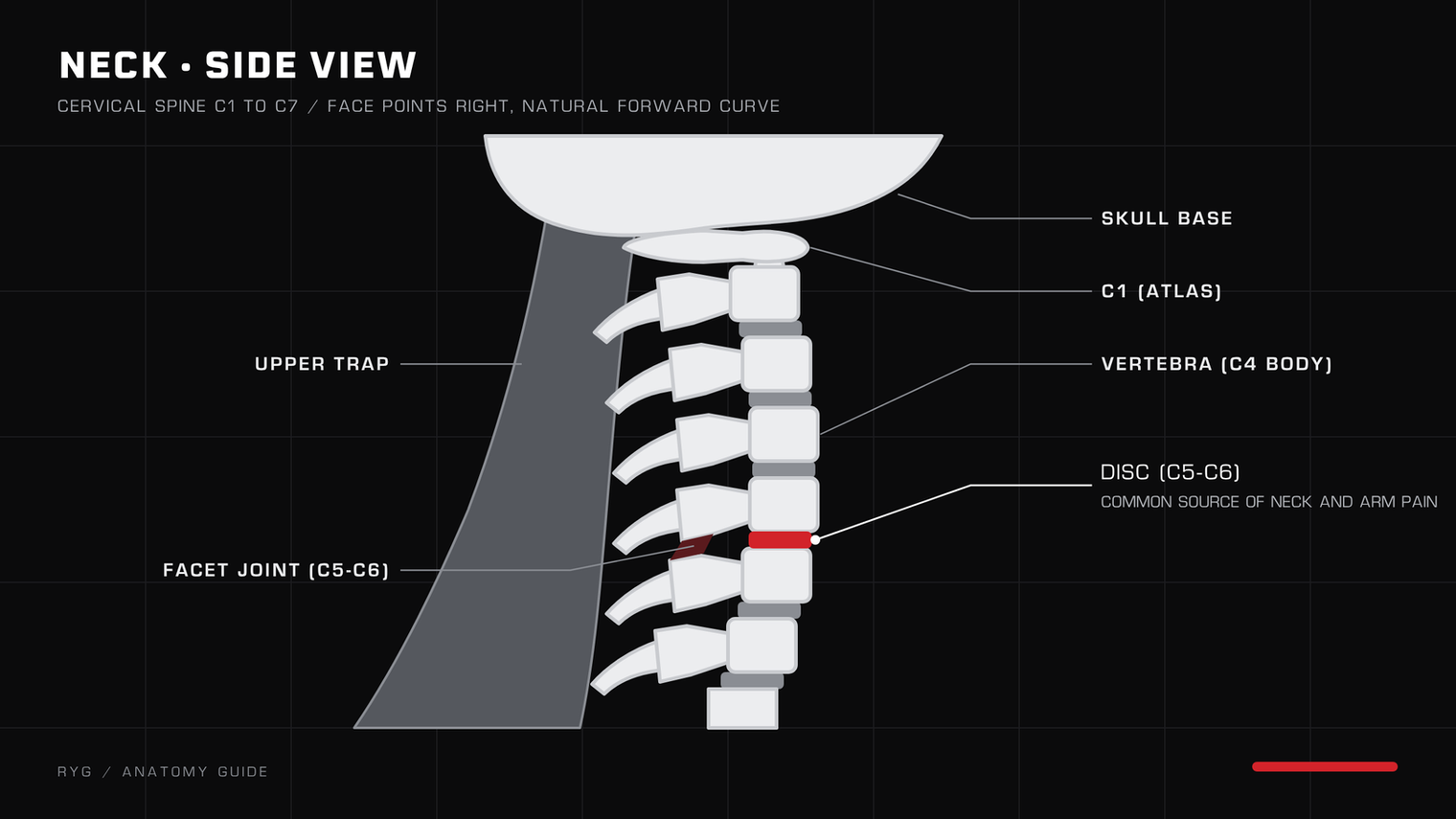
Your cervical spine is seven small vertebrae stacked on top of a lot of muscle. The deep neck flexors and extensors hold your head steady when a shoulder hits your facemask. The bigger muscles, the trapezius and levator scapulae, connect that stack to your shoulder blades. When a collision loads the neck faster than those muscles can brace, the joints and muscles get strained the same way an ankle gets rolled. Most of the time that is a sprain or a strain, and it recovers. The neck is also where nerves exit to the arm, which is why neck problems in football can show up as arm symptoms.
The other reason the neck matters in football is the head. A stronger neck does not stop a hit, but it changes how fast the head moves when the hit lands.
What the research says
- Neck pain is common in athletes: between 38% and 73% have it in a given year depending on the sport, and about 48% have had it at some point1.
- In 6,704 high school athletes, weaker necks and smaller neck circumference predicted concussion, and every 1-pound gain in neck strength lowered the odds of concussion by 5%2.
- In contact-sport athletes aged 8 to 30, both a stronger neck and bracing the neck muscles before an impact independently reduced how fast the head snapped in every direction tested3. Anticipation matters as much as raw strength.
- For a fresh mechanical neck strain, the clinical practice guideline recommends thoracic manipulation plus neck range-of-motion work and shoulder-blade and arm strengthening, not rest4. After a whiplash-type injury from a collision, the guidance is to return to normal, non-provocative activity as soon as possible, minimize collar use, and expect recovery within 2 to 3 months4.
- Strengthening the neck, shoulder blade and upper-limb muscles reduced chronic neck pain by a moderate-to-large amount across 27 randomized trials, while stretching on its own produced no measurable benefit5.
- A caution from hockey: static neck strength measured pre-season did not predict on-ice head accelerations in youth players, so the authors suggest neck training needs to be dynamic and reaction-based rather than just a strength number6.
What we do about it
Step one is sorting normal soreness from something structural, which means a hands-on exam of neck motion, strength in all four directions, nerve tension, and arm strength and sensation. If that exam is clean, you are cleared to move and the plan is active from day one.
Early on we use thoracic mobility work, gentle neck range of motion, and isometric holds against a band. As pain settles we build the neck the way the research says works: progressive isometric strength in flexion, extension and rotation, then dynamic strengthening, then anticipatory bracing drills where you have to fire before a perturbation hits. Alongside that we strengthen the lower trap and serratus so the shoulder blade stops hanging off the neck. The final phase is contact preparation: bracing against a pad, controlled collisions, and helmet-on conditioning.
This is the progression we run in the clinic, with a test at every phase before you move on.
When to get it looked at
- Any neck pain after a hit that comes with numbness, tingling, or weakness in both arms or in the legs. That is an emergency, not a sideline check.
- Pain in the middle of the spine itself, especially if you cannot turn your head or are guarding it with your hands.
- Headache, dizziness, nausea, or fogginess after contact, which needs a concussion evaluation whether or not the neck hurts.
- Burning pain or weakness down one arm that does not clear within minutes, or that keeps coming back.
- Soreness that has not improved after a week of normal activity.
Bottom line
Most football neck pain is a sprain or strain that recovers with movement and strengthening, not rest and a collar. A stronger, faster-reacting neck is also one of the few modifiable things that changes how hard your head gets rattled. If the pain is lingering or came with arm symptoms, get a real exam before the next game.
References
- Noormohammadpour P, Farahbakhsh F, Farahbakhsh F, et al. Prevalence of Neck Pain among Athletes: A Systematic Review. Asian Spine J. 2018;12(6):1146-1153. PubMed
- Collins CL, Fletcher EN, Fields SK, et al. Neck strength: a protective factor reducing risk for concussion in high school sports. J Prim Prev. 2014;35(5):309-319. PubMed
- Eckner JT, Oh YK, Joshi MS, et al. Effect of neck muscle strength and anticipatory cervical muscle activation on the kinematic response of the head to impulsive loads. Am J Sports Med. 2014;42(3):566-576. PubMed
- Blanpied PR, Gross AR, Elliott JM, et al. Neck Pain: Revision 2017 (Clinical Practice Guidelines Linked to the International Classification of Functioning, Disability and Health From the Orthopaedic Section of the American Physical Therapy Association). J Orthop Sports Phys Ther. 2017;47(7):A1-A83. PubMed
- Gross A, Kay TM, Paquin JP, et al. Exercises for mechanical neck disorders. Cochrane Database Syst Rev. 2015;1(1):CD004250. PubMed
- Mihalik JP, Guskiewicz KM, Marshall SW, et al. Does cervical muscle strength in youth ice hockey players affect head impact biomechanics?. Clin J Sport Med. 2011;21(5):416-421. PubMed
It was such a great time, and with the exercises and stretching, my neck felt a lot better afterward. Will definitely recommend it.
This article is for education and does not replace an evaluation. If you're dealing with an active injury, see a licensed medical provider.