
Proximal Hamstring Strain in Golf: That Deep Ache Right Under Your Sit Bone
 Golf
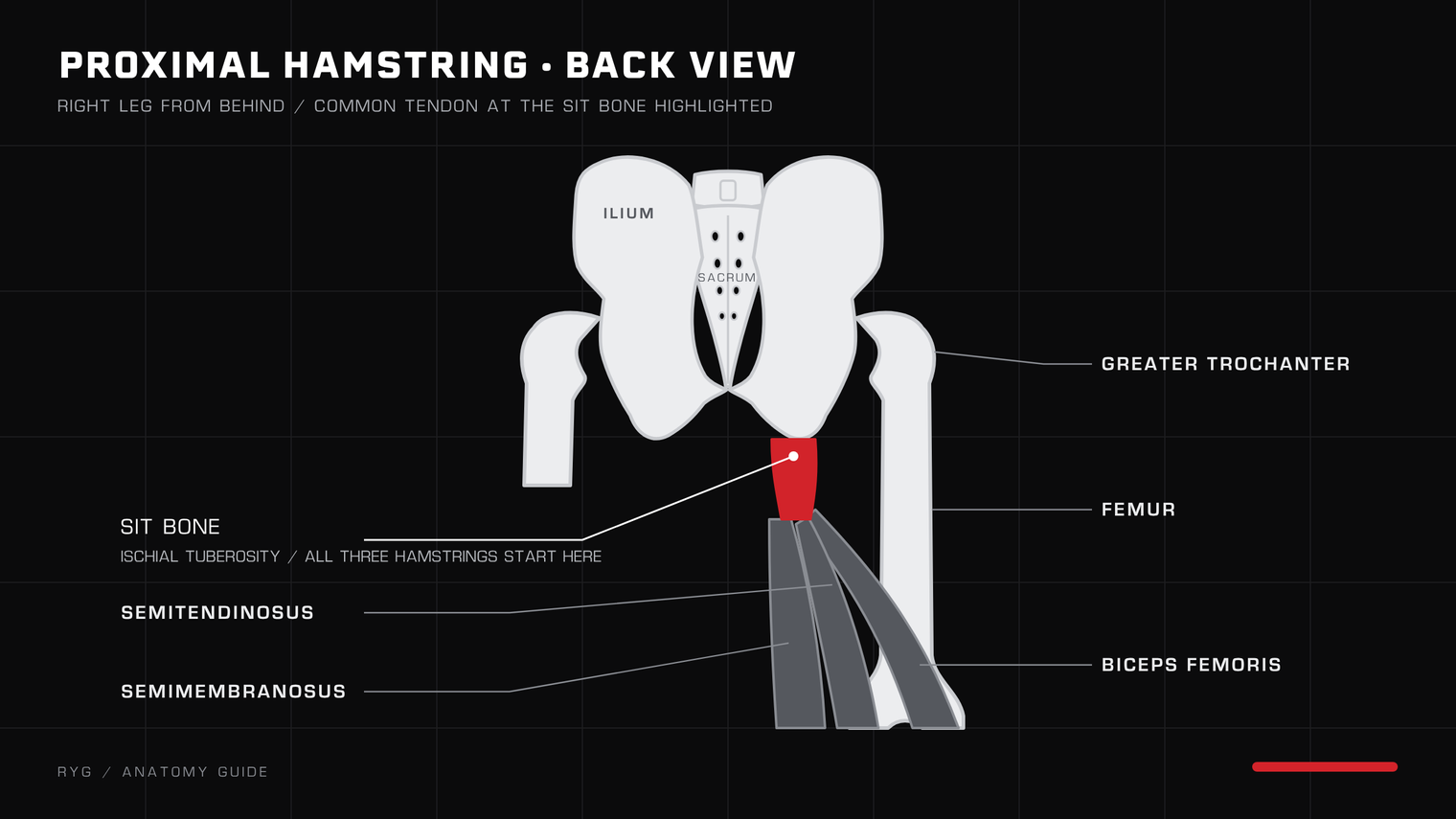
There is a particular pain that lives right where your hamstring attaches to your sit bone, the bony point you feel when you sit on a hard bench. Golfers with a proximal hamstring problem feel a deep, localized ache there that flares with bending forward, sitting on hard surfaces, and sometimes during the swing itself. It can arrive suddenly as a strain during an athletic move, or build slowly as a tendinopathy, an overload of the tendon at that attachment point.
It has a reputation for lingering, and the research explains why: it behaves like other tendon problems, it gets compressed in exactly the positions golfers spend time in, and it is often handled with rest and stretching, which are the two things it tolerates least.
What's actually going on
Golf loads this exact spot more than people realize. Your address posture is a sustained forward hinge, which keeps the hamstrings long and working the entire time you are over the ball, and you are over the ball for a couple of hours across a full round. The swing then adds a stretch and fire cycle: the hamstrings help control your hip hinge in the backswing and then contract to help extend the hips powerfully through impact. Long muscle plus load plus repetition is the standard recipe for attachment point overload.
The proximal hamstring tendon also gets compressed against the sit bone in deep hip flexion, so deep forward folds and aggressive hamstring stretching irritate it rather than help it. Biopsies of operated tendons show degeneration, not inflammation, which fits an overuse tendon problem rather than an acute itis.
What the research says
- High hamstring tendinopathy shows up as deep buttock pain right at the sit bone, is common in sprinters, distance runners and field sport athletes, and tends to linger for months1,2.
- Three simple exam tests are highly reliable between examiners and moderately to highly valid for chronic proximal hamstring tendinopathy in athletes, so the diagnosis is made in the clinic3.
- MRI findings at the hamstring origin are common in people with no symptoms: 52% had changes on both sides and 15% had bilateral partial tears, so a scan has to be matched to the exam4.
- There are no randomized trials of rehab exercise specifically for this tendon; treatment is built on the progressive loading principles proven in Achilles and patellar tendinopathy1,2. In those tendons, heavy slow resistance training held its gains at 6 months while cortisone injections slid back5, and a progressive loading program kept within acceptable pain beat classic painful eccentrics by 9 points at 24 weeks6.
- A systematic review of 12 studies found insufficient evidence to recommend any single treatment, whether injections, shockwave or surgery, over another for proximal hamstring tendinopathy2. In 40 professional athletes, 4 weeks of shockwave gave at least 50% pain relief in 85% at 3 months versus 10% with anti-inflammatories plus standard physiotherapy7.
- When conservative care fails, surgical release returned 80 of 90 athletes to their previous level of sport at an average of 5 months8.
- Sit bone pain with sciatica like symptoms down the leg can be proximal hamstring syndrome, in which the sciatic nerve is compressed near the hamstring origin; the spine should be cleared first9.
What we do about it
Trim the compression. Softer sitting surfaces, no deep forward folds or aggressive hamstring stretching, and swapping some bent over practice time for block work early on. This is the quickest early win.
Isometrics first. Long hold bridges and isometric hip extension at a hip angle that does not compress the tendon, daily, to settle pain and keep the tendon working.
Then heavy and slow. Hip hinges and Romanian deadlifts with light load, adding range and weight as the tendon adapts over 6 to 12 weeks, with pain kept tolerable and settling by the next morning. Only then do we add speed and the full stretch of the address posture.
Return to golf by stages. Short game with a taller posture, then full swings, then full practice volume. Shockwave is an option for stubborn cases. This is the progression we run in the clinic, with a test at every phase before you move on.
When to get it looked at
- A pop at the sit bone with bruising, weakness, or difficulty walking, which can be a tendon avulsion.
- Numbness, tingling, or pain running down the leg below the knee.
- Pain that has not improved after 8 to 12 weeks of proper loading.
- Pain in a teenager at the sit bone, which can be a growth plate injury.
- Any back symptoms alongside the buttock pain.
Bottom line
Sit bone pain in a golfer is usually a tendon that has been compressed and overloaded by hours of hinging and then mismanaged with rest and stretching. The research says to treat it like other tendons: reduce compression, load it progressively, and give it the weeks it needs. If sitting through dinner after a round has become uncomfortable, an in-person evaluation will confirm the diagnosis and set your starting load.
References
- Goom TS, Malliaras P, Reiman MP, et al. Proximal Hamstring Tendinopathy: Clinical Aspects of Assessment and Management. J Orthop Sports Phys Ther. 2016;46(6):483-493. PubMed
- Nasser AM, Vicenzino B, Grimaldi A, et al. Proximal Hamstring Tendinopathy: A Systematic Review of Interventions. Int J Sports Phys Ther. 2021;16(2):288-305. PubMed
- Cacchio A, Borra F, Severini G, et al. Reliability and validity of three pain provocation tests used for the diagnosis of chronic proximal hamstring tendinopathy. Br J Sports Med. 2012;46(12):883-887. PubMed
- Thompson SM, Fung S, Wood DG. The prevalence of proximal hamstring pathology on MRI in the asymptomatic population. Knee Surg Sports Traumatol Arthrosc. 2017;25(1):108-111. PubMed
- Kongsgaard M, Kovanen V, Aagaard P, et al. Corticosteroid injections, eccentric decline squat training and heavy slow resistance training in patellar tendinopathy. Scand J Med Sci Sports. 2009;19(6):790-802. PubMed
- Breda SJ, Oei EHG, Zwerver J, et al. Effectiveness of progressive tendon-loading exercise therapy in patients with patellar tendinopathy: a randomised clinical trial. Br J Sports Med. 2021;55(9):501-509. PubMed
- Cacchio A, Rompe JD, Furia JP, et al. Shockwave therapy for the treatment of chronic proximal hamstring tendinopathy in professional athletes. Am J Sports Med. 2011;39(1):146-153. PubMed
- Lempainen L, Sarimo J, Mattila K, et al. Proximal hamstring tendinopathy: results of surgical management and histopathologic findings. Am J Sports Med. 2009;37(4):727-734. PubMed
- Park JW, Lee YK, Lee YJ, et al. Deep gluteal syndrome as a cause of posterior hip pain and sciatica-like pain. Bone Joint J. 2020;102-B(5):556-567. PubMed
Only was able to work with Alex for a short period of time but was able to made huge strides in rehabbing my hamstring with his help. Great guy, couldn’t recommend him enough.
My son was dealing with a lingering hamstring injury, and while other clinics had long wait times, Regain Your Game got him in quickly. Alex identified the root cause, provided a simple at-home therapy plan, and was always available as a resource throughout the recovery process.
What stood out most was the focus on my son's recovery, not on scheduling additional appointments. After following the treatment plan, he's now back on the field and playing pain-free. We're grateful for Alex's expertise and genuinely caring approach, and we'll definitely return if we ever need PT again.
This article is for education and does not replace an evaluation. If you're dealing with an active injury, see a licensed medical provider.