
Neck Pain and the Golf Swing: What Your Stiff Neck Is Telling You
 Golf
Golf asks something odd of your neck. Your body coils hard away from the target while your eyes, and therefore your head, stay locked on the ball. That means your neck has to rotate in the opposite direction of your shoulders on every backswing. For a healthy neck that is no problem. For a stiff one, every swing becomes a small tug of war, and by the back nine the tug of war shows up as pain, tightness, or a headache at the base of the skull.
The good news is that most golf neck pain is mechanical, which means it responds to movement and strength, not rest and collars.
What's actually going on
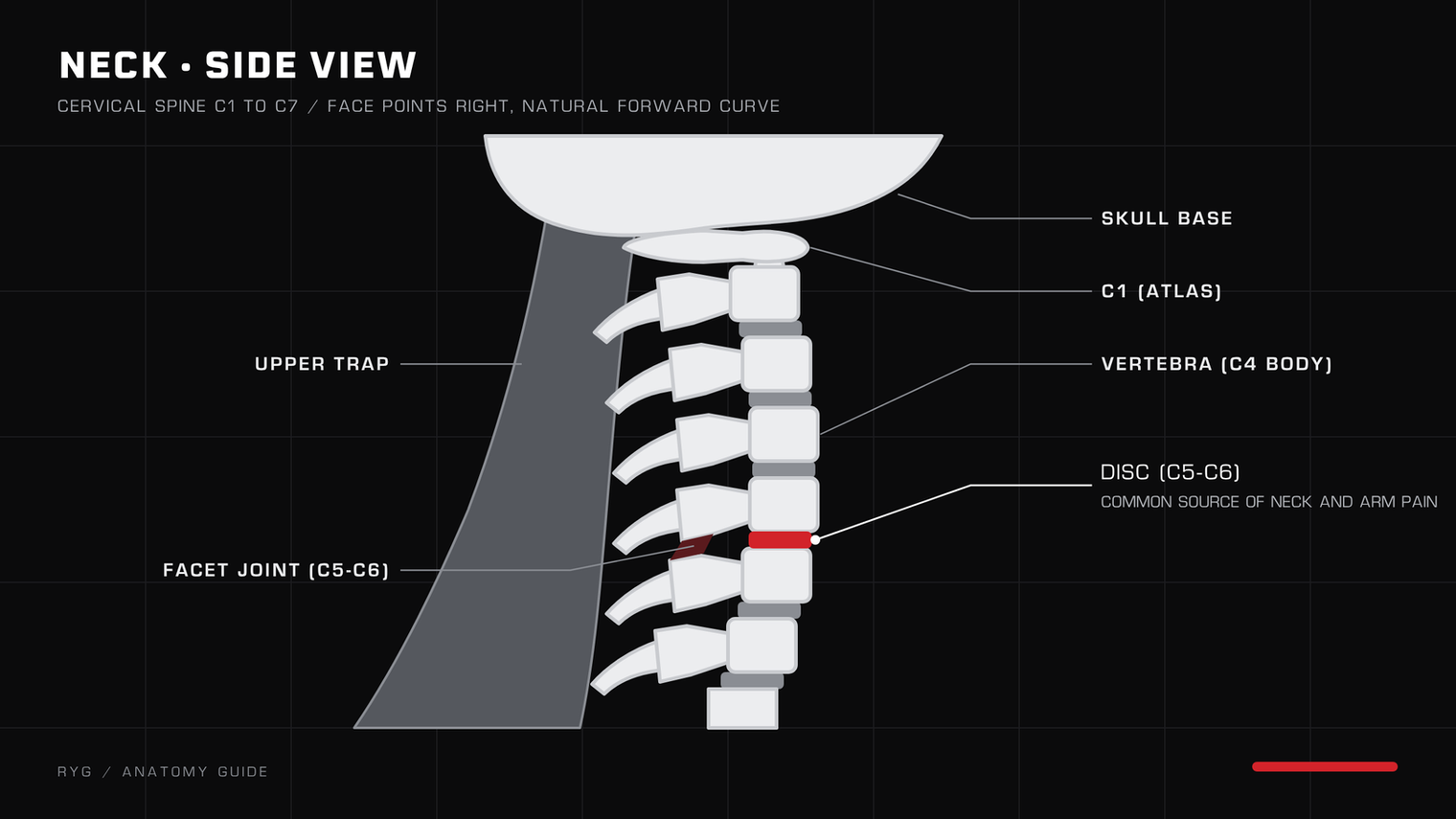
Rotation for the golf swing is supposed to come from several places: your hips, your mid back and your neck, each contributing a share. When the mid back gets stiff, which happens to most adults who sit for work, the neck is forced to make up the missing degrees. The small joints of the neck were never designed to be the main engine of rotation. They get irritated, and the muscles around them guard and clamp down. That guarding is the stiffness you feel when you check your blind spot the next morning.
The neck also sits on top of the shoulder girdle. Weak shoulder blade muscles and an overworked upper trap pull on the neck from below. That is why a neck plan that never looks at the mid back and the shoulder blades tends to fail.
What the research says
- Neck pain is common in athletes: between 38% and 73% have it in a given year depending on the sport, and about 48% have had it at some point1.
- For a fresh mechanical neck strain, the clinical practice guideline recommends thoracic (upper back) manipulation plus a neck range of motion program and shoulder blade and arm strengthening, not rest2. For chronic neck pain the same guideline recommends hands on manual therapy combined with mixed neck and shoulder girdle exercise, including strengthening, endurance and aerobic conditioning2.
- Strengthening the neck, shoulder blade and upper limb muscles reduces chronic neck pain by a moderate to large amount, while stretching on its own produces no measurable benefit3.
- Twelve months of neck strength training raised maximal neck strength by 69% to 110% and reduced pain and disability, and the authors concluded stretching and aerobic exercise alone were much less effective than strengthening4.
- The dose does not have to be heroic: 2 minutes a day of progressive band training for the neck and shoulders, 5 days a week, significantly reduced pain and tenderness within 10 weeks5.
- The mid back matters even when it does not hurt. There is growing evidence that mobilizing or manipulating the thoracic spine helps neck and shoulder problems because it is often a silent contributor to pain felt elsewhere6.
What we do about it
Restore the neighbors first. Thoracic rotation drills and hands on work for the mid back give the neck fewer degrees to make up. This is where most golfers feel the first change.
Then move the neck. Gentle rotation and side bend through comfortable range, several times a day, so the joints stop guarding. We skip the collar and skip the long stretching sessions, since the evidence says they do little on their own.
Then strengthen. Deep neck flexor holds, band resisted neck work, and shoulder blade strengthening with the shoulders down. The research supports a small daily dose at first, progressing to heavier work over 10 to 12 weeks. We test rotation range and strength along the way rather than guessing.
Then take it to the swing. Half swings with the head free to move a little, then full swings, then range volume. If your neck barks every time you play, or you have started shortening your backswing to avoid it, This is the progression we run in the clinic, with a test at every phase before you move on.
When to get it looked at
- Pain, numbness or tingling that runs into the arm or hand, or weakness in the hand.
- Neck pain that started with a fall, a collision or a car accident.
- Headaches that are new, severe, or come with dizziness or vision changes.
- Pain that has not improved after 3 to 4 weeks of movement and basic strengthening.
- Fever, unexplained weight loss, or night pain that does not change with position.
Bottom line
A stiff neck in a golfer is usually a neck doing rotation that the mid back should be doing. Restore the mid back, move the neck, strengthen the whole upper quarter, and the swing feels smooth again instead of pinched. The research is clear that strengthening beats stretching here. An in-person evaluation will show you in a few minutes where your rotation is really coming from.
References
- Noormohammadpour P, Farahbakhsh F, Farahbakhsh F, et al. Prevalence of Neck Pain among Athletes: A Systematic Review. Asian Spine J. 2018;12(6):1146-1153. PubMed
- Blanpied PR, Gross AR, Elliott JM, et al. Neck Pain: Revision 2017 (Clinical Practice Guidelines Linked to the International Classification of Functioning, Disability and Health From the Orthopaedic Section of the American Physical Therapy Association). J Orthop Sports Phys Ther. 2017;47(7):A1-A83. PubMed
- Gross A, Kay TM, Paquin JP, et al. Exercises for mechanical neck disorders. Cochrane Database Syst Rev. 2015;1(1):CD004250. PubMed
- Ylinen J, Takala EP, Nykänen M, et al. Active neck muscle training in the treatment of chronic neck pain in women: a randomized controlled trial. JAMA. 2003;289(19):2509-2516. PubMed
- Andersen LL, Saervoll CA, Mortensen OS, et al. Effectiveness of small daily amounts of progressive resistance training for frequent neck/shoulder pain: randomised controlled trial. Pain. 2011;152(2):440-446. PubMed
- Heneghan NR, Rushton A. Understanding why the thoracic region is the 'Cinderella' region of the spine. Man Ther. 2016;21:274-276. PubMed
It was such a great time, and with the exercises and stretching, my neck felt a lot better afterward. Will definitely recommend it.
This article is for education and does not replace an evaluation. If you're dealing with an active injury, see a licensed medical provider.