
Ankle Sprains in Hockey: Yes, They Happen in Skates, and Here Is Why They Linger
 Hockey
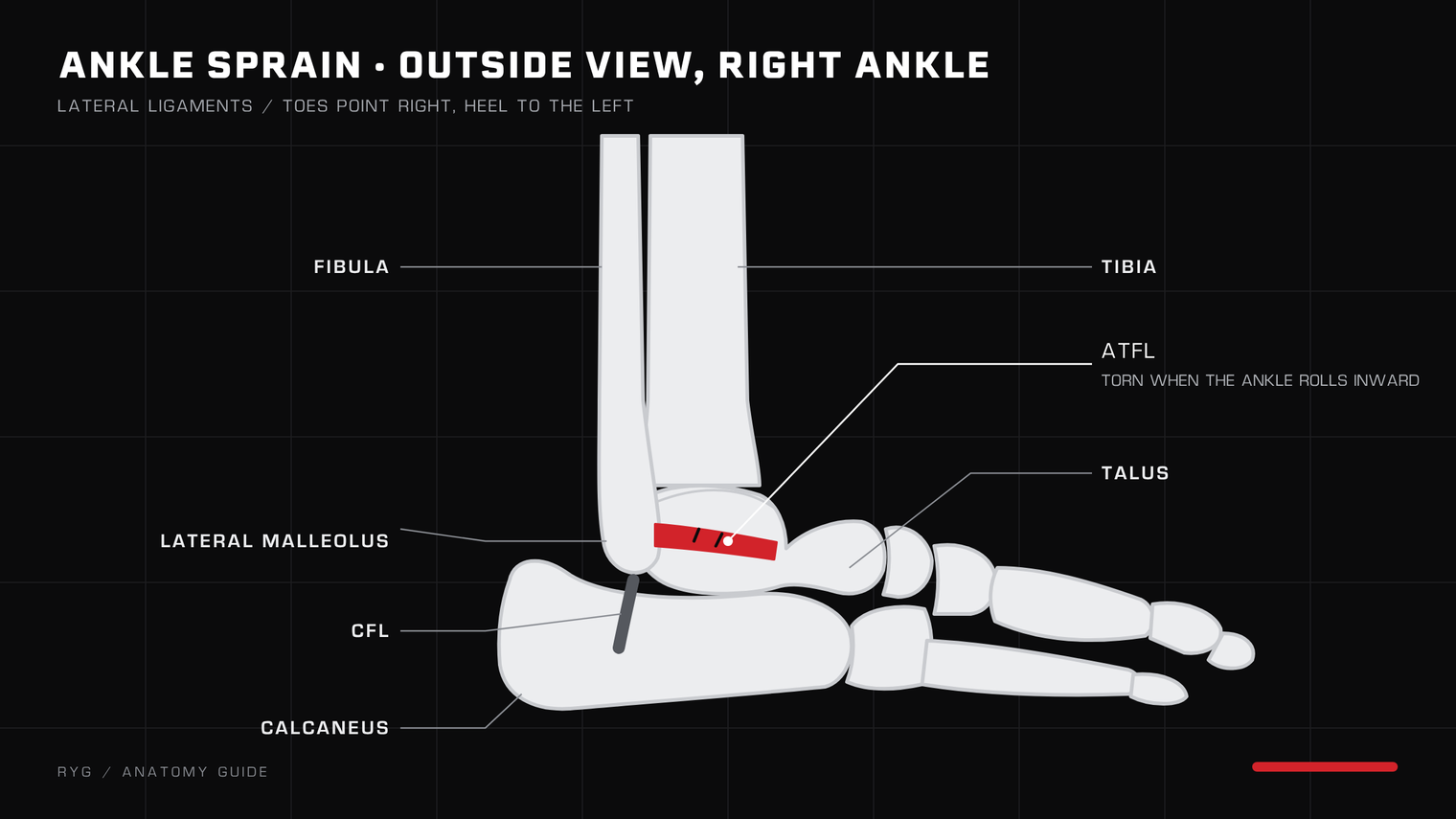
People assume skates protect hockey players from ankle sprains, and they do change the picture, just not the way most think. A stiff boot limits the classic rolled ankle, so hockey trades some of those for a different injury, the high ankle sprain. When a blade catches a rut or the boards while the leg keeps rotating, the force twists above the boot line and strains the ligaments that bind your two shin bones together just above the ankle joint.
Regular low ankle sprains happen too, usually off the ice in training or when a foot catches in a battle. Both types have one thing in common in the research: the problem is not the first sprain, it is what happens after it.
What's actually going on
High ankle ligaments hold the two leg bones together like the lashing on a pair of poles, and every step, stride and push tries to spread the bones apart. The injured tissue gets stressed with nearly everything you do, which is why a high ankle sprain that gets the walk-it-off treatment can nag for months.
Low ankle sprains heal faster but come with their own trap. Sprains stretch the nerve endings that tell your brain where your ankle is, and until that system is retrained, re-injury risk stays high even after pain is gone. In a skate, the ankle stabilizes every inside and outside edge you carve, so a slow or fuzzy ankle costs edge control before it costs you another sprain.
What the research says
- High ankle sprains occurred at 1 per 10,000 athlete-exposures in college sports, with football, wrestling and ice hockey the highest; 60% came from player contact and nearly half cost 7 or more days out1. In collegiate hockey, high ankle sprains caused the most severe time loss of any foot and ankle injury2.
- The severity of a sprain is judged most reliably by a hands-on exam 4 to 5 days after injury, once the initial swelling has settled3.
- Guidelines favor a brace or tape plus a supervised exercise program over rest and passive treatments, with surgery reserved for sprains that fail thorough rehab3,4. People who started exercise in the first week after a sprain had better function at weeks 1 and 2 than those who rested, iced, compressed and elevated, with the same reinjury rate5.
- Under usual care, about 1 in 3 athletes re-sprains the same ankle within a year; adding an 8-week home balance program cut that to 22%, a 35% reduction6.
- Bracing has strong evidence and neuromuscular training moderate evidence for preventing a repeat sprain4.
- Being unable to do a single-leg drop landing or a drop jump 2 weeks after a first sprain predicted who would go on to chronic ankle instability, and about 40% of first-time sprains progress to it7,8.
What we do about it
Short protection, then load. A brief protection phase, sometimes with a boot for high ankle sprains, then early weight bearing and motion, which carries the ankle guideline's strongest recommendation8.
Progressive strength. Calf, peroneal and foot strength, then single-leg loading.
The part everyone skips: balance and reaction. Single-leg balance progressing to unstable surfaces, then hopping, landing and reactive cutting, because the balance program is what cut recurrence by a third6.
Rebuild the edges. Inside and outside edge work, tight turns and stops in counted doses before full practice, with a brace during the transition as the evidence supports. This is the progression we run in the clinic, with a test at every phase before you move on.
When to get it looked at
- Pain at the bony points of the ankle after a twist, or inability to bear weight for a few steps, which warrants an X-ray to rule out a fracture.
- Pain above the ankle joint that is worse when the foot is turned outward or the lower leg is squeezed, which points to a high ankle sprain.
- An ankle that is still swollen or unstable two weeks after the injury.
- A second sprain within a season. That is the start of chronic instability, not bad luck.
Bottom line
A sprain in a skate is often the high type, and both types linger when rehab stops at the swelling-is-gone stage. The research says load early, brace while you transition, and finish with balance and reaction training, which is what actually prevents the next one. An in-person evaluation tells you which milestones to hit before returning to the ice.
References
- Mauntel TC, Wikstrom EA, Roos KG, et al. The Epidemiology of High Ankle Sprains in National Collegiate Athletic Association Sports. Am J Sports Med. 2017;45(9):2156-2163. PubMed
- Crowley SG, Trofa DP, Vosseller JT, et al. Epidemiology of Foot and Ankle Injuries in National Collegiate Athletic Association Men's and Women's Ice Hockey. Orthop J Sports Med. 2019;7(8):2325967119865908. PubMed
- Vuurberg G, Hoorntje A, Wink LM, et al. Diagnosis, treatment and prevention of ankle sprains: update of an evidence-based clinical guideline. Br J Sports Med. 2018;52(15):956. PubMed
- Doherty C, Bleakley C, Delahunt E, et al. Treatment and prevention of acute and recurrent ankle sprain: an overview of systematic reviews with meta-analysis. Br J Sports Med. 2017;51(2):113-125. PubMed
- Bleakley CM, O'Connor SR, Tully MA, et al. Effect of accelerated rehabilitation on function after ankle sprain: randomised controlled trial. BMJ. 2010;340:c1964. PubMed
- Hupperets MD, Verhagen EA, van Mechelen W. Effect of unsupervised home based proprioceptive training on recurrences of ankle sprain: randomised controlled trial. BMJ. 2009;339:b2684. PubMed
- Doherty C, Bleakley C, Hertel J, et al. Recovery From a First-Time Lateral Ankle Sprain and the Predictors of Chronic Ankle Instability: A Prospective Cohort Analysis. Am J Sports Med. 2016;44(4):995-1003. PubMed
- Martin RL, Davenport TE, Fraser JJ, et al. Ankle Stability and Movement Coordination Impairments: Lateral Ankle Ligament Sprains Revision 2021. J Orthop Sports Phys Ther. 2021;51(4):CPG1-CPG80. PubMed
Our son broke his ankle in a hockey game. With his goal of being ready for spring TO’s we were on the hunt for a PT that knew the game and expectations of a hockey player. We were referred to Alex by a coach.
After meeting with/ Alex our son , wife and I were 100% this is the right guy to help our son. Alex put multiple pt plans together along with on ice plans to reintroduce skating. Most of all our son trusts and listens to Alex about the recovery process. Our son is ahead of schedule!
Pretty much the best experience we’ve ever had with a doctor.
Thank you
Lessner’s
Over the years I’ve been going to see Alex he has not only helped me quickly and efficiently get back to normal, but coming back stronger. He’s helped me with my knees and hips so that they are no longer any issue and my ankle when I sprained it. Highly recommended.
This article is for education and does not replace an evaluation. If you're dealing with an active injury, see a licensed medical provider.