
Neck Pain in Hockey: What Is Normal Soreness and What Needs Attention
 Hockey
 asks more of the neck than almost any other sport. You skate bent forward with your head up, absorb contact along the boards, and whip your head around to track a play behind you. So when a player says their neck is stiff, sore after games, or pinches when they look over one shoulder, it is rarely a mystery. It is the predictable result of a joint and muscle system doing a hard job without much direct training.
The question that matters is which kind of neck pain you have. Most of it is mechanical and settles with the right work. Some of it involves a nerve and needs a different plan.
What's actually going on
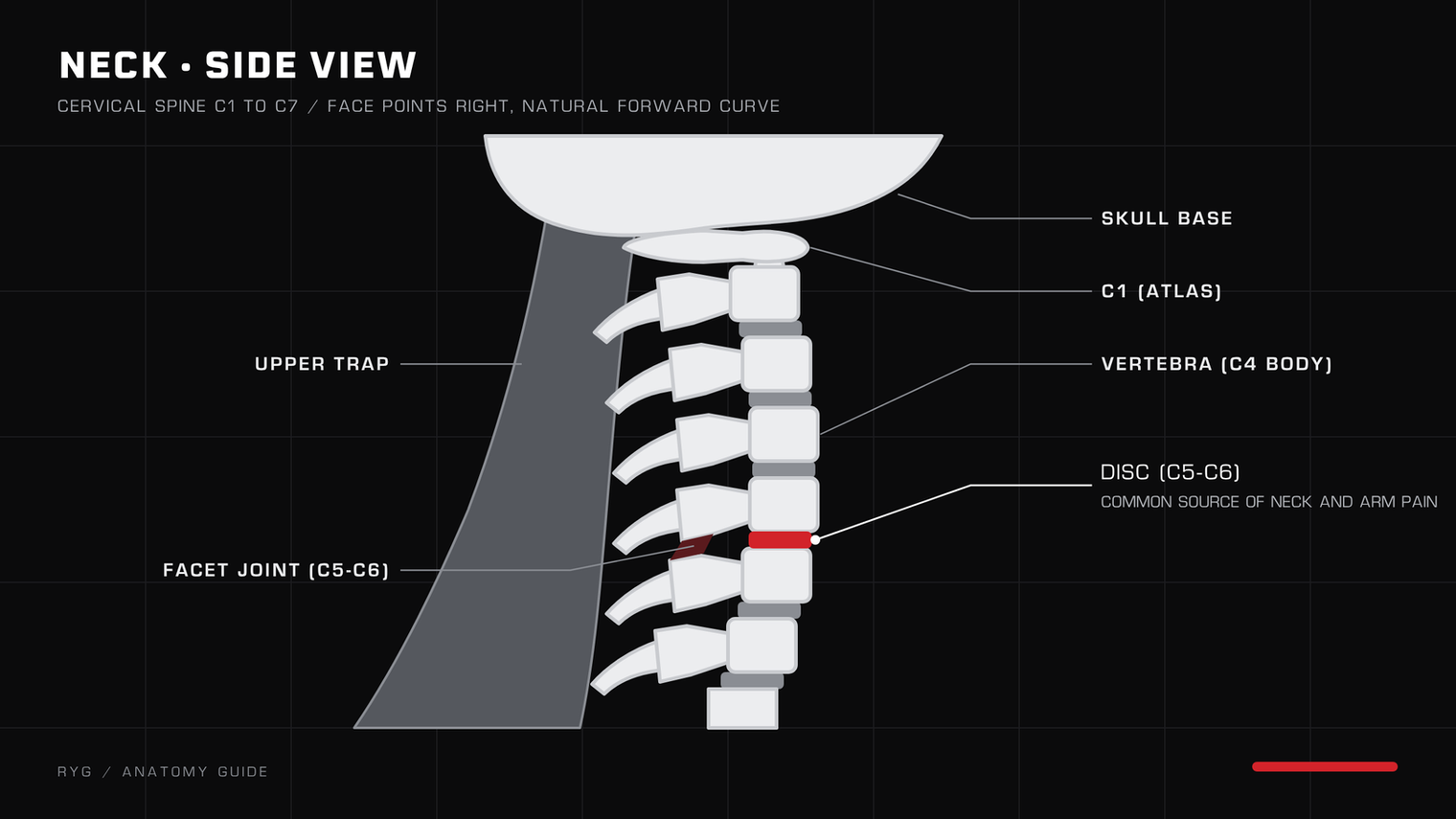
The small joints of the neck are built to glide as you turn and extend. When they get irritated they guard, which feels like stiffness and a blocked turn to one side. The muscles tense up around them and add the ache. In hockey the extension-plus-rotation demand of skating with your head up, the weight of the helmet, and repeated checks all stack load onto those joints and muscles.
The deeper layer is control. The deep neck flexors and the muscles between the shoulder blades stabilize your head during contact. When they are weak, the superficial muscles and the joints take the hits. That is also why neck strength shows up in the concussion research: a neck that resists motion better takes less whip.
Nerve involvement is different. Pain that runs down an arm, numbness, tingling, or weakness in a hand means a nerve root is irritated, usually by a disc or a narrowed opening in the spine, and that deserves a proper evaluation rather than a wait and see approach.
What the research says
- Neck pain is far from rare in athletes: between 38% and 73% have it in a given year depending on the sport, and about half (48%) have had it at some point1.
- For a fresh mechanical neck strain, the JOSPT guideline recommends thoracic manipulation plus neck range-of-motion exercise and shoulder-blade and arm strengthening, not rest2.
- After a whiplash-type injury such as a hard check, the guidance is to return to normal, non-provocative activity as soon as possible, minimize collar use, and expect recovery within 2 to 3 months2.
- Strengthening the neck, shoulder-blade and upper-limb muscles reduced chronic neck pain by a moderate-to-large amount across 27 trials, whereas stretching on its own did nothing measurable3.
- In 6,704 high school athletes, weaker necks predicted concussion, and every 1-pound gain in neck strength lowered the odds of concussion by 5%4. Both a stronger neck and bracing the neck before impact independently reduced how fast the head snapped in athletes aged 8 to 305.
- The hockey picture is less tidy. In 37 youth players wearing instrumented helmets for a season, static neck strength measured preseason did not predict on-ice head accelerations, so the authors suggest neck training for hockey should be dynamic and reaction-based, not just a static number6.
What we do about it
Restore rotation first. Hands-on work to the neck and upper back plus active range of motion drills so checking over your shoulder is easy again. Manual therapy combined with exercise is the guideline-backed approach for both acute and chronic neck pain2.
Build the deep stabilizers. Chin nods, deep neck flexor holds and isometrics in all four directions, progressed in load. In a 12-month trial, neck strength training raised maximal strength by 69% to 110% and reduced pain and disability more than stretching and aerobic exercise alone7.
Strengthen what supports the neck. Rows, lower trap work and thoracic extension so the neck is not doing all the postural work alone.
Make it dynamic. Perturbation drills, bracing on cue, and controlled contact progressions, because the hockey-specific data say reaction and bracing may matter more than a static strength score6. This is the progression we run in the clinic, with a test at every phase before you move on.
When to get it looked at
- Pain, numbness or tingling running into the arm or hand, or weakness in the hand.
- Neck pain after a hit that comes with dizziness, confusion, nausea or vision changes, which needs a concussion evaluation the same day.
- Pain that does not let you turn to one side after a couple of weeks of trying.
- Symptoms in both arms, or any change in walking or balance, which are urgent.
Bottom line
The everyday stiff and sore hockey neck is a load problem, and the research is consistent that movement plus strengthening beats rest and stretching. Nerve signs change the plan and should not be waited out. If your neck has been nagging for more than a couple of weeks, an in-person evaluation can sort which camp you are in and get the right work started.
References
- Noormohammadpour P, Farahbakhsh F, Farahbakhsh F, et al. Prevalence of Neck Pain among Athletes: A Systematic Review. Asian Spine J. 2018;12(6):1146-1153. PubMed
- Blanpied PR, Gross AR, Elliott JM, et al. Neck Pain: Revision 2017 (Clinical Practice Guidelines Linked to the International Classification of Functioning, Disability and Health From the Orthopaedic Section of the American Physical Therapy Association). J Orthop Sports Phys Ther. 2017;47(7):A1-A83. PubMed
- Gross A, Kay TM, Paquin JP, et al. Exercises for mechanical neck disorders. Cochrane Database Syst Rev. 2015;1(1):CD004250. PubMed
- Collins CL, Fletcher EN, Fields SK, et al. Neck strength: a protective factor reducing risk for concussion in high school sports. J Prim Prev. 2014;35(5):309-319. PubMed
- Eckner JT, Oh YK, Joshi MS, et al. Effect of neck muscle strength and anticipatory cervical muscle activation on the kinematic response of the head to impulsive loads. Am J Sports Med. 2014;42(3):566-576. PubMed
- Mihalik JP, Guskiewicz KM, Marshall SW, et al. Does cervical muscle strength in youth ice hockey players affect head impact biomechanics?. Clin J Sport Med. 2011;21(5):416-421. PubMed
- Ylinen J, Takala EP, Nykänen M, et al. Active neck muscle training in the treatment of chronic neck pain in women: a randomized controlled trial. JAMA. 2003;289(19):2509-2516. PubMed
It was such a great time, and with the exercises and stretching, my neck felt a lot better afterward. Will definitely recommend it.
This article is for education and does not replace an evaluation. If you're dealing with an active injury, see a licensed medical provider.