
Wrist Pain in Hockey: Why Your Shot Hurts and What to Do About It
 Hockey
 players will play through almost anything, but wrist pain is sneaky because it attacks the part of the game players care about most, the shot. Snap shots lose their pop, stickhandling feels clumsy, and pushing up off the ice after a fall stings.
Wrist pain in hockey usually comes from one of three places: a fall on an outstretched hand, the repetitive snap of shooting and passing, or a slash that everyone laughed off at the time. Each has a different plan, and one of them has a bone you cannot afford to miss.
What's actually going on
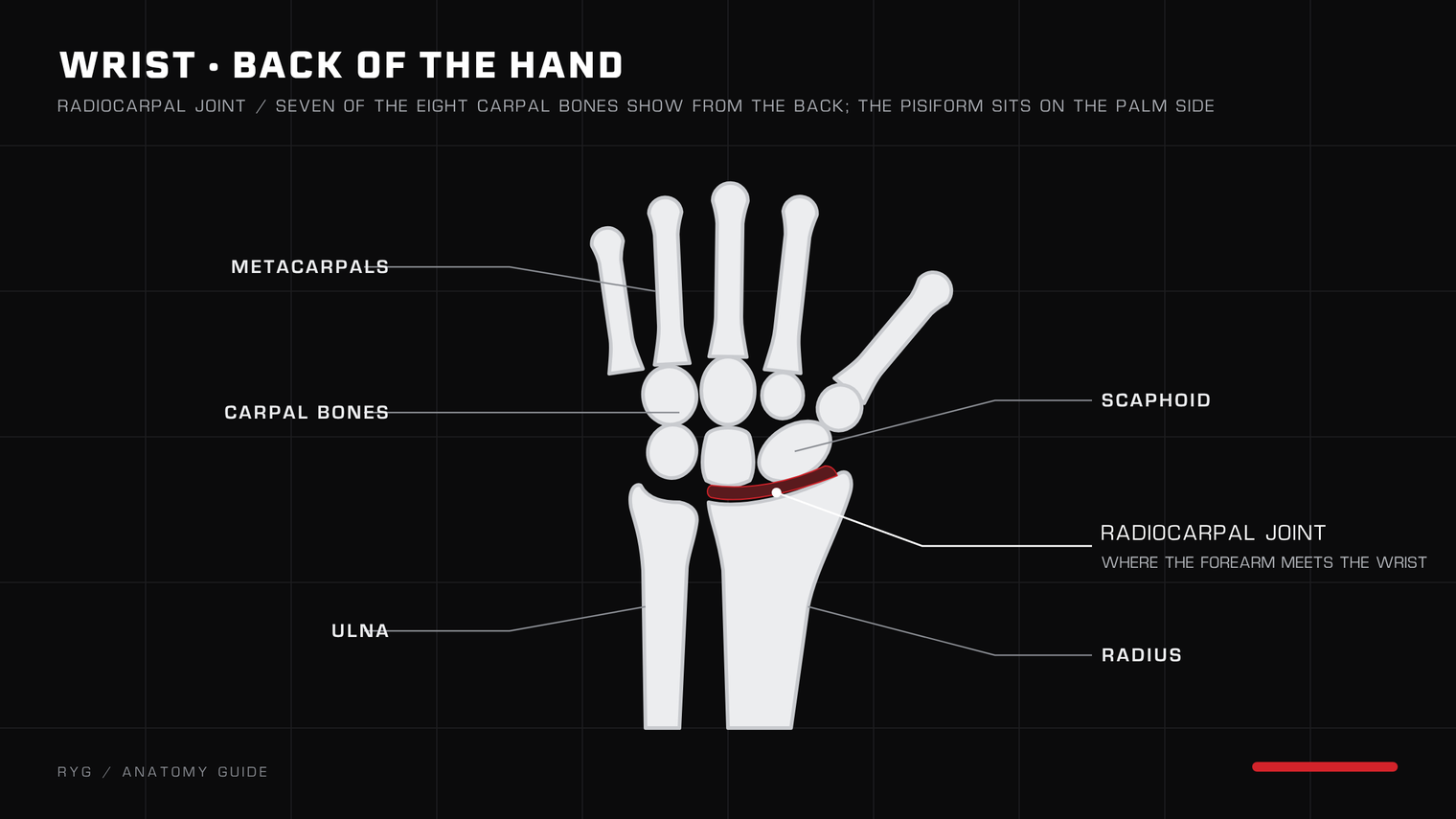
The wrist is a busy intersection. Two forearm bones, eight small carpal bones and a stack of tendons all meet in a space about the width of a watch band. A wrist shot loads this area in a specific way: the wrist cocks back, then snaps forward and rotates through contact with the puck, hundreds of times a week between practices, games and driveway sessions. Tendons that flex and extend the wrist get irritated from that volume, which shows up as an ache along the top or thumb side that warms up during play and complains afterward.
Falls are the other story. Landing on an outstretched hand can sprain wrist ligaments or fracture the scaphoid, a small bone at the base of the thumb known for two things: being broken in falls and being missed on first look. Pinky-side pain after a fall or a hard bottom-hand shot points to the TFCC, the wrist's cartilage cushion, which has its own article.
What the research says
- Hand and wrist injuries make up as much as 25% of all sports injuries, and in professional athletes only about 18% need surgery; average return to play is 2.8 months and most athletes get back to their previous performance1.
- The scaphoid accounts for over 85% of sport-related wrist bone fractures, which is why thumb-side pain after a fall gets an X-ray even when it seems mild2.
- Scaphoid fractures treated in a cast healed in 85% of cases over about 14 weeks, while screw fixation healed 97% in about 10 weeks and got athletes back roughly 2 weeks sooner; playing immediately in a cast carries a significant risk of non-union2.
- In college football, wrist and hand injuries happened 7 times more often in games than in practice, mostly from player contact; 7 in 10 cost no time, but fractures caused the longest absences3.
- Tendons are built for pulling load, not squeezing, and compressive load is a recognized contributor to tendinopathy, which is why a wrist tendon pinned under a glove cuff or a slash gets irritated4.
- The injuries that matter most are the ones that get missed: scaphoid fractures, hook of hamate fractures and wrist ligament injuries are the traumatic wrist problems the literature flags for careful diagnosis before return5.
What we do about it
Rule out the bone first. Any fall with pain in the hollow at the base of the thumb gets imaging before loading. The data on non-union are the reason we do not guess here2.
Calm the tendons. Short-term modification of shot volume and the provoking grip positions, with isometric grip and wrist holds to keep the tissue working without flaring it.
Rebuild through the shooting motion. Progressive wrist flexion, extension and rotation strength, grip work, and weight-bearing tolerance for pushing up off the ice. We load the exact motions the release demands.
Count the shots back. Stickhandling, then half-effort wrist shots, then rising counts, with snap shots and slappers last. Players are often surprised how much velocity they gain when the wrist is actually strong. This is the progression we run in the clinic, with a test at every phase before you move on.
When to get it looked at
- Pain in the hollow at the base of the thumb after a fall, even if it seems mild. Get an X-ray.
- Any visible deformity, or swelling that does not settle within a few days.
- Clicking, catching or a sense of the wrist giving way under load.
- Pain on the pinky side that flares every time you shoot, which may be a TFCC injury.
- Numbness or tingling in the fingers.
Bottom line
Most hockey wrist pain is tendon overload that responds to a short calm-down and progressive loading through the shot. The exception is the fall on an outstretched hand, where a missed scaphoid fracture can cause problems for years. An in-person evaluation can help you decide whether you need an X-ray first and what to do while you wait.
References
- Lehman JD, Krishnan KR, Stepan JG, et al. Prevalence and Treatment Outcomes of Hand and Wrist Injuries in Professional Athletes: A Systematic Review. HSS J. 2020;16(3):280-287. PubMed
- Goffin JS, Liao Q, Robertson GA. Return to sport following scaphoid fractures: A systematic review and meta-analysis. World J Orthop. 2019;10(2):101-114. PubMed
- Bartels DW, Hevesi M, Wyles C, et al. Epidemiology of Hand and Wrist Injuries in NCAA Men's Football: 2009-2010 to 2013-2014. Orthop J Sports Med. 2019;7(4):2325967119835375. PubMed
- Cook JL, Purdam C. Is compressive load a factor in the development of tendinopathy?. Br J Sports Med. 2012;46(3):163-168. PubMed
- Rettig AC. Athletic injuries of the wrist and hand. Part I: traumatic injuries of the wrist. Am J Sports Med. 2003;31(6):1038-1048. PubMed
Alex is very approachable and makes you feel comfortable. Wrote me a program to rehab my broken wrist that I had surgery on. You can tell he truly cares and takes his profession seriously.
This article is for education and does not replace an evaluation. If you're dealing with an active injury, see a licensed medical provider.