
Year-Round Hockey Is Breaking Young Players: A Workload Reality Check for Parents
 Hockey
Twenty years ago hockey season ended and kids played something else until fall. Now there is winter season, spring league, summer skills camps and fall tryout prep, and for a lot of families the ice never closes. The intention is good: more development, keeping up with peers. The biology disagrees.
Overuse injuries in youth hockey, hip and groin problems, low back stress issues and tendon complaints, climb alongside the year-round calendar, and the research keeps landing on the same conclusion. Young athletes who skip recovery periods get hurt more, not less.
What's actually going on
Tissue grows stronger through a cycle of stress and recovery, and growing bodies have an extra vulnerability: growth plates and developing tendons that handle repetitive one-pattern loading poorly. Skating is a highly repetitive, asymmetric, flexed-posture activity, and doing it twelve months a year means the same tissues get loaded the same way without a season for the system to rebalance.
It also means the muscles skating never trains, and the movement skills other sports build, sprinting, jumping, throwing, overhead work, never develop. Even the shape of the hip joint is being set by the sport during the adolescent growth window. The players who take a real off-season and play other sports tend to arrive at camp healthier and more athletic.
What the research says
- Between 46% and 54% of all youth sports injuries are overuse injuries, not acute ones, and high school athletes who played a sport year-round reported 42% more overuse injuries than those who played three seasons or fewer1.
- A young athlete who spends more hours per week in organized sport than their age in years has about twice the odds of a serious overuse injury, and kids whose organized sport time outweighs free play by more than 2 to 1 have 1.9 times the odds2.
- Among 1,544 Wisconsin high school athletes, high competition volume doubled the odds of a prior lower-extremity injury and playing club sports raised it 1.5 times; highly specialized athletes were 1.85 times more likely to suffer a lower-extremity injury over a year3,4.
- Growth spurts do not explain the injury gap: injured and uninjured young athletes grew at the same rate, but injured athletes logged more hours of organized sport5.
- Cam morphology in the hip, the bone shape behind hockey's impingement problem, develops fastest between ages 12 and 14, and athletes competing at a national level had alpha angles 7.7 degrees higher than kids who play no sport, a dose-response relationship6.
- Fewer than 1 in 5 former NCAA athletes specialized before age 15, early specializers were no more likely to earn a scholarship, and they burned out at a higher rate; the AOSSM consensus states that playing multiple sports will not hold an athlete back from long-term success7,8. Well-designed resistance training can cut overuse injuries in children and adolescents by roughly half9.
What we do about it
Build the calendar on the numbers. Organized sport hours per week at or below the child's age in years, free play time that is not outweighed by organized time, and a real break from hockey each year, which is what the risk data point to2,1.
Spring is for a different sport. Multi-sport play builds the skills skating skips and is not a competitive disadvantage in the college data7.
Summer holds strength, not just skills. For teenagers a supervised strength program is the single best injury insurance in the sport, endorsed by pediatric and strength bodies alike9.
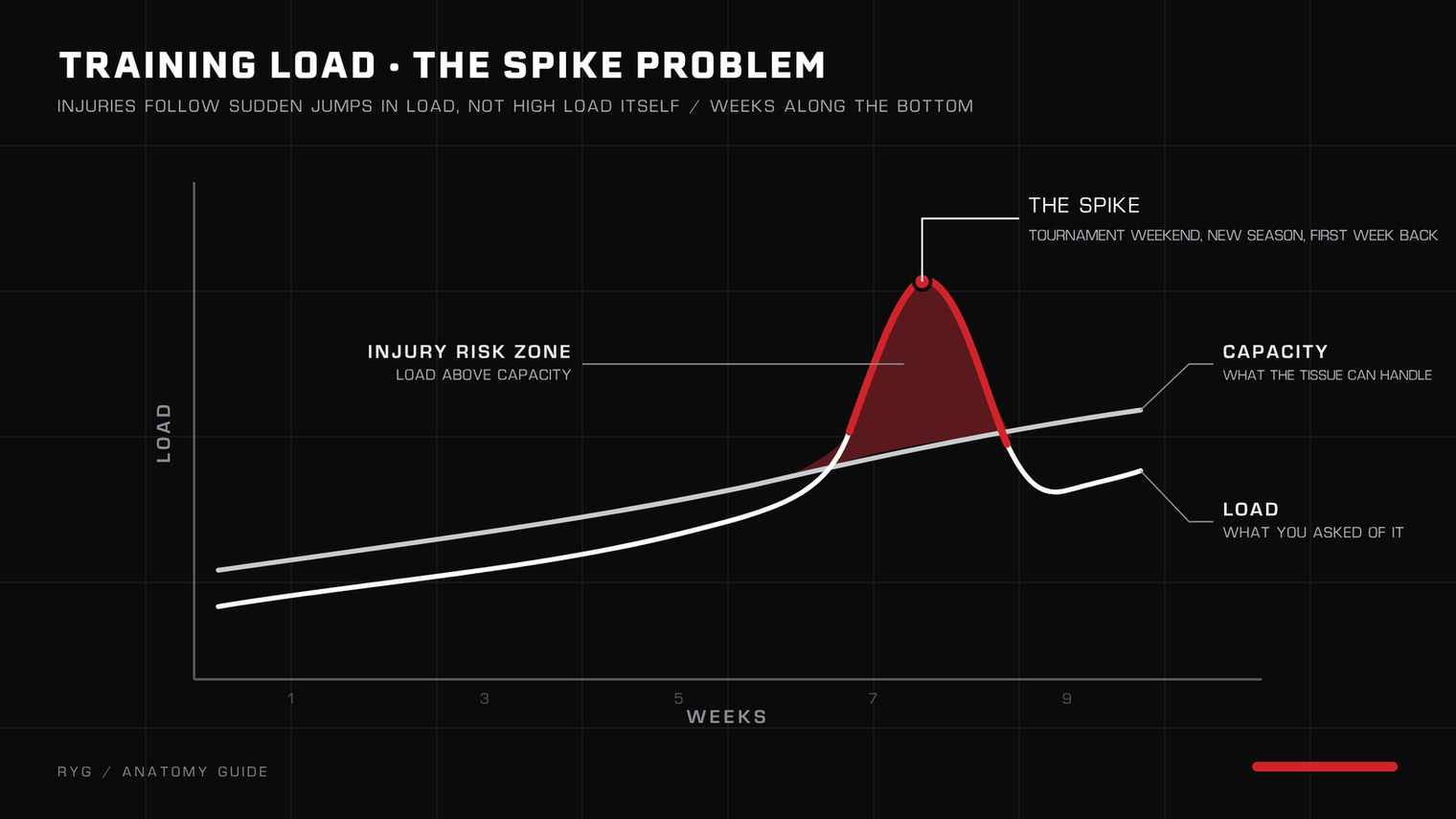
Watch the spikes and the mood. Daily spikes in training load roughly doubled next-day injury odds in adolescent athletes, and worse mood was an independent predictor, so tryout weeks and tournament stacks need a plan10. This is the progression we run in the clinic, with a test at every phase before you move on.
When to get it looked at
- Any pain that has lasted more than two weeks in a growing athlete, especially hip, groin or low back pain that is worse with arching.
- A second overuse injury in the same season.
- Declining performance, persistent fatigue, trouble sleeping or a kid who has stopped enjoying the sport, which are the signs of overtraining and burnout11.
- Pain at a growth plate site, the heel, the bump below the kneecap, or the front of the hip, which has its own plan.
Bottom line
Parents ask whether their kid will fall behind with a real off-season. The research runs the other way: year-round play raises overuse injury odds, early specialization does not improve the odds of a scholarship, and the rested, stronger player tends to pass the one nursing a third groin strain by November. If you want help building a season plan, an in-person evaluation maps a healthy calendar by age.
References
- DiFiori JP, Benjamin HJ, Brenner J, et al. Overuse injuries and burnout in youth sports: a position statement from the American Medical Society for Sports Medicine. Clin J Sport Med. 2014;24(1):3-20. PubMed
- Jayanthi NA, LaBella CR, Fischer D, et al. Sports-specialized intensive training and the risk of injury in young athletes: a clinical case-control study. Am J Sports Med. 2015;43(4):794-801. PubMed
- Post EG, Bell DR, Trigsted SM, et al. Association of Competition Volume, Club Sports, and Sport Specialization With Sex and Lower Extremity Injury History in High School Athletes. Sports Health. 2017;9(6):518-523. PubMed
- McGuine TA, Post EG, Hetzel SJ, et al. A Prospective Study on the Effect of Sport Specialization on Lower Extremity Injury Rates in High School Athletes. Am J Sports Med. 2017;45(12):2706-2712. PubMed
- Jayanthi NA, LaBella CR, Fischer D, et al. Sports-specialized intensive training and the risk of injury in young athletes: a clinical case-control study. Am J Sports Med. 2015;43(4):794-801. PubMed
- Palmer A, Fernquest S, Gimpel M, et al. Physical activity during adolescence and the development of cam morphology: a cross-sectional cohort study of 210 individuals. Br J Sports Med. 2018;52(9):601-610. PubMed
- Rugg CM, Coughlan MJ, Li JN, et al. Early Sport Specialization Among Former National Collegiate Athletic Association Athletes: Trends, Scholarship Attainment, Injury, and Attrition. Am J Sports Med. 2021;49(4):1049-1058. PubMed
- LaPrade RF, Agel J, Baker J, et al. AOSSM Early Sport Specialization Consensus Statement. Orthop J Sports Med. 2016;4(4):2325967116644241. PubMed
- Lloyd RS, Faigenbaum AD, Stone MH, et al. Position statement on youth resistance training: the 2014 International Consensus. Br J Sports Med. 2014;48(7):498-505. PubMed
- Watson A, Brickson S, Brooks A, et al. Subjective well-being and training load predict in-season injury and illness risk in female youth soccer players. Br J Sports Med. 2017;51(3):194-199. PubMed
- Brenner JS, Watson A, Council on Sports Medicine and Fitness. Overuse Injuries, Overtraining, and Burnout in Young Athletes. Pediatrics. 2024;153(2):e2023065129. PubMed
This article is for education and does not replace an evaluation. If you're dealing with an active injury, see a licensed medical provider.