
Ankle and Foot Prehab for Lacrosse: Ten Minutes a Week That Prevents the Most Common Injuries
 Lacrosse
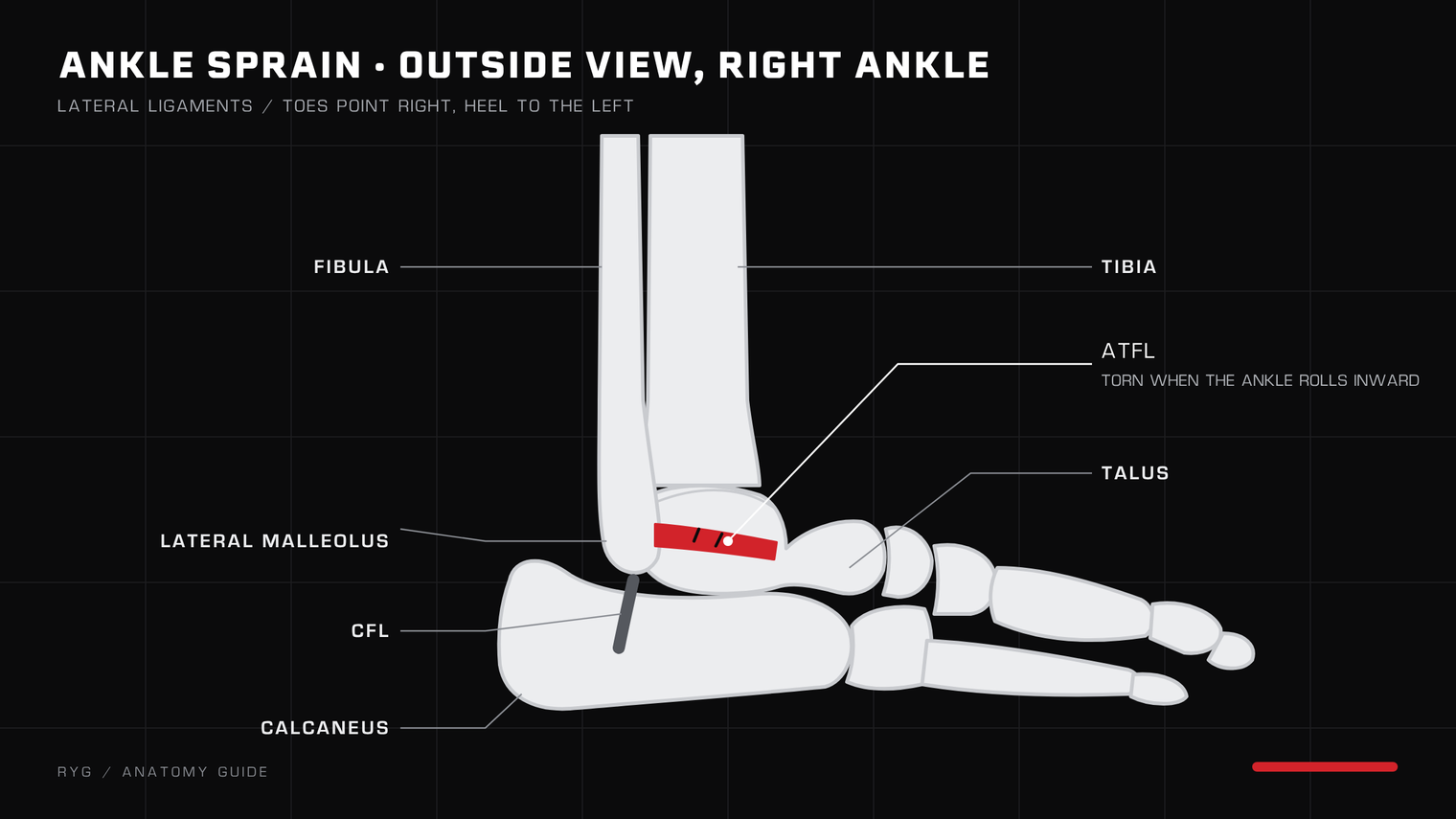
Here is an unglamorous fact about lacrosse injuries. The ankle and foot account for a huge share of lost practice time, and they are also the region where prevention evidence is strongest. The most common injury in the sport is also one of the most preventable, for the price of about ten focused minutes a few times per week.
What's actually going on
Ankle sprains happen in the fraction of a second when the foot lands slightly wrong and the muscles fail to correct in time. Prevention training targets exactly that gap. Balance work sharpens the position sense that detects a bad landing early. Strength work in the calf and the peroneal muscles along the outer shin gives the correction muscles the horsepower to act. Landing and hopping drills rehearse the correction at game speed until it becomes reflex. You are not building armor. You are shortening reaction time.
What the research says
- Across 16 years of NCAA data, more than half of all injuries were to the lower extremity and ankle sprains alone made up 15%, the single most common injury in college sport1. Female athletes sprain ankles at roughly twice the rate of males2.
- An 8-week home-based balance program cut re-sprains from 33% to 22% over a year in 522 athletes, a 35% reduction, and recurrent sprains that cost sports time fell even more; the benefit was greatest in athletes whose original sprain had not been medically treated3.
- Across 46 systematic reviews, bracing had strong evidence and neuromuscular training moderate evidence for preventing a repeat ankle sprain4.
- In a randomized trial of 1,460 high school basketball players, lace-up ankle braces cut acute ankle injury rates from 1.41 to 0.47 per 1,000 exposures, in players with and without a previous sprain, though they reduced how often injuries happened rather than how severe they were5.
- Team-wide warm-ups work beyond the ankle: in a randomized trial of 61 college men's soccer teams, the 15-minute FIFA 11+ warm-up cut injury rates by 46% and days lost to injury by 29%6.
- Across randomized trials in 7,738 athletes, strength training cut sports injuries by about two thirds, and every 10% increase in strength training volume reduced injury risk by more than 4 percentage points7.
- A sprain leaves a trail: being unable to do a single-leg drop landing or a drop jump 2 weeks after a first sprain predicts who will go on to chronic ankle instability8.
What we do about it
Balance while busy. Single-leg balance while playing catch with a partner, which trains the foot while the brain is occupied, exactly like a game. This is the piece with the clearest prevention evidence3.
Land and hold. Lateral hops with a stick in hand, landing quietly and holding each landing for two counts, then reactive hops on a cue.
Strengthen the correction muscles. Heavy calf raises, both straight and bent knee, and banded work for the outer shin, inside a strength program the team keeps all year7.
Brace the ones with history. A lace-up brace for practices in athletes who have sprained before, alongside the training rather than instead of it5,4. Done as part of warm-ups, it costs nothing and the whole roster benefits6. This is the progression we run in the clinic, with a test at every phase before you move on.
When to get it looked at
- An ankle that has been sprained before and never rehabbed. A previous sprain is the biggest risk factor for the next one, and the untreated group gained the most from training3.
- A player who cannot hold a single-leg landing or hop cleanly on one side8.
- Recurring rolls on routine cuts, which is chronic instability and needs more than a warm-up.
- Foot or arch pain that shows up with the start of every season.
Bottom line
The evidence for ankle prevention is unusually strong: balance training cuts re-sprains by a third, braces cut injuries in players with history, and team warm-ups reduce injuries across the roster. Ten minutes a few times a week is the whole cost. An in-person evaluation gives you a printable version to bring to practice.
References
- Hootman JM, Dick R, Agel J. Epidemiology of collegiate injuries for 15 sports: summary and recommendations for injury prevention initiatives. J Athl Train. 2007;42(2):311-319. PubMed
- Doherty C, Delahunt E, Caulfield B, et al. The incidence and prevalence of ankle sprain injury: a systematic review and meta-analysis of prospective epidemiological studies. Sports Med. 2014;44(1):123-140. PubMed
- Hupperets MD, Verhagen EA, van Mechelen W. Effect of unsupervised home based proprioceptive training on recurrences of ankle sprain: randomised controlled trial. BMJ. 2009;339:b2684. PubMed
- Doherty C, Bleakley C, Delahunt E, et al. Treatment and prevention of acute and recurrent ankle sprain: an overview of systematic reviews with meta-analysis. Br J Sports Med. 2017;51(2):113-125. PubMed
- McGuine TA, Brooks A, Hetzel S. The effect of lace-up ankle braces on injury rates in high school basketball players. Am J Sports Med. 2011;39(9):1840-1848. PubMed
- Silvers-Granelli H, Mandelbaum B, Adeniji O, et al. Efficacy of the FIFA 11+ Injury Prevention Program in the Collegiate Male Soccer Player. Am J Sports Med. 2015;43(11):2628-2637. PubMed
- Lauersen JB, Andersen TE, Andersen LB. Strength training as superior, dose-dependent and safe prevention of acute and overuse sports injuries: a systematic review, qualitative analysis and meta-analysis. Br J Sports Med. 2018;52(24):1557-1563. PubMed
- Doherty C, Bleakley C, Hertel J, et al. Recovery From a First-Time Lateral Ankle Sprain and the Predictors of Chronic Ankle Instability: A Prospective Cohort Analysis. Am J Sports Med. 2016;44(4):995-1003. PubMed
Our son broke his ankle in a hockey game. With his goal of being ready for spring TO’s we were on the hunt for a PT that knew the game and expectations of a hockey player. We were referred to Alex by a coach.
After meeting with/ Alex our son , wife and I were 100% this is the right guy to help our son. Alex put multiple pt plans together along with on ice plans to reintroduce skating. Most of all our son trusts and listens to Alex about the recovery process. Our son is ahead of schedule!
Pretty much the best experience we’ve ever had with a doctor.
Thank you
Lessner’s
Had an amazing time this summer rehabbing my ankle with Dr. Shuchuk. He is very knowledgeable in any area of PT and always willing and able to help any ailment you have! I thought my ankle could never be fixed, but after getting on a plan and staying consistent I have regained my game!
Thanks Shu
This article is for education and does not replace an evaluation. If you're dealing with an active injury, see a licensed medical provider.