
High Hamstring Strain in Lacrosse: The Sit Bone Pain That Sprinting Keeps Reopening
 Lacrosse
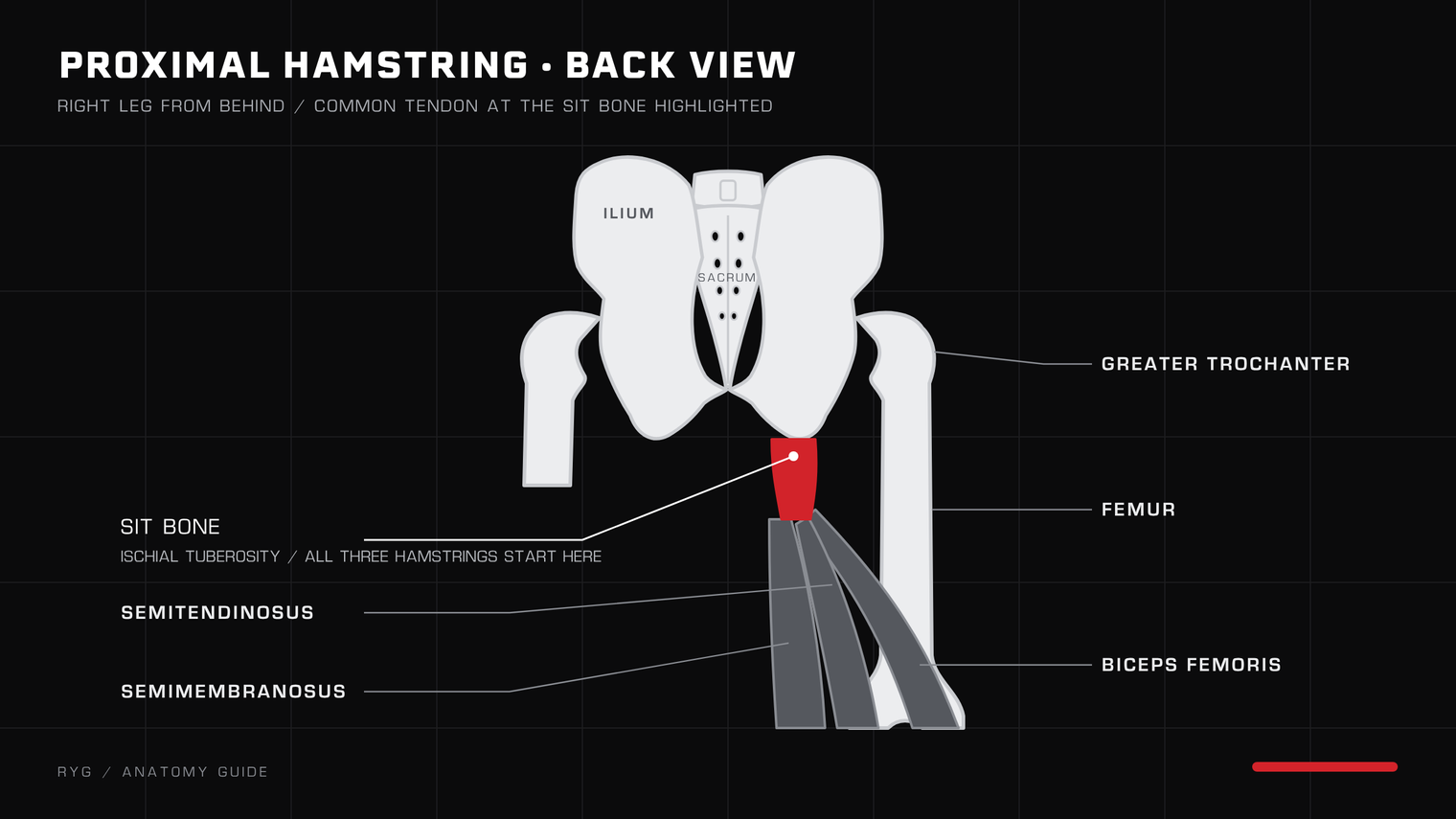
Hamstring strains come in two flavors, and the location changes everything. A strain in the meaty middle of the muscle usually heals in a few weeks. A strain up high, right where the hamstring tendons attach to the sit bone, is a different animal. This proximal version causes a deep ache just below the buttock, hurts with sitting on hard bleachers and car seats, and has a well-earned reputation for lingering months when it is managed casually.
What's actually going on
High hamstring injuries happen when the muscle is stretched to near maximum while contracting hard, exactly what occurs in the late swing phase of a full sprint, when the leg reaches out in front and the hamstring slams the brakes on the swinging shin. Lacrosse middies and transition defenders live at these speeds. The injury site is mostly tendon rather than muscle belly, and tendon heals on a slower timeline, which is why the two-week rest that fixes a mild mid-belly strain barely dents this one.
Two management mistakes keep it alive: aggressive early stretching, which pulls directly on the healing tendon where it is compressed against the sit bone, and returning to sprinting based on jogging comfort.
What the research says
- Proximal hamstring tendinopathy shows up as deep buttock pain right at the sit bone; it is common in sprinters, distance runners and field-sport athletes, and pain and dysfunction are often long-standing1,2.
- Three simple exam tests are highly reliable between examiners and moderately to highly valid for chronic proximal hamstring tendinopathy in athletes3. MRI findings at the hamstring origin are common in people with no symptoms, with 52% showing changes on both sides, so a scan has to be matched to the exam4.
- There are no randomized trials of rehab exercise specifically for this condition; treatment is built on the progressive loading principles proven in Achilles and patellar tendinopathy, and a systematic review found insufficient evidence to recommend any single treatment over another1,2.
- In 40 professional athletes, 4 weeks of shockwave therapy gave at least 50% pain relief in 85% at 3 months, versus 10% with anti-inflammatories plus standard physiotherapy5.
- When conservative care fails, surgical release returned 80 of 90 athletes to their previous level of sport at an average of 5 months, and biopsies showed degeneration rather than inflammation, which fits an overuse tendon problem rather than an acute itis6.
- For acute hamstring strains, rehab that emphasizes lengthening exercises got elite soccer players back to full training in 28 days versus 51 with conventional exercises7, and having had a hamstring strain before raises the risk of another 2.7 times8.
What we do about it
Confirm it by exam. The bent-knee stretch tests and sit-bone palpation, with the spine cleared, because sit-bone pain with sciatica-like symptoms can be proximal hamstring syndrome pinching the nerve3,9.
Stop compressing it. Trim deep stretching and long sitting on hard surfaces early, and use isometric holds to settle pain while keeping the tendon loaded.
Then load it heavy and long. Romanian deadlifts, hip thrusts and eventually exercises that strengthen the hamstring in long positions, following the tendinopathy playbook the literature points to1, with lengthening-biased work because it speeds return in acute strains7.
Rebuild speed in measured steps. A true sprint progression over weeks, not a jog-then-go, and shockwave as an add-on for stubborn cases5. This is the progression we run in the clinic, with a test at every phase before you move on.
When to get it looked at
- A pop at the sit bone with bruising and difficulty walking, which can mean a tendon avulsion that needs imaging promptly.
- Sit-bone pain with numbness or tingling down the leg9.
- Pain that has not improved after three months of structured loading, where other options come into play5,6.
- A deep buttock ache in a young teen that limits sitting and running, which can involve the growth plate at the sit bone.
Bottom line
High hamstring pain is a tendon problem living at the sit bone, and it answers to patient loading rather than stretching or rest. The evidence base is thinner than for other tendons, so we borrow the proven playbook and progress by test, not by calendar. An in-person evaluation shows what being ready actually requires.
References
- Goom TS, Malliaras P, Reiman MP, et al. Proximal Hamstring Tendinopathy: Clinical Aspects of Assessment and Management. J Orthop Sports Phys Ther. 2016;46(6):483-493. PubMed
- Nasser AM, Vicenzino B, Grimaldi A, et al. Proximal Hamstring Tendinopathy: A Systematic Review of Interventions. Int J Sports Phys Ther. 2021;16(2):288-305. PubMed
- Cacchio A, Borra F, Severini G, et al. Reliability and validity of three pain provocation tests used for the diagnosis of chronic proximal hamstring tendinopathy. Br J Sports Med. 2012;46(12):883-887. PubMed
- Thompson SM, Fung S, Wood DG. The prevalence of proximal hamstring pathology on MRI in the asymptomatic population. Knee Surg Sports Traumatol Arthrosc. 2017;25(1):108-111. PubMed
- Cacchio A, Rompe JD, Furia JP, et al. Shockwave therapy for the treatment of chronic proximal hamstring tendinopathy in professional athletes. Am J Sports Med. 2011;39(1):146-153. PubMed
- Lempainen L, Sarimo J, Mattila K, et al. Proximal hamstring tendinopathy: results of surgical management and histopathologic findings. Am J Sports Med. 2009;37(4):727-734. PubMed
- Askling CM, Tengvar M, Thorstensson A. Acute hamstring injuries in Swedish elite football: a prospective randomised controlled clinical trial comparing two rehabilitation protocols. Br J Sports Med. 2013;47(15):953-959. PubMed
- Green B, Bourne MN, van Dyk N, et al. Recalibrating the risk of hamstring strain injury (HSI): A 2020 systematic review and meta-analysis of risk factors for index and recurrent hamstring strain injury in sport. Br J Sports Med. 2020;54(18):1081-1088. PubMed
- Park JW, Lee YK, Lee YJ, et al. Deep gluteal syndrome as a cause of posterior hip pain and sciatica-like pain. Bone Joint J. 2020;102-B(5):556-567. PubMed
Alex did a great job helping me with my hamstring. You can tell Alex really cares about the athletes he’s working with and really takes into consideration the athletes goals/interests while also making sure the athlete makes the best decision in the long run. He helped me get back to playing in no time with exercises and stretches that made a huge differences. Once I was back playing he would check up over the phone or in person almost daily to make sure everything was going well, along with updating my pt plan so I could continue to make progress. I really thank Alex for what he’s done for me.
Alex has been Amazing! He initially assisted me with the rehabilitation of my hamstring and getting it back to 100%. He diagnosed the issue, and set me up on a path to get it back to full strength. Additionally, when other minor things came up, he’s been fantastic in giving insight and direction. He’s very knowledgeable, willing to accommodate scheduling asap, and an overall super individual. I highly recommend anyone who is an athlete or not and needs PT to go and see Alex! You will very glad you did!
This article is for education and does not replace an evaluation. If you're dealing with an active injury, see a licensed medical provider.