
The Year Round Lacrosse Problem: How Spring Plus Club Seasons Quietly Overload Young Bodies
 Lacrosse
Twenty years ago lacrosse ended in May. Today the spring school season flows into summer club, which flows into fall tournaments, winter box or indoor training, and January recruiting showcases. Many committed players never take six consecutive weeks off. As sports PTs, we can tell you where that calendar shows up: in tendons, growth plates and stress injuries that used to be rare in this sport, arriving in kids who did nothing wrong except say yes to everything.
What's actually going on
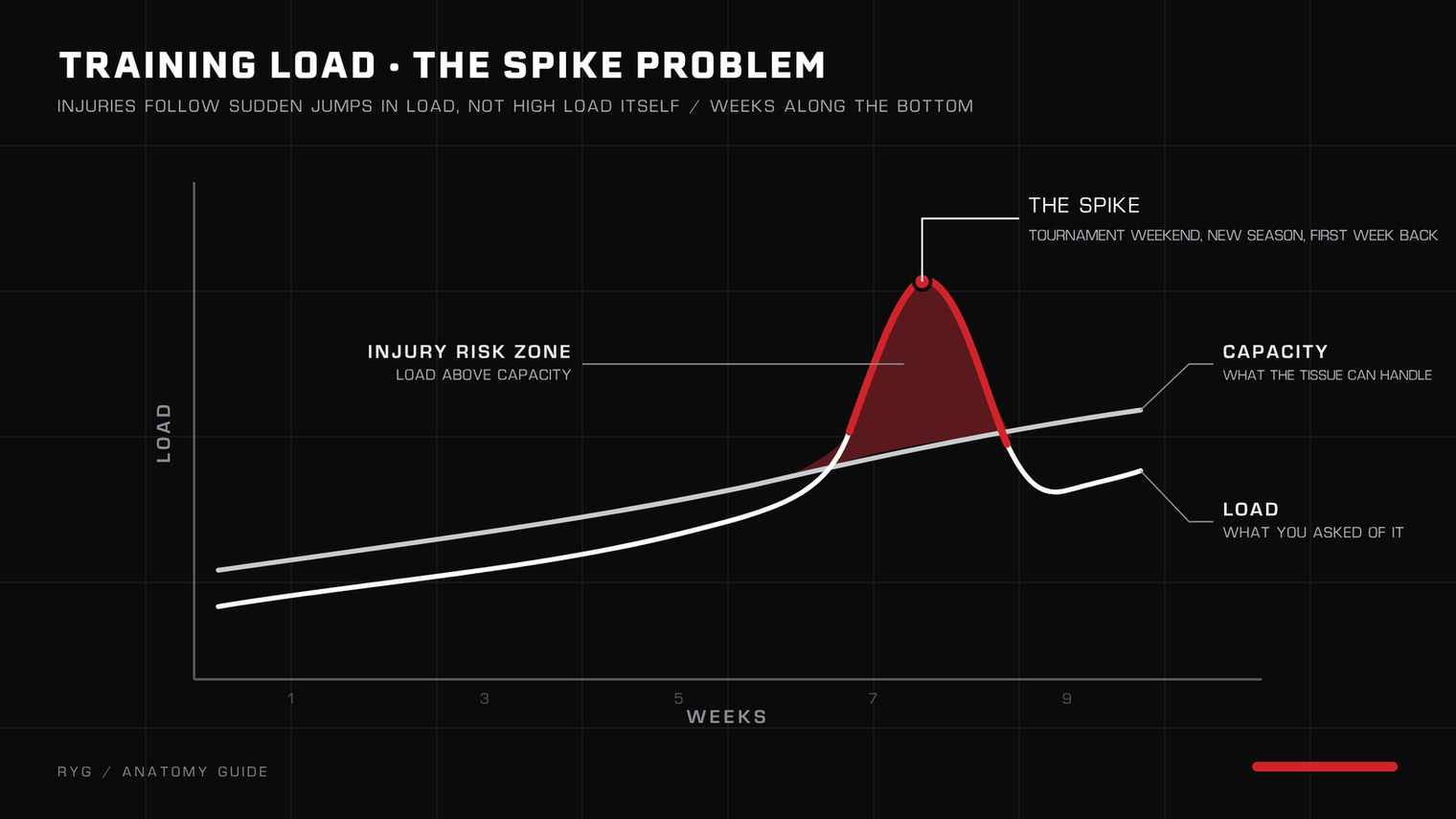
The mechanism is the mismatch between how fast schedules change and how fast tissue adapts. Bone, tendon and muscle strengthen in response to load, but on a timescale of weeks to months, and only with recovery in between. The danger is not high workload itself. It is the spike: tripling sprint and shooting volume in a single week when club season starts, or playing five games in a weekend after a light month. Growing athletes carry extra risk because growth plates and growing tendons are the weak links in the chain.
What the research says
- Between 46% and 54% of all youth sports injuries are overuse injuries, not acute ones. High school athletes who played a sport year-round reported 42% more overuse injuries than those who played three seasons or fewer, and training more than 16 hours per week was linked to higher injury risk1.
- A young athlete who spends more hours per week in organized sport than their age in years has about twice the odds of a serious overuse injury, and kids whose organized sport time outweighs free play by more than 2 to 1 have 1.9 times the odds2.
- Among 1,544 Wisconsin high school athletes, high competition volume doubled the odds of a prior lower-extremity injury, playing club sports raised it 1.5 times, and high specialization raised it 2.6 times3.
- Highly specialized young athletes have 1.8 times the risk of an overuse injury compared with kids who play multiple sports, and even moderate specialization raises risk 1.4-fold4. Playing one sport more than 8 months of the year is the working definition of specialization5.
- Spikes matter day to day: in adolescent soccer players, a jump in that day's training load roughly doubled the odds of injury, and worse mood that day was an independent predictor as well6. Non-contact injuries are rarely caused by training itself; they are caused by excessive, rapid increases in load, and athletes used to high training loads actually get injured less7.
- The specialization payoff is thin. Fewer than 1 in 5 former NCAA athletes specialized before age 15, early specializers were no more likely to earn a scholarship, and they burned out at a higher rate8. The AOSSM consensus states that playing multiple sports will not hold an athlete back from long-term competitive success9.
What we do about it
Ramp, do not spike. Build into each new season over two to three weeks of rising sprint and shooting volume instead of two days, because the spike is what the data blame7,6.
Use the hours-per-age rule. A 13 year old doing more than 13 hours a week of organized sport has crossed the line the research drew, and free play should not be crowded out2.
Schedule rest on purpose. The position statement on overuse recommends limiting weekly and yearly participation and scheduling rest periods tailored to the sport and the athlete's age1. For a lacrosse family that means a protected rest day weekly, recovery days after tournament weekends, and one true offseason block.
Watch for the whispers. Morning stiffness, aches that outlast warm-ups and slipping performance are the early signals, and overtraining lowers performance and raises illness risk before the injury shows up10. We help families build a season plan around the athlete instead of the other way around.
When to get it looked at
- Pain that is present during warm-ups and lasts into the next day, for more than two weeks.
- Back pain with arching or shooting in a 10 to 18 year old, or heel, knee or hip pain near a growth plate.
- A noticeable drop in speed or shot velocity alongside fatigue, poor sleep or mood changes, which is the overtraining pattern10.
- Any injury that keeps recurring at the start of each new season.
Bottom line
None of this requires quitting club. It requires managing the calendar like the training variable it is, because the research consistently blames the spike and the year-round single-sport schedule, not lacrosse itself. Ramp in, rest on purpose, and keep an eye on the early signals. An in-person evaluation makes the calendar conversation concrete.
References
- DiFiori JP, Benjamin HJ, Brenner J, et al. Overuse injuries and burnout in youth sports: a position statement from the American Medical Society for Sports Medicine. Clin J Sport Med. 2014;24(1):3-20. PubMed
- Jayanthi NA, LaBella CR, Fischer D, et al. Sports-specialized intensive training and the risk of injury in young athletes: a clinical case-control study. Am J Sports Med. 2015;43(4):794-801. PubMed
- Post EG, Bell DR, Trigsted SM, et al. Association of Competition Volume, Club Sports, and Sport Specialization With Sex and Lower Extremity Injury History in High School Athletes. Sports Health. 2017;9(6):518-523. PubMed
- Bell DR, Post EG, Biese K, et al. Sport Specialization and Risk of Overuse Injuries: A Systematic Review With Meta-analysis. Pediatrics. 2018;142(3):e20180657. PubMed
- Myer GD, Jayanthi N, DiFiori JP, et al. Sport Specialization, Part I: Does Early Sports Specialization Increase Negative Outcomes and Reduce the Opportunity for Success in Young Athletes?. Sports Health. 2015;7(5):437-442. PubMed
- Watson A, Brickson S, Brooks A, et al. Subjective well-being and training load predict in-season injury and illness risk in female youth soccer players. Br J Sports Med. 2017;51(3):194-199. PubMed
- Gabbett TJ. The training-injury prevention paradox: should athletes be training smarter and harder?. Br J Sports Med. 2016;50(5):273-280. PubMed
- Rugg CM, Coughlan MJ, Li JN, et al. Early Sport Specialization Among Former National Collegiate Athletic Association Athletes: Trends, Scholarship Attainment, Injury, and Attrition. Am J Sports Med. 2021;49(4):1049-1058. PubMed
- LaPrade RF, Agel J, Baker J, et al. AOSSM Early Sport Specialization Consensus Statement. Orthop J Sports Med. 2016;4(4):2325967116644241. PubMed
- Brenner JS, Watson A, Council on Sports Medicine and Fitness. Overuse Injuries, Overtraining, and Burnout in Young Athletes. Pediatrics. 2024;153(2):e2023065129. PubMed
This article is for education and does not replace an evaluation. If you're dealing with an active injury, see a licensed medical provider.