
Sit Bone Pain in Runners: The High Hamstring Problem That Hates Sitting and Hills
 Track & Running
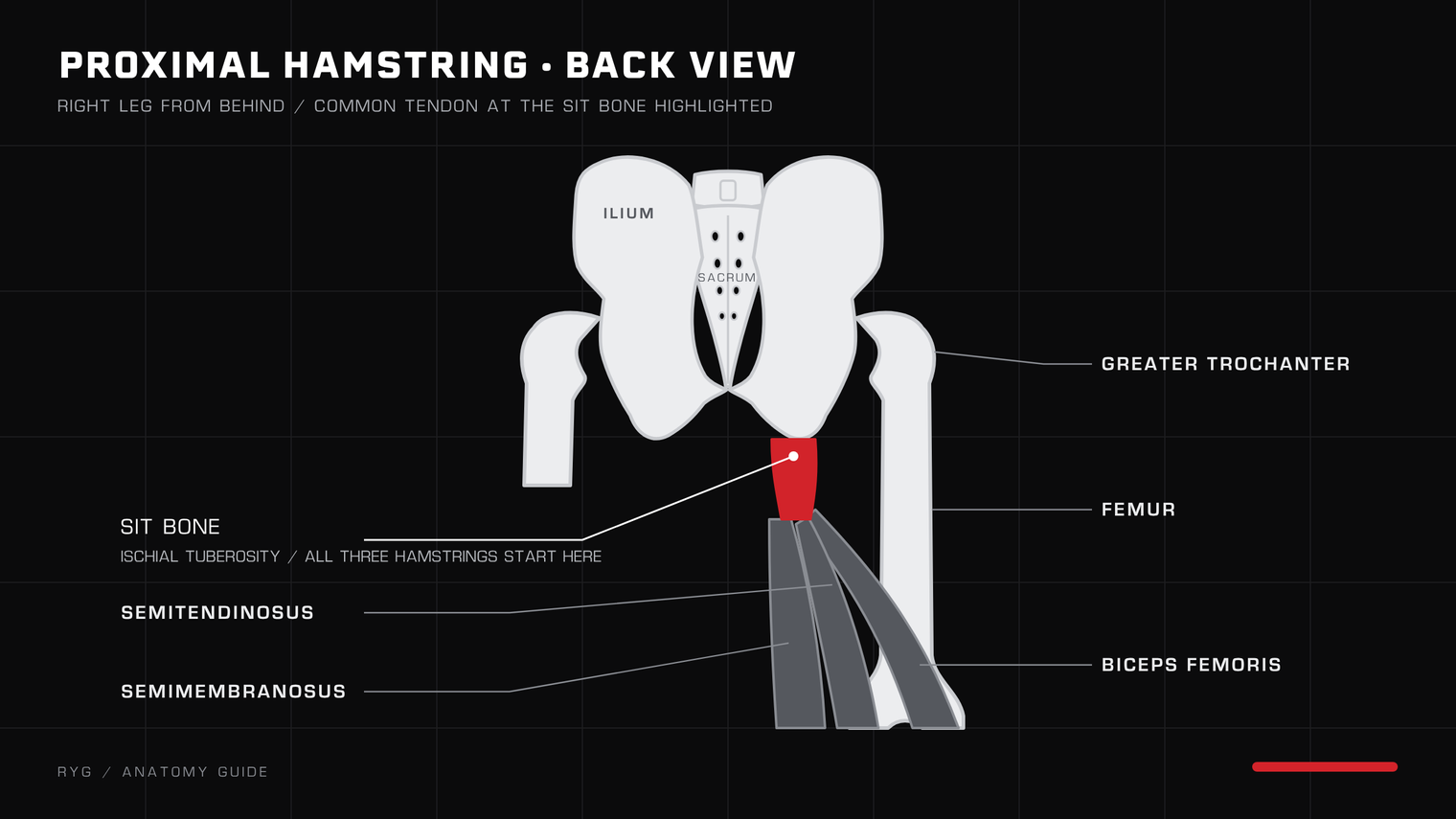
There is a very specific kind of pain that distance runners describe with remarkable consistency. It sits right on the sit bone, the bony point you feel when you sit on a hard surface. It aches during long drives and desk days, flares with hill repeats and faster running, and often started sometime after a block of speed work or a new hill route. That is proximal hamstring tendinopathy, an irritated tendon where your hamstrings anchor to your pelvis, and it has a well-earned reputation for lingering when it is managed wrong.
The runner we see most often has had it for over a year and has already tried rest more than once. Even that far in, the tendon responds to the right dose of load. It just does not respond to nothing.
What's actually going on
The mechanism is a double hit, the same combination that plagues other stubborn tendons. Tensile load, because your hamstrings work hardest when your hip is flexed and your trunk is leaned forward, exactly the position of hill climbing and fast running. And compression, because in deep hip flexion the tendon gets pressed against the sit bone itself. Sitting adds insult by compressing the tendon directly for hours a day.
So the runner who does hill repeats, then sits at a desk all day, then stretches their "tight hamstring" into deep forward folds at night is hitting the tendon from all three directions. Biopsies of these tendons show degeneration, not inflammation, which is why anti-inflammatory strategies disappoint.
What the research says
- High hamstring tendinopathy shows up as deep buttock pain at the sit bone where the hamstrings attach. It is common in sprinters, distance runners and field-sport athletes and tends to linger for months1,2.
- Three simple exam tests (Puranen-Orava, bent-knee stretch and modified bent-knee stretch) are highly reliable between examiners and moderately to highly valid for chronic proximal hamstring tendinopathy in athletes3.
- MRI findings at the hamstring origin are common in people with no symptoms. In one review, 52% had changes on both sides and 15% had bilateral partial tears, so a scan has to be matched to the exam4.
- There are no randomized trials of rehab exercise specifically for this tendon. Treatment is built on the progressive loading principles proven in Achilles and patellar tendinopathy, and a systematic review of 12 studies found insufficient evidence to recommend any single treatment, whether injections, shockwave or surgery, over another1,2.
- In 40 professional athletes, 4 weeks of shockwave therapy gave at least 50% pain relief in 85% at 3 months, versus 10% with anti-inflammatories plus standard physiotherapy5.
- Operated tendons show tendinosis rather than inflammation on biopsy. When conservative care fails, surgical release returned 80 of 90 athletes to their previous level of sport at an average of 5 months6.
What we do about it
The first move is subtraction. Pause the hills and speed work for a few weeks, break up long sitting or use a cushion that floats the sit bones, and stop stretching it. Stretching feels virtuous but loads the tendon in its most compressed position. Flat, easy running is usually fine and even helpful if pain stays mild and settles within a day.
Then the rebuilding starts, borrowed directly from the tendon research. Isometric bridges and long-lever holds early, which tend to quiet pain. Then heavy slow work: Romanian deadlifts, hip thrusts and Nordic-style hamstring work through a comfortable range. Then gradually deeper hip flexion under load, and finally a staged return of hills and speed. Shockwave is a reasonable add-on for the stubborn cases given the professional athlete trial. This is the progression we run in the clinic, with a test at every phase before you move on.
When to get it looked at
- A sudden pop at the sit bone with bruising and weakness, which can be a tendon avulsion and needs imaging
- Sciatica-like symptoms down the leg alongside the sit bone pain, since the nerve can be involved near the hamstring origin and the spine must be cleared first7
- Pain that has not changed after a couple of months of a real loading program
- Sit bone pain in a growing athlete, where the attachment can pull away from the pelvis
Bottom line
Sit bone pain is a tendon that has been compressed and overloaded, and it gets better with less compression and more of the right load. The research base is thinner than for the Achilles, but the principles transfer and the outcomes are good when you stick with it. If you have been resting it on repeat, an in-person evaluation can explain the first two weeks step by step.
References
- Goom TS, Malliaras P, Reiman MP, et al. Proximal Hamstring Tendinopathy: Clinical Aspects of Assessment and Management. J Orthop Sports Phys Ther. 2016;46(6):483-493. PubMed
- Nasser AM, Vicenzino B, Grimaldi A, et al. Proximal Hamstring Tendinopathy: A Systematic Review of Interventions. Int J Sports Phys Ther. 2021;16(2):288-305. PubMed
- Cacchio A, Borra F, Severini G, et al. Reliability and validity of three pain provocation tests used for the diagnosis of chronic proximal hamstring tendinopathy. Br J Sports Med. 2012;46(12):883-887. PubMed
- Thompson SM, Fung S, Wood DG. The prevalence of proximal hamstring pathology on MRI in the asymptomatic population. Knee Surg Sports Traumatol Arthrosc. 2017;25(1):108-111. PubMed
- Cacchio A, Rompe JD, Furia JP, et al. Shockwave therapy for the treatment of chronic proximal hamstring tendinopathy in professional athletes. Am J Sports Med. 2011;39(1):146-153. PubMed
- Lempainen L, Sarimo J, Mattila K, et al. Proximal hamstring tendinopathy: results of surgical management and histopathologic findings. Am J Sports Med. 2009;37(4):727-734. PubMed
- Park JW, Lee YK, Lee YJ, et al. Deep gluteal syndrome as a cause of posterior hip pain and sciatica-like pain. Bone Joint J. 2020;102-B(5):556-567. PubMed
Alex saw my son Evan for a hamstring injury he sustained during track. He spent the time to listen to him, performed a thorough exam and started him right away on rehabing to return to sport. His personal attention and expertise is among the top of physical therapists. Highly recommend him
I’m a 58-year-old pro bodybuilder in my first post show season trying to build mass. I started having hamstring issues and my son who is a pro hockey player told me about Dr. Schuey. He did a comprehensive analysis during my first visit and came up with a treatment plan that not only targeted the injury, but the root cause of the injury. His plan involved regaining strength in the hamstring as well as flexibility and stabilization in the areas that were contributing to the weakness. It was amazing! I am now pain-free, and gained 17% more strength in the hamstring then when I started. Al is extremely knowledgeable and I highly recommend him as he is a comprehensive physical therapist offering many treatment modalities. He definitely helped me regain my game!
This article is for education and does not replace an evaluation. If you're dealing with an active injury, see a licensed medical provider.