
The Ten Percent Rule Is Half Right: How Training Load Errors Cause Most Running Injuries
 Track & Running
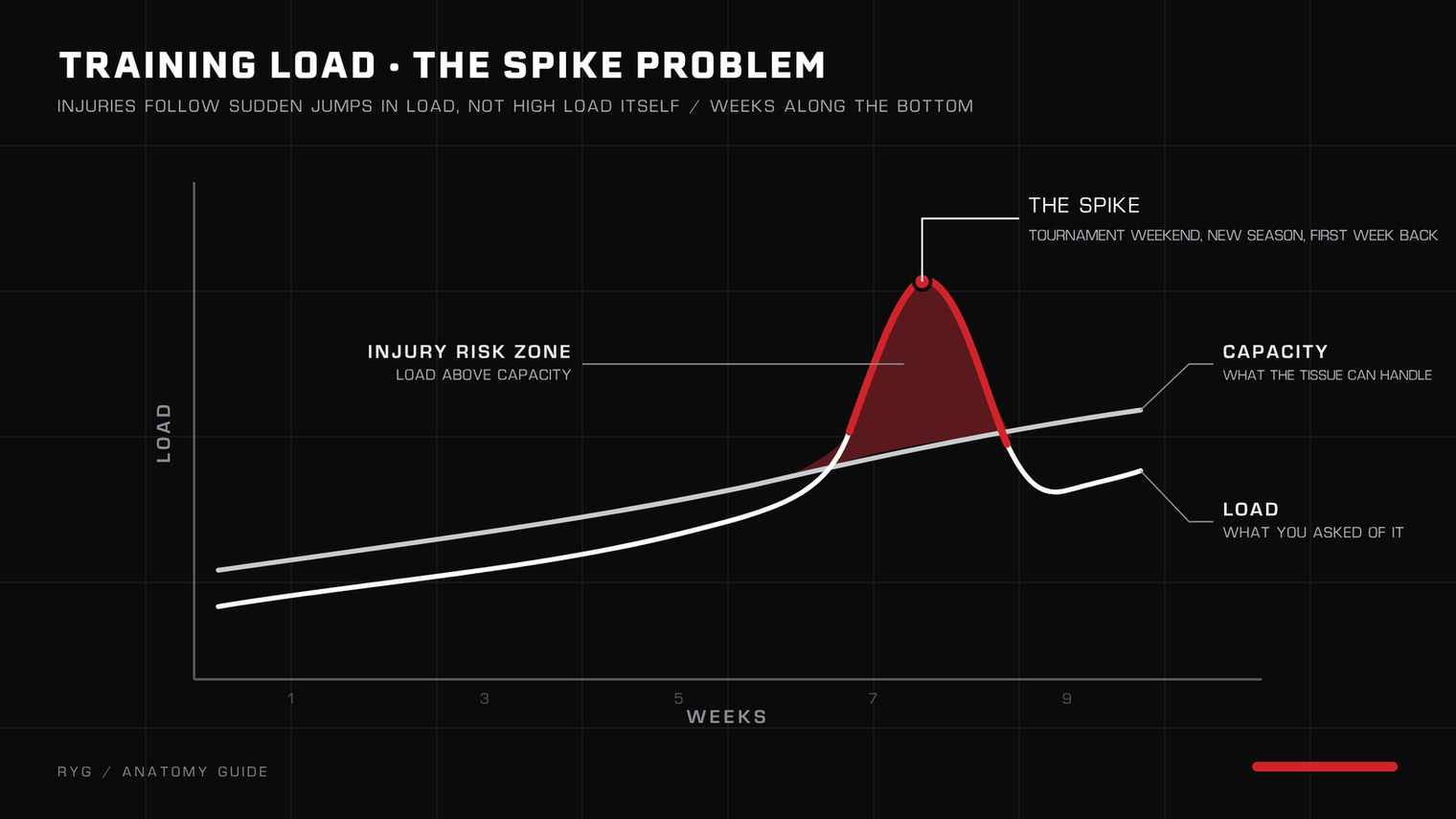
Ask a room of physical therapists what causes most running injuries and you will not hear much about shoes, surfaces or foot type. You will hear two words: training error. The majority of running injuries trace back to a simple mismatch, the training load went up faster than the body's tissues could adapt. The famous ten percent rule, never increase weekly mileage by more than ten percent, is the folk wisdom version of this idea, and the research says it is half right.
The other half is more interesting, and it explains the injuries that the rule never predicted: the ones that happen when you come back from a break, swap easy runs for hard ones, or train less than your body was used to.
What's actually going on
Muscle adapts to new load in days to weeks, but tendons and especially bone remodel over weeks to months, so they are always the last to catch up and the first to fail when you rush. What the rule misses is that risk is not about percentages alone. It is about your recent history relative to what you have been prepared for over the previous weeks. A runner averaging the same mileage all winter can often jump more than ten percent safely. A runner coming off two weeks of nothing who returns straight to their old week has technically increased by zero percent and is at real risk anyway.
The other blind spot is intensity. A week of unchanged mileage that swaps two easy runs for hill repeats and a track workout is a large load increase in disguise, because fast running multiplies the force on tendons and bone per stride.
What the research says
- Non-contact injuries are rarely caused by training itself. They are caused by inappropriate programs, and excessive, rapid increases in load are responsible for a large share of soft-tissue injuries1.
- The paradox: athletes who are used to high training loads get injured less than athletes who train less, and under-training can itself raise injury risk. The acute-to-chronic workload ratio, this week's load relative to the prior weeks, is a practical way to spot a spike1.
- Novice runners who increased weekly distance by more than 30% had a higher rate of distance-related injuries such as patellofemoral pain, IT band syndrome and shin splints than those who increased by less than 10%, but there was no significant difference in overall injury rate across the groups, so the authors advise keeping increases under 30% over a 2-week period rather than treating 10% as a hard line2.
- A 13-week running program built on the 10% rule did not reduce injuries in 532 novice runners: 20.8% got hurt versus 20.3% on a standard 8-week plan. About 1 in 5 novice runners gets a running-related injury while training for a 4-mile event regardless of program3.
- In long-distance runners, a previous injury and high weekly mileage are the strongest predictors of the next injury, while a gradual increase in weekly distance was actually protective for the knee4.
- Previous injury is a stronger predictor of the next running injury than any shoe feature, and in one cohort longer average session distance and more hours of other sports were associated with lower risk, which fits the idea that a well-prepared, varied body tolerates more5.
What we do about it
The practical fixes are boring and effective. Change one variable at a time, mileage or intensity, not both. After any break of two weeks or more, return below where you left off and rebuild, because your preparedness dropped while you rested even if your fitness did not. Keep most running easy. Treat sleep and fueling as part of the training load math.
We track the ratio the research describes, this week against the last several, and we flag spikes before they become injuries. We also keep the chronic load up through strength training and cross-training, because the paradox is real: the fit, well-loaded runner is the durable one. And when a niggle appears, trim load early. A down week now beats six weeks off later. The big injury clusters we see every year follow the same calendar, January enthusiasm, spring track intensity ramps, and the panicked final month before a goal race, and all three are load spikes with a name.
When to get it looked at
- A niggle that is getting worse week over week rather than settling with a down week
- Pinpoint bone pain, especially in the shin, foot, hip or groin, which can be a bone stress injury
- Pain that has changed your stride, since compensation spreads injuries up the chain
- A second injury in the same build, which usually means the plan rather than the body is the problem
- Persistent fatigue, poor sleep or declining performance despite rest, which can signal overtraining
Bottom line
The ten percent rule gets the principle right and the arithmetic wrong. The research says spikes relative to what you are prepared for cause injuries, that a rigid percentage does not prevent them, and that a high, steady, well-recovered load is protective. If you would like your buildup designed instead of guessed, an in-person evaluation can do the math for your next block.
References
- Gabbett TJ. The training-injury prevention paradox: should athletes be training smarter and harder?. Br J Sports Med. 2016;50(5):273-280. PubMed
- Nielsen RØ, Parner ET, Nohr EA, et al. Excessive progression in weekly running distance and risk of running-related injuries: an association which varies according to type of injury. J Orthop Sports Phys Ther. 2014;44(10):739-747. PubMed
- Buist I, Bredeweg SW, van Mechelen W, et al. No effect of a graded training program on the number of running-related injuries in novice runners: a randomized controlled trial. Am J Sports Med. 2008;36(1):33-39. PubMed
- van Gent RN, Siem D, van Middelkoop M, et al. Incidence and determinants of lower extremity running injuries in long distance runners: a systematic review. Br J Sports Med. 2007;41(8):469-480. PubMed
- Malisoux L, Ramesh J, Mann R, et al. Can parallel use of different running shoes decrease running-related injury risk?. Scand J Med Sci Sports. 2015;25(1):110-115. PubMed
This article is for education and does not replace an evaluation. If you're dealing with an active injury, see a licensed medical provider.