
High Hamstring Pain in Soccer: Why Pain Under Your Sit Bone Hates Stretching
 Soccer
Hamstring pain that sits high, right where the muscle attaches to the sit bone, behaves differently from the classic mid thigh pull. It aches when you sit on hard chairs, twinges on hills and long strides, and drags on for months if it is treated like a normal strain. This is the proximal hamstring, and problems here come in two flavors. A sudden strain, often from a slide tackle, a split or a sprint reaching for a through ball, or a slow-burning tendinopathy where the tendon gets overloaded gradually.
This article is about the slow-burning version, the one that famously hates stretching. The research base is thinner than for the Achilles or patellar tendon, but what exists points the same way: load it, do not stretch it, and be patient.
What's actually going on
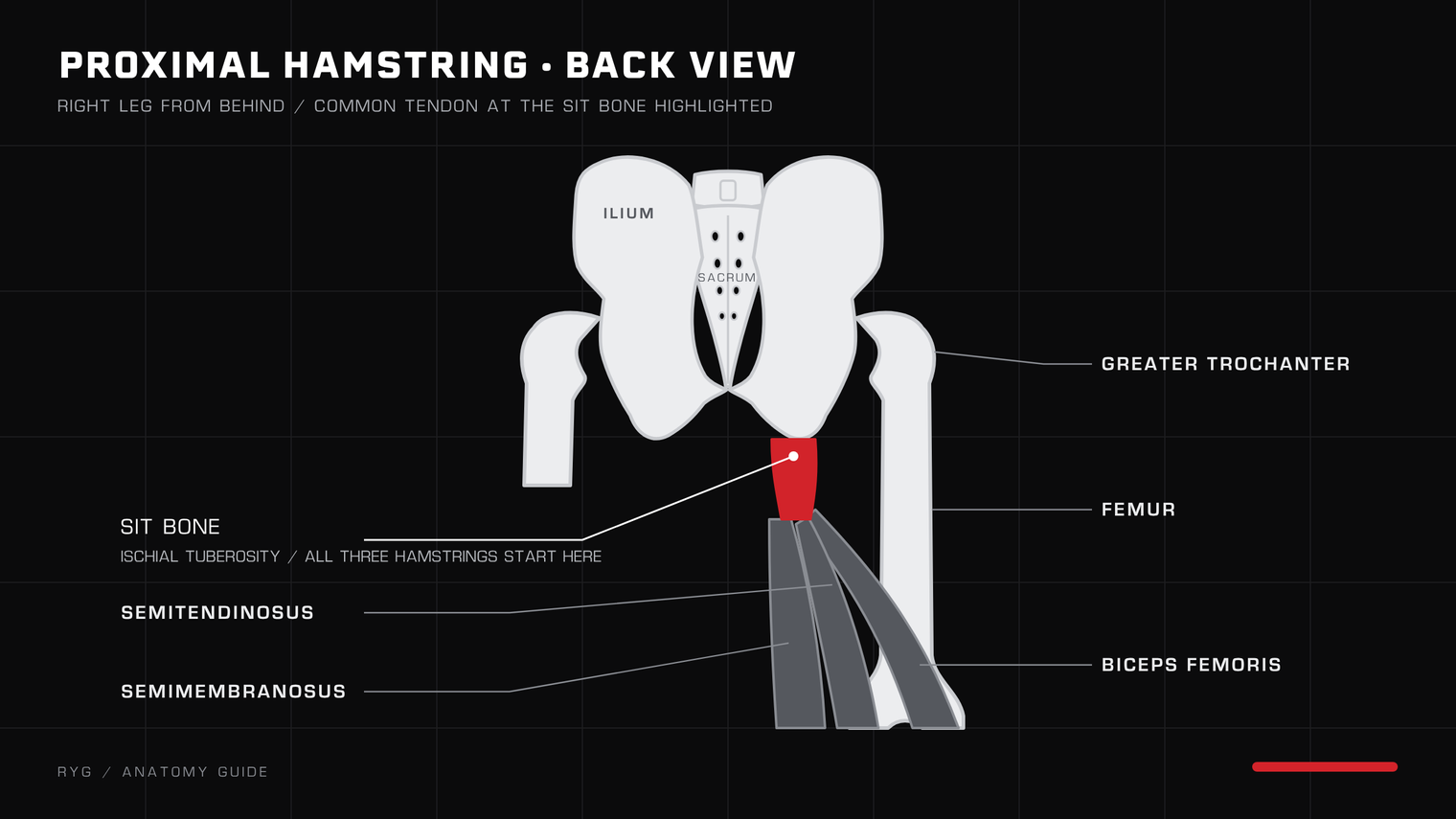
The hamstring tendon wraps close to the sit bone, so positions of deep hip flexion, sitting, squatting and stretching press the irritated tendon against bone. That is why this injury hates stretching. Players feel the tightness and stretch harder, which compresses the tendon more, which creates more tightness. It is one of the clearest examples in sports medicine of the intuitive fix making things worse. Biopsies of operated tendons show degeneration rather than inflammation, which fits an overuse tendon problem, not an acute itis that an anti-inflammatory will fix1. The sciatic nerve runs right past the attachment, so some athletes also get sciatica-like symptoms down the leg.
What the research says
- High hamstring tendinopathy presents as deep buttock pain at the sit bone, is common in sprinters, distance runners and field sport athletes, and tends to linger for months2,3.
- Three simple exam tests, the Puranen-Orava, bent-knee stretch and modified bent-knee stretch, are highly reliable between examiners with ICC values of 0.82 to 0.88, and moderately to highly valid in athletes4.
- MRI findings at the hamstring origin are common in people with no symptoms: 52 percent had changes on both sides and 15 percent had bilateral partial tears, so a scan has to be matched to the exam5.
- There are no randomized trials of rehab exercise specifically for proximal hamstring tendinopathy; treatment is built on the progressive loading principles proven in Achilles and patellar tendinopathy2,3.
- A systematic review of 12 studies found insufficient evidence to recommend any single treatment, whether injections, shockwave or surgery, over another3.
- In 40 professional athletes, 4 weeks of shockwave therapy gave at least 50 percent pain relief in 85 percent at 3 months, versus 10 percent with anti-inflammatories plus standard physiotherapy6.
- When conservative care fails, surgical release returned 80 of 90 athletes to their previous level of sport at an average of 5 months1.
What we do about it
What works is progressive loading with the compression managed, borrowed directly from the tendon research in the Achilles and patellar tendon, where athletes who kept training with pain capped at 5 out of 10 recovered as well at 12 months as those who rested7.
Calm the compression. A temporary truce with hills, long strides, deep squats and aggressive stretching. Isometric hamstring holds in comfortable positions start loading without pinching the tendon. A slightly forward tilted cushion makes school and car rides livable.
Build heavy and slow. Bridges, hip hinge patterns and hamstring curls progressed into heavier loads and gradually deeper hip flexion as the tendon tolerates it, following the heavy slow resistance model that holds its gains in other tendons.
Restore the spring. Fast, elastic work and sprint progressions, because a soccer hamstring must handle top speed, not just slow gym reps. This is the progression we run in the clinic, with a test at every phase before you move on. Picture a 20 year old college forward who has battled sit bone pain for nearly a year of on and off stretching; rebuilding her loading from scratch is slow, but it is the path that gives her a real shot at full 90 minute matches the following season.
When to get it looked at
- A sudden pop at the sit bone with bruising or weakness, which can mean a tendon avulsion and needs imaging quickly.
- Numbness, tingling or weakness down the leg, or pain that behaves like sciatica, so the spine can be cleared.
- Sit bone pain in a growing athlete, because the growth plate there can pull away with a hard sprint or split.
- Pain that has not changed after a few months of properly progressed loading, when shockwave or a surgical opinion may be worth discussing.
Bottom line
High hamstring pain is a tendon problem that hates compression and responds to patient, progressive loading. Stretching feels right and makes it worse. Timelines run in months, not weeks, but athletes who load consistently almost always get back to full sprinting. An in-person evaluation can tell high hamstring pain from a regular strain.
References
- Lempainen L, Sarimo J, Mattila K, et al. Proximal hamstring tendinopathy: results of surgical management and histopathologic findings. Am J Sports Med. 2009;37(4):727-734. PubMed
- Goom TS, Malliaras P, Reiman MP, et al. Proximal Hamstring Tendinopathy: Clinical Aspects of Assessment and Management. J Orthop Sports Phys Ther. 2016;46(6):483-493. PubMed
- Nasser AM, Vicenzino B, Grimaldi A, et al. Proximal Hamstring Tendinopathy: A Systematic Review of Interventions. Int J Sports Phys Ther. 2021;16(2):288-305. PubMed
- Cacchio A, Borra F, Severini G, et al. Reliability and validity of three pain provocation tests used for the diagnosis of chronic proximal hamstring tendinopathy. Br J Sports Med. 2012;46(12):883-887. PubMed
- Thompson SM, Fung S, Wood DG. The prevalence of proximal hamstring pathology on MRI in the asymptomatic population. Knee Surg Sports Traumatol Arthrosc. 2017;25(1):108-111. PubMed
- Cacchio A, Rompe JD, Furia JP, et al. Shockwave therapy for the treatment of chronic proximal hamstring tendinopathy in professional athletes. Am J Sports Med. 2011;39(1):146-153. PubMed
- Silbernagel KG, Thomeé R, Eriksson BI, et al. Continued sports activity, using a pain-monitoring model, during rehabilitation in patients with Achilles tendinopathy: a randomized controlled study. Am J Sports Med. 2007;35(6):897-906. PubMed
Alex has been Amazing! He initially assisted me with the rehabilitation of my hamstring and getting it back to 100%. He diagnosed the issue, and set me up on a path to get it back to full strength. Additionally, when other minor things came up, he’s been fantastic in giving insight and direction. He’s very knowledgeable, willing to accommodate scheduling asap, and an overall super individual. I highly recommend anyone who is an athlete or not and needs PT to go and see Alex! You will very glad you did!
In my previous sport season I pulled my hamstring twice and ever since working with Alex I have had no issues with my lower or upper body. He takes very detailed evaluations of your injuries to help him best determine how he can get you back to 100%. He finds where you are weak and helps you strengthen those areas.
This article is for education and does not replace an evaluation. If you're dealing with an active injury, see a licensed medical provider.