
Neck Pain From Soccer: Headers, Collisions, and What Actually Helps
 Soccer
 does not look like a neck sport until you count the headers. A competitive player heads the ball hundreds of times a season, and each one asks the neck to absorb force and keep the head steady. Add the occasional shoulder to shoulder collision, an awkward fall, or a keeper getting bowled over in the box, and it is no surprise that neck pain shows up in soccer players of every age.
Most of it is mechanical, which is the good kind. Muscles and joints got loaded faster than they were prepared for, they guard, and turning to check your shoulder suddenly feels stiff and sore. That pattern responds to movement and strength, not to a collar and a week on the couch.
What's actually going on
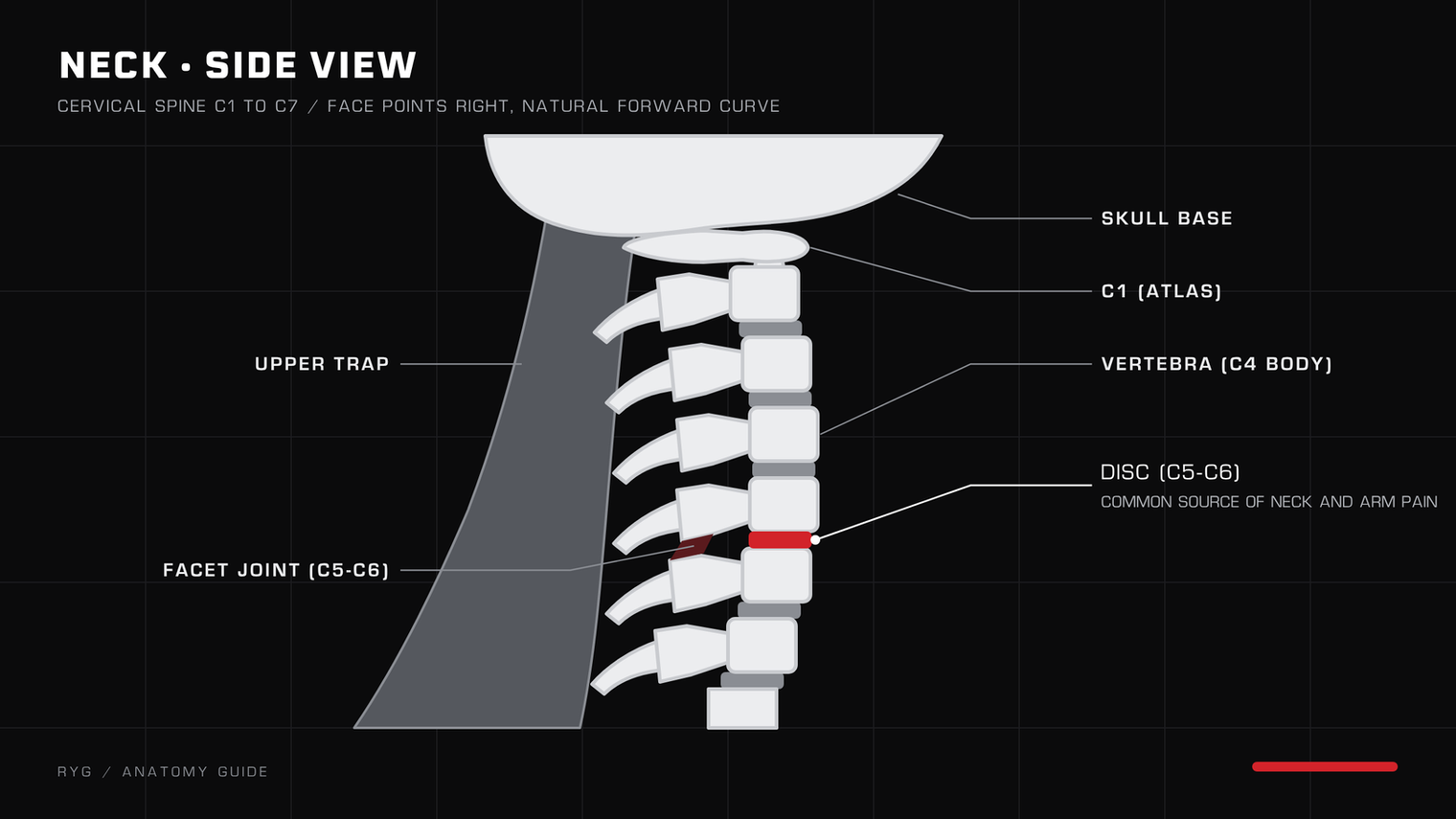
The neck has more than twenty small muscles whose main job is controlling head position. When a header or a jolt catches them off guard, they can strain just like a hamstring does. The joints between the vertebrae and the muscles that run from the neck to the shoulder blade then tighten up to protect the area, and that guarding is what you feel as stiffness. Two soccer specific pieces matter. First, the neck's ability to brace before contact decides whether a header is a controlled strike or a whiplash event. Second, the upper back and shoulder blade muscles are part of the system, which is why neck rehab that ignores the shoulder girdle tends to stall.
What the research says
- Neck pain is common in athletes: in a given year between 38 and 73 percent have it depending on the sport, and about 48 percent have had it at some point1.
- For a fresh mechanical neck strain, the JOSPT guideline recommends upper back manipulation plus neck range of motion exercise and shoulder blade and arm strengthening, not rest2.
- After a whiplash-type injury from a collision, the same guideline says to return to normal, non-provocative activity as soon as possible, minimize collar use, and expect recovery within 2 to 3 months2.
- A Cochrane review of 27 trials found that strengthening the neck, shoulder blade and upper limb muscles reduced chronic neck pain by a moderate to large amount, while stretching alone produced no measurable benefit3.
- Across five studies, soccer players with stronger necks experienced lower head acceleration when heading, with a correlation stronger than minus 0.54.
- In 6,704 high school soccer, basketball and lacrosse athletes, weaker necks and smaller neck circumference predicted concussion, and every 1 pound gain in neck strength lowered the odds of concussion by 5 percent5.
- Both a stronger neck and bracing the neck muscles before an impact independently reduced how fast the head snapped in every direction tested, in athletes aged 8 to 306.
What we do about it
We follow the guideline logic: keep the neck moving, restore strength from the shoulder blades up, and get back to normal activity early rather than waiting for the pain to disappear on its own2.
Early. Gentle range of motion in every direction, hands-on work through the upper back to restore rotation, and isometric holds for the deep neck flexors. Heading pauses briefly; running and ball work usually do not.
Build. Progressive strengthening for the neck in flexion, extension, side bending and rotation, paired with shoulder blade and upper limb strength, because that combination is what the Cochrane review found effective and stretching alone is not3.
Brace and return. Timed bracing drills, then a graded heading progression from soft tosses to served balls to contested headers. The goal is a neck that stiffens on time, because that is what lowers head acceleration6. This is the progression we run in the clinic, with a test at every phase before you move on.
When to get it looked at
- Any header or collision followed by headache, dizziness, fog, nausea or feeling off. That is a possible concussion and needs assessment before returning to play.
- Pain, tingling or weakness running into the arm or hand.
- Neck pain after a fall or collision with a hard landing on the head, which needs to be checked for bony injury before anyone tests movement.
- Stiffness that is not improving after a couple of weeks of normal activity.
Bottom line
Most soccer neck pain is a strength and loading problem, and the evidence says to treat it that way: move early, strengthen the neck and shoulder girdle, and train the brace. A stronger neck is also one of the few concussion risk factors you can change. If your neck has been stiff for weeks or you are not sure a header was just a header, an in-person evaluation sorts it out quickly.
References
- Noormohammadpour P, Farahbakhsh F, Farahbakhsh F, et al. Prevalence of Neck Pain among Athletes: A Systematic Review. Asian Spine J. 2018;12(6):1146-1153. PubMed
- Blanpied PR, Gross AR, Elliott JM, et al. Neck Pain: Revision 2017 (Clinical Practice Guidelines Linked to the International Classification of Functioning, Disability and Health From the Orthopaedic Section of the American Physical Therapy Association). J Orthop Sports Phys Ther. 2017;47(7):A1-A83. PubMed
- Gross A, Kay TM, Paquin JP, et al. Exercises for mechanical neck disorders. Cochrane Database Syst Rev. 2015;1(1):CD004250. PubMed
- Peek K, Elliott JM, Orr R. Higher neck strength is associated with lower head acceleration during purposeful heading in soccer: A systematic review. J Sci Med Sport. 2020;23(5):453-462. PubMed
- Collins CL, Fletcher EN, Fields SK, et al. Neck strength: a protective factor reducing risk for concussion in high school sports. J Prim Prev. 2014;35(5):309-319. PubMed
- Eckner JT, Oh YK, Joshi MS, et al. Effect of neck muscle strength and anticipatory cervical muscle activation on the kinematic response of the head to impulsive loads. Am J Sports Med. 2014;42(3):566-576. PubMed
It was such a great time, and with the exercises and stretching, my neck felt a lot better afterward. Will definitely recommend it.
This article is for education and does not replace an evaluation. If you're dealing with an active injury, see a licensed medical provider.