
Growth Spurt Injuries in Soccer: Osgood-Schlatter, Sever's, and Why Your Kid's Pain Is Real
 Soccer
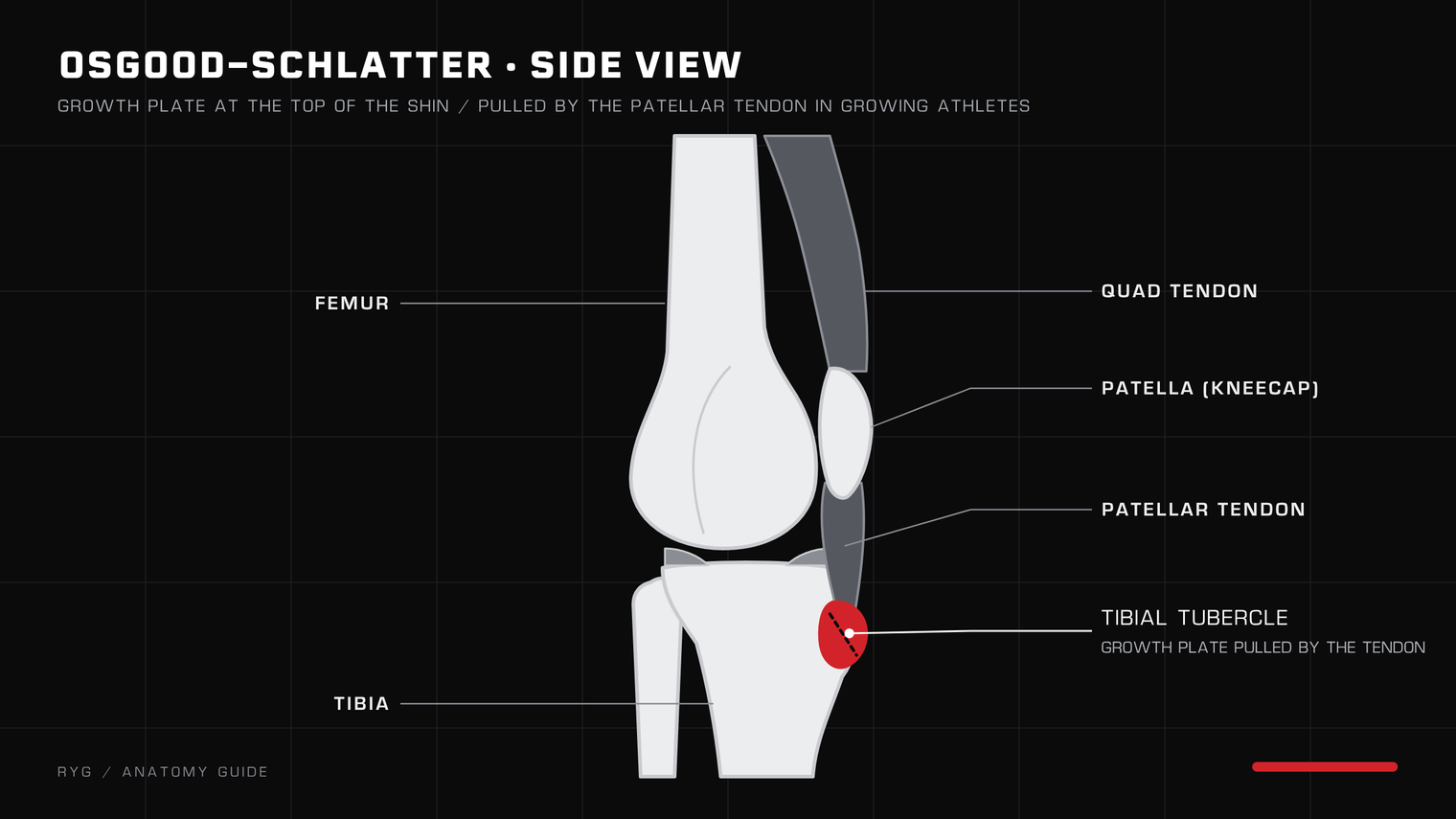
Every soccer parent eventually meets one of these two names. Osgood-Schlatter disease, pain and a tender bump below the kneecap, and Sever's disease, pain in the heel. Neither is a disease in the scary sense. Both are growth plate irritations, and they cluster in soccer players during the growth years for one reason. During a growth spurt, bones lengthen first and muscles catch up later, which temporarily increases the pull of tendons on the soft growth cartilage where they attach. The patellar tendon pulls on the shin's growth plate in Osgood-Schlatter, and the Achilles pulls on the heel's growth plate in Sever's.
The first thing to say is that the pain is real and not a toughness issue. The research measures exactly how much it costs these kids. The second thing is reassuring: a structured plan lets most of them keep playing, and the evidence for it is better than the evidence for rest.
What's actually going on
The growth plate is the weakest link in a growing athlete's chain. Where a tendon attaches to it, repeated pulling from sprinting, kicking and jumping irritates the cartilage and the bone underneath, and in Osgood-Schlatter it can build a permanent bump. Tight, strong quads pull harder on the shin's growth plate, and a sport built on sprinting, kicking and firm ground loads both attachment points thousands of times a week. Both conditions settle as the growth plate matures and do not damage the joint itself. The goal of management is keeping the athlete playing as much as comfortably possible while the skeleton catches up, and building the strength that takes load off the attachment.
What the research says
- Osgood-Schlatter affects about 1 in 10 adolescents, 9.8 percent in a population sample, with 11 percent of boys and 8 percent of girls aged 12 to 151.
- Playing sport regularly roughly doubled the odds of Osgood-Schlatter, and a tight rectus femoris at the front of the thigh raised the odds 7-fold1.
- Peak age of onset was 12 in boys and 11 in girls, and boys were diagnosed nearly twice as often as girls2.
- The pain is costly: adolescents with Osgood-Schlatter scored 22 to 56 points lower than pain-free peers on knee function, sport and quality of life scales and had measurably weaker quadriceps, yet they were still logging over 2 hours of vigorous activity a day3.
- Most kids get advice or rest from their doctor; only 13 percent were referred to physiotherapy and 1 in 5 was sent for imaging2.
- A 12 week program of pain-guided activity modification, progressive knee strengthening and graded return to sport led to a successful outcome in 80 percent at 12 weeks and 90 percent at 12 months, in adolescents who had already been in pain for an average of 21 months; quad strength rose 32 percent and jump height 19 percent in the first 12 weeks, and 69 percent were back in sport at 12 months4.
- Sever's disease is the most common cause of heel pain in children, and a simple heel cup cut pain odds by 80 percent compared with a heel wedge while boys kept training at full volume5.
What we do about it
Management is about dosage, not elimination, and the structured program above is our template4. The research base is thin, with only 2 randomized trials in a 2021 review, so we track symptoms and strength rather than promise timelines6.
The activity ladder. Pain that stays mild during play and settles by the next morning is acceptable; pain that changes how the athlete runs or lingers into the next day means the load comes down a rung that week: fewer sessions, less jumping volume, shorter practices.
Build strength and length. Progressive quad and hip strengthening, because these kids test weaker than their peers, plus quad and calf flexibility work to ease the pull on the attachment3,1. Supervised strength training in this age group is safe and endorsed by pediatric and strength organizations7.
Heel cups and graded return. For Sever's, a heel cup in the cleat during training5. For both, sport is rebuilt in steps as the ladder allows. Our sports physical therapy team walks families through these seasons, and the year-round schedule gets a look too, because a kid who spends more hours a week in organized sport than their age in years has about twice the odds of a serious overuse injury8.
When to get it looked at
- Knee or heel pain that is present at rest or at night, or that came on suddenly with a pop during a sprint or jump, which can mean the growth plate has pulled away and needs imaging.
- Swelling inside the knee joint, locking or giving way, which point to something other than the growth plate.
- A limp that persists between sessions, or pain in only one hip or knee with a limp, which needs the hip checked.
- Pain that keeps flaring every time the schedule ramps up despite sensible load changes.
Bottom line
Growth plate pain in a young soccer player is real, common and manageable. The evidence favors a pain-guided activity ladder with progressive strengthening over rest, and a heel cup for Sever's, so a season usually means playing through with occasional lighter weeks rather than months on the couch. If your young player's knee bump or heel pain keeps flaring, an in-person evaluation explains what to watch for and when it needs a closer look.
References
- de Lucena GL, dos Santos Gomes C, Guerra RO. Prevalence and associated factors of Osgood-Schlatter syndrome in a population-based sample of Brazilian adolescents. Am J Sports Med. 2011;39(2):415-420. PubMed
- van Leeuwen GJ, de Schepper EI, Rathleff MS, et al. Incidence and management of Osgood-Schlatter disease in general practice: retrospective cohort study. Br J Gen Pract. 2022;72(717):e301-e306. PubMed
- Rathleff MS, Winiarski L, Krommes K, et al. Pain, Sports Participation, and Physical Function in Adolescents With Patellofemoral Pain and Osgood-Schlatter Disease: A Matched Cross-sectional Study. J Orthop Sports Phys Ther. 2020;50(3):149-157. PubMed
- Rathleff MS, Winiarski L, Krommes K, et al. Activity Modification and Knee Strengthening for Osgood-Schlatter Disease: A Prospective Cohort Study. Orthop J Sports Med. 2020;8(4):2325967120911106. PubMed
- Perhamre S, Lundin F, Norlin R, et al. Sever's injury; treat it with a heel cup: a randomized, crossover study with two insole alternatives. Scand J Med Sci Sports. 2011;21(6):e42-e47. PubMed
- Neuhaus C, Appenzeller-Herzog C, Faude O. A systematic review on conservative treatment options for OSGOOD-Schlatter disease. Phys Ther Sport. 2021;49:178-187. PubMed
- Lloyd RS, Faigenbaum AD, Stone MH, et al. Position statement on youth resistance training: the 2014 International Consensus. Br J Sports Med. 2014;48(7):498-505. PubMed
- Jayanthi NA, LaBella CR, Fischer D, et al. Sports-specialized intensive training and the risk of injury in young athletes: a clinical case-control study. Am J Sports Med. 2015;43(4):794-801. PubMed
This article is for education and does not replace an evaluation. If you're dealing with an active injury, see a licensed medical provider.