
Neck Pain From Swimming: How Breathing Mechanics and Head Position Drive It
 Swimming
Neck pain might be the most misunderstood complaint in swimming. Parents often assume it came from sleeping wrong or carrying a heavy backpack, but for a swimmer training four or five days a week, the pool is usually the culprit. The neck works constantly in the water, and small habits repeated thousands of times add up fast.
The good news is that this is one of the better-studied problems in sports medicine, and the guidance is clear: move it, strengthen it, and fix the pattern that keeps loading it.
What's actually going on
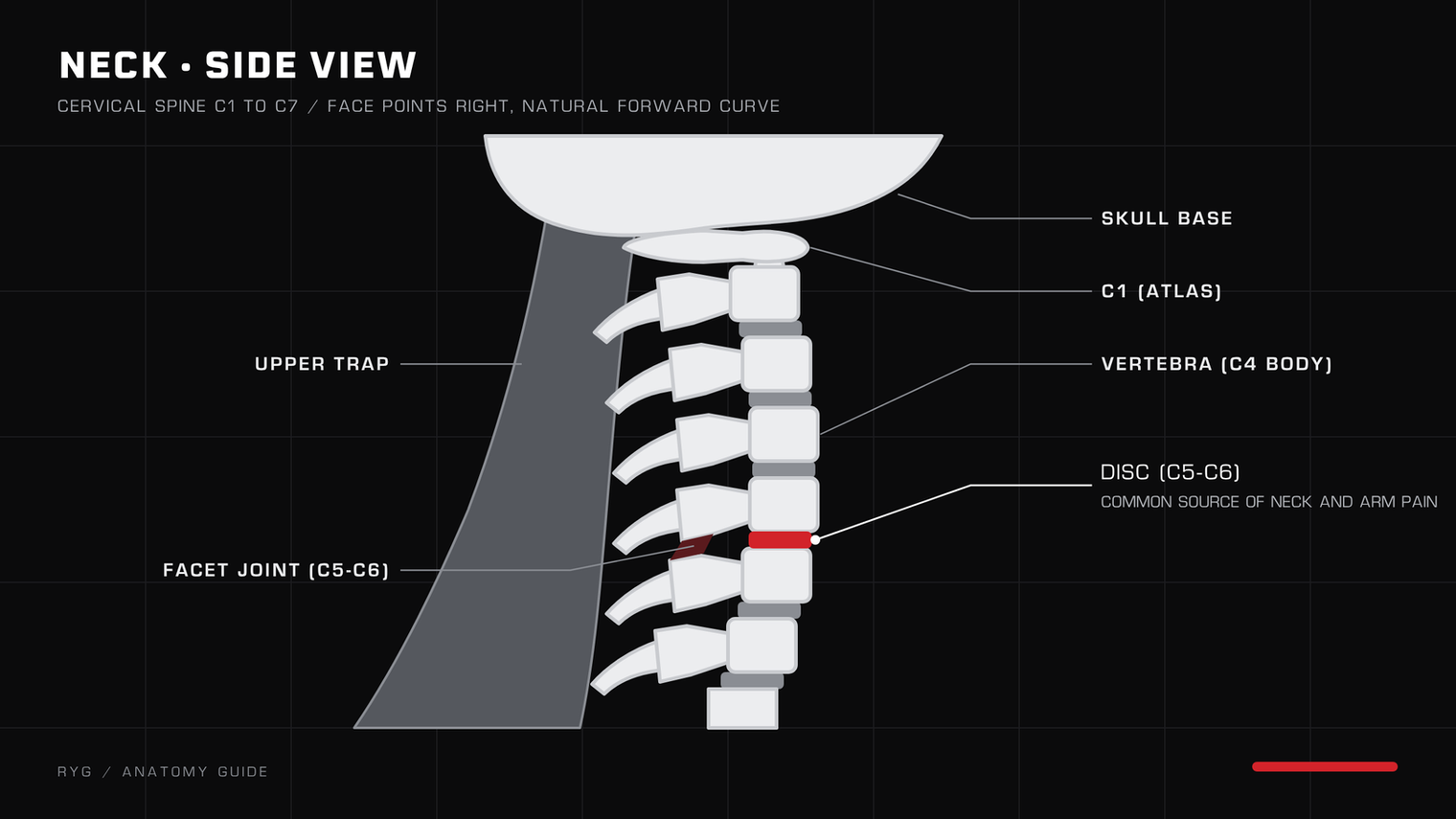
Two things drive most swimming neck pain, head position and breathing. In freestyle the head should stay in line with the spine, eyes looking mostly down, with the breath coming from body rotation rather than a neck crank. Many swimmers instead look forward toward the wall, which holds the neck in extension for the whole length. Held extension compresses the small joints at the back of the neck, and those joints get irritated when they are loaded lap after lap.
Then comes the breath. A swimmer who rotates the whole body needs only a small turn of the head to find air. A swimmer with flat body rotation has to whip the neck around to clear the water, and that repeated over-rotation strains the same few muscles and joints every cycle. Breathing to one side only makes it worse: one side of the neck does all the rotating while the other side stiffens up, and over a season that asymmetry can turn into pain that shows up on land too.
What the research says
- Neck pain is common in athletes. Across six studies, between 38% and 73% of athletes had neck pain in a given year depending on the sport, and about 48% had experienced it at some point1.
- For a fresh mechanical neck strain, the JOSPT clinical practice guideline recommends thoracic (upper back) manipulation plus a neck range of motion program and shoulder blade and arm strengthening, not rest2.
- For neck pain that has hung around, the same guideline recommends a combined program of hands-on manual therapy with mixed neck and shoulder girdle exercise, including strengthening, endurance and aerobic conditioning2.
- A Cochrane review of 27 randomized trials found that strength training for the neck, shoulder blade and arm reduced chronic neck pain by a moderate to large amount right after treatment, while stretching on its own, breathing exercises and general fitness did not change pain or function3.
- Strength is the lever. In a 12-month trial of 180 women with chronic neck pain, isometric neck strengthening raised maximal neck strength by 110% in flexion, 76% in rotation and 69% in extension, and both training groups had significantly less pain and disability than controls4.
- The breathing side shows up in the data. In 3D video of freestyle swimmers, one-sided breathing was associated with less body tilt on the breathing side and a high incidence of shoulder impingement on that side, which is the same mechanics that crank the neck5.
What we do about it
Calm and move. Hands-on work to the upper back and neck, then early range of motion. Most swimmers keep training with a snorkel or a modified breathing pattern while this happens, because the guideline evidence favors staying active over resting2.
Strengthen the system. Deep neck flexor holds, isometric neck work in all four directions, and shoulder blade strengthening with rows, prone Y raises and lower trap work. This is the piece that makes the pain stay gone, and it is the piece a stretching routine skips3.
Rebuild the pattern. In the pool, a neutral head position with the eyes down and a breath that comes from body rotation. We build bilateral breathing gradually so one side of the neck stops doing all the work. This is the progression we run in the clinic, with a test at every phase before you move on.
Test, then progress. Neck strength and rotation are measured, not guessed, and yardage and fly sets come back as the numbers improve.
When to get it looked at
- Pain, numbness or tingling that travels into the arm or hand, or weakness in the hand.
- Neck pain that started with a collision, a dive into shallow water or a fall, especially with dizziness or a headache.
- Pain that is getting worse week over week, or that wakes the swimmer at night.
- A swimmer turning the head gingerly or avoiding breathing to one side for more than two weeks.
Bottom line
Neck pain from swimming is a loading problem with a mechanical cause, and the evidence says the cure is active: restore motion, strengthen the neck and shoulder girdle, and change the breathing pattern that keeps aggravating it. Most swimmers can keep training with smart modifications while that happens. An in-person evaluation is an easy first step you can film and check from the pool deck.
References
- Noormohammadpour P, Farahbakhsh F, Farahbakhsh F, et al. Prevalence of Neck Pain among Athletes: A Systematic Review. Asian Spine J. 2018;12(6):1146-1153. PubMed
- Blanpied PR, Gross AR, Elliott JM, et al. Neck Pain: Revision 2017 (Clinical Practice Guidelines Linked to the International Classification of Functioning, Disability and Health From the Orthopaedic Section of the American Physical Therapy Association). J Orthop Sports Phys Ther. 2017;47(7):A1-A83. PubMed
- Gross A, Kay TM, Paquin JP, et al. Exercises for mechanical neck disorders. Cochrane Database Syst Rev. 2015;1(1):CD004250. PubMed
- Ylinen J, Takala EP, Nykänen M, et al. Active neck muscle training in the treatment of chronic neck pain in women: a randomized controlled trial. JAMA. 2003;289(19):2509-2516. PubMed
- Yanai T, Hay JG. Shoulder impingement in front-crawl swimming: II. Analysis of stroking technique. Med Sci Sports Exerc. 2000;32(1):30-40. PubMed
It was such a great time, and with the exercises and stretching, my neck felt a lot better afterward. Will definitely recommend it.
This article is for education and does not replace an evaluation. If you're dealing with an active injury, see a licensed medical provider.