
High Hamstring Pain in Tennis: The Sit Bone Ache That Lingers for Months
 Tennis
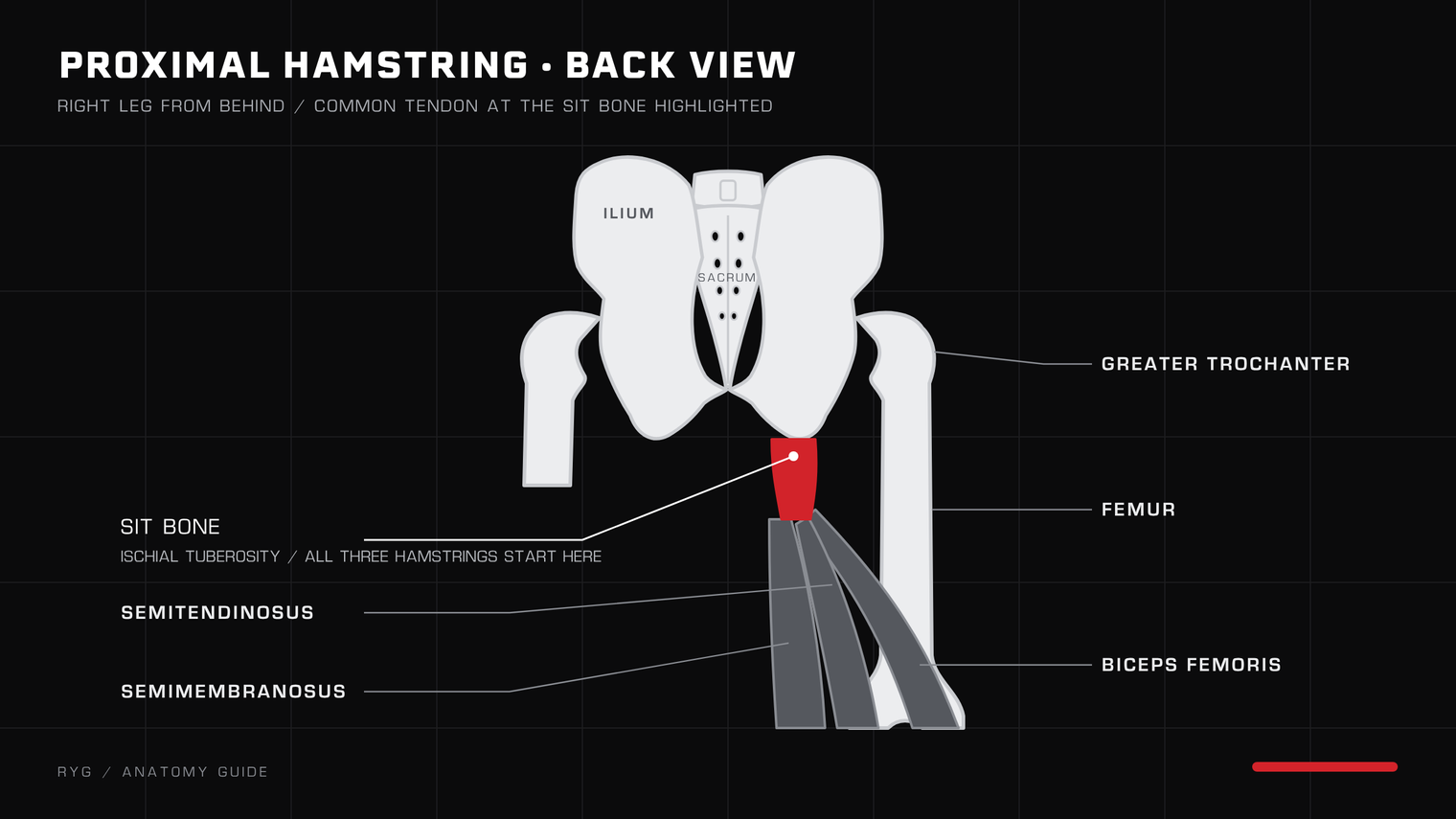
There is hamstring pain, and then there is high hamstring pain. The second kind sits right at the sit bone, the bony point you feel on a hard bench, where all three hamstring muscles anchor via a thick shared tendon. Tennis players get two versions. The sudden one, a sharp grab during a sprint or an overstretched lunge. And the slow one, proximal hamstring tendinopathy, an ache that builds over weeks and becomes a constant companion during matches, car rides and long sits.
The position that drives both is the same. Reaching for a low ball means folding the trunk forward over a relatively straight front leg, which stretches the hamstring to near full length while it works hard to control your body weight. Sprinting to a drop shot does the same thing at higher speed.
What's actually going on
This injury has a reputation for lingering, and the reason is compression. Like the tendon on the side of the hip, the high hamstring tendon gets pressed against bone in deep hip flexion, which includes sitting. Players rest it for a month, feel decent, then flare it with one low lunge, because rest never rebuilt the tendon's capacity, it just paused the irritation.
The tendon is not inflamed in the usual sense. It is degenerated and sensitive, which is why anti inflammatories and waiting rarely finish the job.
What the research says
- High hamstring tendinopathy shows up as deep buttock pain right at the sit bone where the hamstrings attach; it is common in sprinters, distance runners and field sport athletes and tends to linger for months1,2.
- Three simple exam tests, the Puranen-Orava, bent knee stretch and modified bent knee stretch, are highly reliable between examiners and moderately to highly valid for chronic proximal hamstring tendinopathy in athletes3.
- MRI findings at the hamstring origin are common in people with no symptoms: 52% had changes on both sides and 15% had bilateral partial tears, so a scan has to be matched to the exam4.
- There are no randomized trials of rehab exercise specifically for proximal hamstring tendinopathy; treatment is built on the progressive loading principles proven in Achilles and patellar tendinopathy1,2. In those tendons, heavy slow resistance training and eccentric loading give equally good results that last a year, with better adherence for heavy slow resistance5.
- A systematic review of 12 studies found insufficient evidence to recommend any single treatment, whether injections, shockwave or surgery, over another2. In 40 professional athletes, 4 weeks of shockwave gave at least 50% pain relief in 85% at 3 months, versus 10% with anti inflammatories plus standard physiotherapy6.
- When conservative care fails, surgical release returned 80 of 90 athletes to their previous level of sport at an average of 5 months, and biopsies showed degeneration rather than inflammation7.
What we do about it
Stage 1, settle without compressing. Isometric hamstring holds and bridges with minimal hip bend, a cushion for long sits, and a temporary pause on deep lunges and forward folds. Pain is monitored, not banned, and the rule is that it settles by the next morning.
Stage 2, heavy and slow. Romanian deadlifts and hamstring curls with meaningful load, gradually adding hip flexion range as the tendon tolerates it. This is the phase borrowed from the Achilles and patellar research, and it is the phase players most want to skip.
Stage 3, speed and the court. Skipping, strides and sprint work, then low ball reaches and deep lunges at increasing speed, because a tennis hamstring must handle sprinting or it is not done. The full timeline often runs a few months, and shockwave is a reasonable add on for a tendon that is not responding. This is the progression we run in the clinic, with a test at every phase before you move on.
When to get it looked at
- A pop at the sit bone with bruising down the back of the thigh and trouble walking, which can be a tendon tear off the bone.
- Sciatica like symptoms down the leg, which means the spine and the nerve need to be checked.
- Sit bone pain in a growing teenager, which can be a growth plate injury rather than a tendon problem.
- Pain that has not changed after three months of consistent progressive loading.
Bottom line
High hamstring pain lingers because the tendon is compressed every time you sit and because rest does not rebuild it. The research supports a hands on diagnosis, caution with the MRI, and a progressive loading plan borrowed from the best studied tendons in the body. An in-person evaluation helps you figure out which stage you are starting from.
References
- Goom TS, Malliaras P, Reiman MP, et al. Proximal Hamstring Tendinopathy: Clinical Aspects of Assessment and Management. J Orthop Sports Phys Ther. 2016;46(6):483-493. PubMed
- Nasser AM, Vicenzino B, Grimaldi A, et al. Proximal Hamstring Tendinopathy: A Systematic Review of Interventions. Int J Sports Phys Ther. 2021;16(2):288-305. PubMed
- Cacchio A, Borra F, Severini G, et al. Reliability and validity of three pain provocation tests used for the diagnosis of chronic proximal hamstring tendinopathy. Br J Sports Med. 2012;46(12):883-887. PubMed
- Thompson SM, Fung S, Wood DG. The prevalence of proximal hamstring pathology on MRI in the asymptomatic population. Knee Surg Sports Traumatol Arthrosc. 2017;25(1):108-111. PubMed
- Beyer R, Kongsgaard M, Hougs Kjær B, et al. Heavy Slow Resistance Versus Eccentric Training as Treatment for Achilles Tendinopathy: A Randomized Controlled Trial. Am J Sports Med. 2015;43(7):1704-1711. PubMed
- Cacchio A, Rompe JD, Furia JP, et al. Shockwave therapy for the treatment of chronic proximal hamstring tendinopathy in professional athletes. Am J Sports Med. 2011;39(1):146-153. PubMed
- Lempainen L, Sarimo J, Mattila K, et al. Proximal hamstring tendinopathy: results of surgical management and histopathologic findings. Am J Sports Med. 2009;37(4):727-734. PubMed
Alex helped me recover from a hamstring injury with dry needling and I was very happy with the results and would highly recommend Alex and Regain your Game. Very knowledgeable, very professional and my hamstring feels like new! Thanks Alex
I went to Alex after multiple Hamstring injuries. After dealing with tightness and pain over and over again Alex helped me get back and get better than I was before. Very grateful to work with him!
This article is for education and does not replace an evaluation. If you're dealing with an active injury, see a licensed medical provider.