
Neck Pain When You Serve? What Looking Up at the Toss Does to Your Spine
 Tennis
Think about what your neck does during a serve. You tilt your head back to watch the toss, hold it there while your body coils, then whip through contact while your eyes stay locked on the ball. That is repeated cervical extension, arching the neck backward, combined with rotation, and a player who serves sixty times a match plus practice buckets is doing it hundreds of times a week.
There is usually an accomplice below the neck. Your upper back, the thoracic spine, is supposed to extend and rotate as you load the serve. When it is stiff, and after long days at a desk or a school laptop it usually is, the neck has to make up the missing motion. The stiffer your mid back, the more your neck arches to find the toss.
What's actually going on
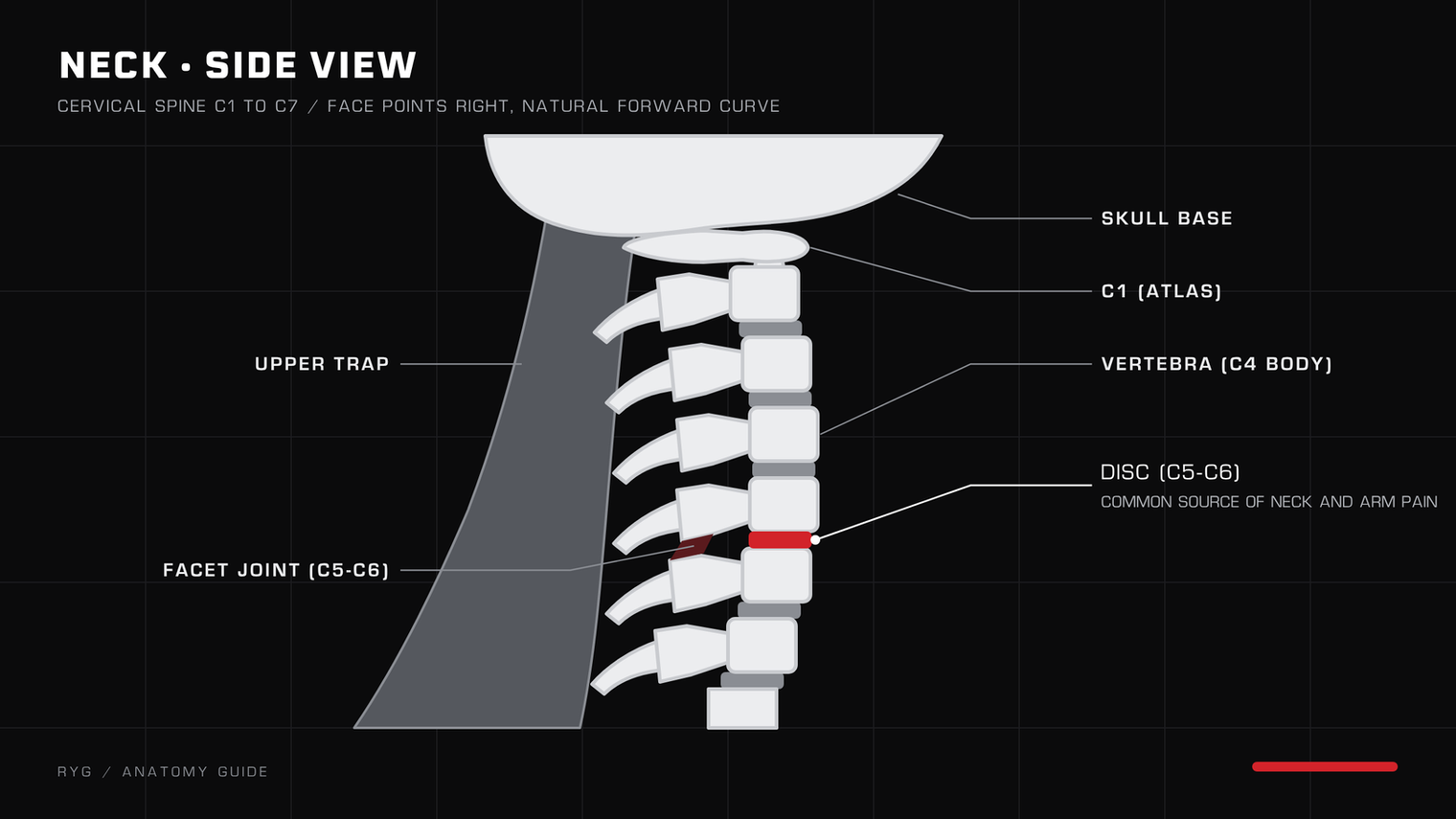
The small joints along the back of the neck, the facet joints, close down when you look up. Hold that position hundreds of times a week under the load of a full body serve and they get irritated like any other overworked joint. The deep muscles that support the front of the neck fatigue, the upper traps take over, and by the third set the whole area feels like it is being squeezed.
Most tennis neck pain is mechanical: it comes from load and position, not from damage. That matters, because mechanical neck pain responds to movement and strength, not to collars and rest.
What the research says
- Neck pain is common in athletes: between 38% and 73% have it in a given year depending on the sport, and about 48% have had it at some point1.
- For a fresh mechanical neck strain, the JOSPT clinical practice guideline recommends thoracic manipulation, a neck range of motion program, and shoulder blade and arm strengthening, not rest2.
- Strengthening the neck, shoulder blade and upper limb muscles reduces chronic neck pain by a moderate to large amount, while stretching alone produces no measurable benefit3.
- Twelve months of neck strength training raised maximal neck strength by 69% to 110% and reduced pain and disability, and the authors concluded stretching and aerobic exercise alone were much less effective than strengthening4.
- The thoracic spine is often a silent contributor to neck and shoulder problems, and mobilizing it has growing evidence for helping pain that is felt somewhere else5.
- Neck pain that refers into the arm is treated with intermittent traction combined with stretching, strengthening and spinal mobilization, plus encouragement to keep working and exercising2.
What we do about it
Restore the mid back first. Open books, foam roller extensions and thoracic rotation drills give the serve the upper back motion it needs so the neck stops doing all the arching. Hands on thoracic mobilization is part of this in the clinic, consistent with the guideline.
Build the deep neck muscles. Chin nod holds and progressive resisted neck work build the small muscles that support the neck in that tilted back position. We progress the resistance over weeks, because the research effect comes from getting stronger, not from a few gentle reps.
Fix the toss and the volume. A toss that drifts behind you forces extra arching. A slightly lower, more forward toss often takes pressure off the neck in a single session. Serve volume is trimmed, not eliminated, then rebuilt. This is the progression we run in the clinic, with a test at every phase before you move on.
When to get it looked at
- Pain that shoots down the arm, or numbness or tingling in the fingers.
- A neck that locks and will not turn, especially after a fall or a collision at the net.
- Weakness in the hand or arm, or dropping things.
- Dizziness, visual changes or a severe headache that comes on with neck movement.
- Neck pain that has stayed the same for more than six weeks despite consistent exercise.
Bottom line
Serving asks the neck to look up hundreds of times a week, and a stiff upper back makes that job harder. The guideline backed fix is mobility for the mid back plus progressive strength for the neck and shoulder blade, and stretching alone will not get you there. An in-person evaluation can usually spot a toss problem in a few minutes.
References
- Noormohammadpour P, Farahbakhsh F, Farahbakhsh F, et al. Prevalence of Neck Pain among Athletes: A Systematic Review. Asian Spine J. 2018;12(6):1146-1153. PubMed
- Blanpied PR, Gross AR, Elliott JM, et al. Neck Pain: Revision 2017 (Clinical Practice Guidelines Linked to the International Classification of Functioning, Disability and Health From the Orthopaedic Section of the American Physical Therapy Association). J Orthop Sports Phys Ther. 2017;47(7):A1-A83. PubMed
- Gross A, Kay TM, Paquin JP, et al. Exercises for mechanical neck disorders. Cochrane Database Syst Rev. 2015;1(1):CD004250. PubMed
- Ylinen J, Takala EP, Nykänen M, et al. Active neck muscle training in the treatment of chronic neck pain in women: a randomized controlled trial. JAMA. 2003;289(19):2509-2516. PubMed
- Heneghan NR, Rushton A. Understanding why the thoracic region is the 'Cinderella' region of the spine. Man Ther. 2016;21:274-276. PubMed
It was such a great time, and with the exercises and stretching, my neck felt a lot better afterward. Will definitely recommend it.
This article is for education and does not replace an evaluation. If you're dealing with an active injury, see a licensed medical provider.