
Neck Pain After Volleyball: What Serving and Hitting Have to Do With It
 Volleyball
Neck pain sneaks up on volleyball players. It rarely starts with one big moment. More often it builds over a season, shows up when you look up to track a serve, and gets cranky after long car rides to tournaments. Parents often worry something serious is going on, and while it is smart to get checked, most volleyball neck pain comes from muscles and joints that are overworked, not damaged.
The fix is also not what most families expect. It is rarely a collar, a pillow or a stretching routine. It is strength.
What's actually going on
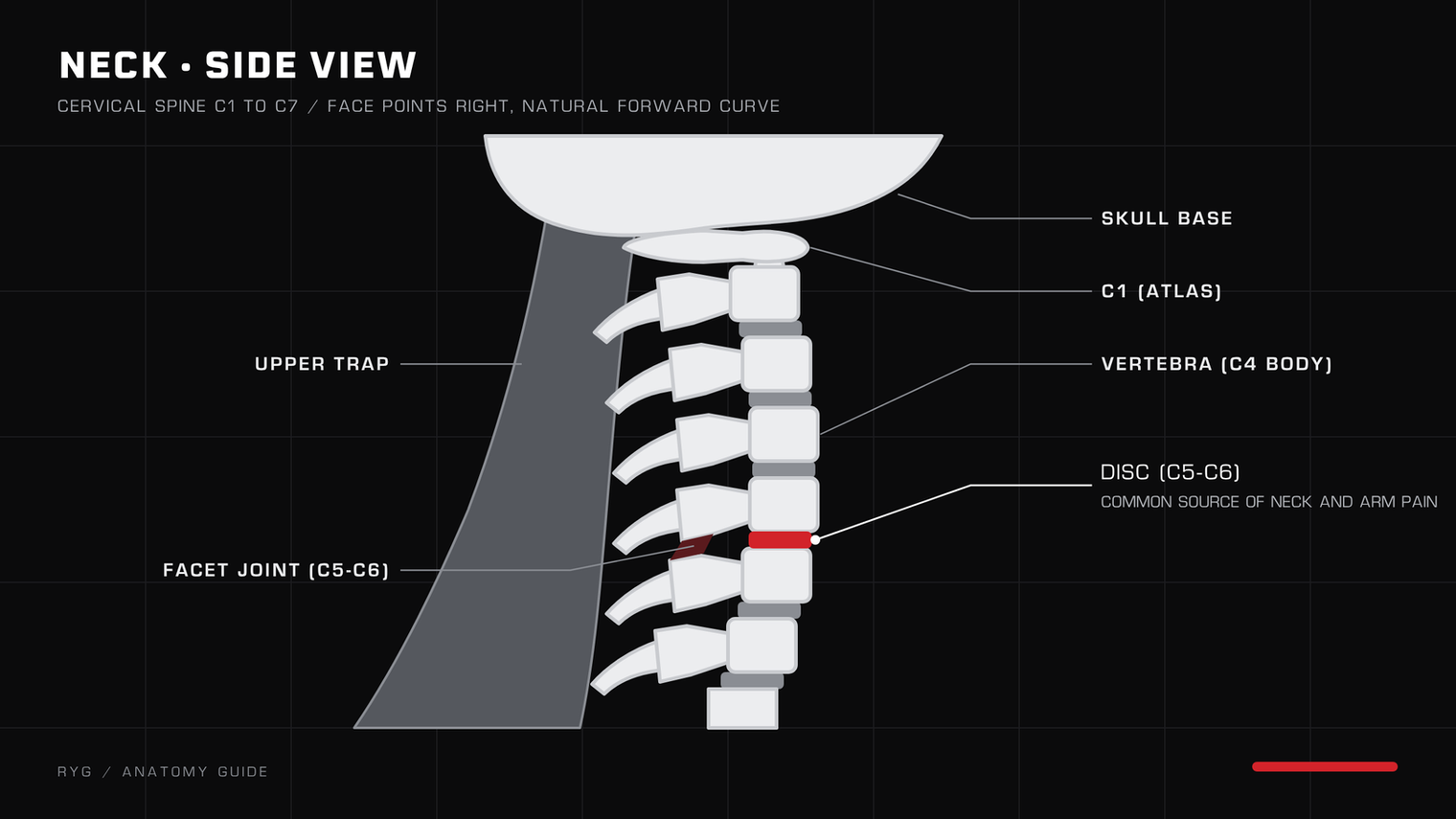
Every serve and every swing asks your neck to do two things at once: hold your head steady while your eyes track a ball overhead, and anchor the shoulder blade while the arm whips through at speed. The small deep muscles along the front of the neck handle the first job. The bigger muscles connecting the neck to the shoulder blade, the trapezius and levator scapulae, handle the second. If the shoulder blade does not move well, or the upper back is stiff from school desks and phones, the neck muscles absorb demand that should be spread across the whole upper body. They fatigue, tighten, and develop tender spots that refer pain up into the skull and out toward the shoulder. Long rides in a car seat afterward lock the whole system in one position and make it worse.
What the research says
- Neck pain is not rare in athletes. Depending on the sport, between 38% and 73% have it in a given year, and about half have had it at some point1.
- For a fresh mechanical neck strain, the clinical practice guideline recommends thoracic (upper back) manipulation plus a neck range-of-motion program and shoulder blade and arm strengthening, not rest2.
- Chronic neck pain responds best to a combined program of hands-on manual therapy plus mixed exercise for the neck and shoulder girdle, including strengthening, endurance and aerobic conditioning2.
- A Cochrane review of 27 trials found that strengthening the neck, shoulder blade and upper limb muscles reduces chronic neck pain by a moderate-to-large amount, while stretching on its own produced no measurable benefit3.
- Twelve months of neck strength training raised maximal neck strength by 69% to 110% and reduced pain and disability, and the authors concluded stretching and aerobic exercise alone were much less effective than strengthening4.
- Overhead athletes with shoulder symptoms show higher upper trapezius activity and lower middle and lower trapezius activity than healthy athletes, which is why a sore neck in a hitter is often a shoulder blade problem in disguise5.
Notice what is missing from that list: collars, long rest and stretching-only plans. The evidence points the other direction.
What we do about it
We start with a hands-on exam of the neck, upper back and shoulder blade. A simple test you can try at home is turning your head fully each way. If one side feels blocked or reproduces your pain, that is useful information, and it usually points to a stiff segment that responds to manual therapy and motion work.
Then the real work. Deep neck flexor training, which looks like a gentle chin nod held against resistance, builds the muscles that hold your head steady during a swing. Upper back extension and rotation mobility takes load off the neck. Scapular strengthening with rows, prone Y and T lifts and serratus work cleans up the shoulder blade mechanics that were overloading the neck in the first place. We progress resistance every week because the research effect comes from getting stronger, not from going through the motions.
The last phase is serve and attack volume rebuilt in steps while we track neck strength and symptoms. Players in This is the progression we run in the clinic, with a test at every phase before you move on.
When to get it looked at
- Neck pain after a collision, fall or hard landing on the head, especially with dizziness, nausea or confusion.
- Numbness, tingling or weakness in an arm or hand.
- Pain that is constant, worse at night, or paired with fever or unexplained weight loss.
- Loss of balance, clumsiness or changes in walking.
- Neck pain that has not improved after two to three weeks of self-care.
Bottom line
Most volleyball neck pain is a strength and mechanics problem that builds over a season, and the research consistently shows that strengthening the neck and shoulder girdle beats stretching and rest. Upper back mobility and shoulder blade control are part of the fix. If the pain came from an impact, or there are arm symptoms, get it evaluated. Otherwise a focused program, in person, gets most players turning their head freely and serving without the ache.
References
- Noormohammadpour P, Farahbakhsh F, Farahbakhsh F, et al. Prevalence of Neck Pain among Athletes: A Systematic Review. Asian Spine J. 2018;12(6):1146-1153. PubMed
- Blanpied PR, Gross AR, Elliott JM, et al. Neck Pain: Revision 2017 (Clinical Practice Guidelines Linked to the International Classification of Functioning, Disability and Health From the Orthopaedic Section of the American Physical Therapy Association). J Orthop Sports Phys Ther. 2017;47(7):A1-A83. PubMed
- Gross A, Kay TM, Paquin JP, et al. Exercises for mechanical neck disorders. Cochrane Database Syst Rev. 2015;1(1):CD004250. PubMed
- Ylinen J, Takala EP, Nykänen M, et al. Active neck muscle training in the treatment of chronic neck pain in women: a randomized controlled trial. JAMA. 2003;289(19):2509-2516. PubMed
- Cools AM, Declercq GA, Cambier DC, et al. Trapezius activity and intramuscular balance during isokinetic exercise in overhead athletes with impingement symptoms. Scand J Med Sci Sports. 2007;17(1):25-33. PubMed
It was such a great time, and with the exercises and stretching, my neck felt a lot better afterward. Will definitely recommend it.
This article is for education and does not replace an evaluation. If you're dealing with an active injury, see a licensed medical provider.