
Turf Toe in Baseball: The Small Joint Injury With an Outsized Effect on Speed and Power
 Baseball
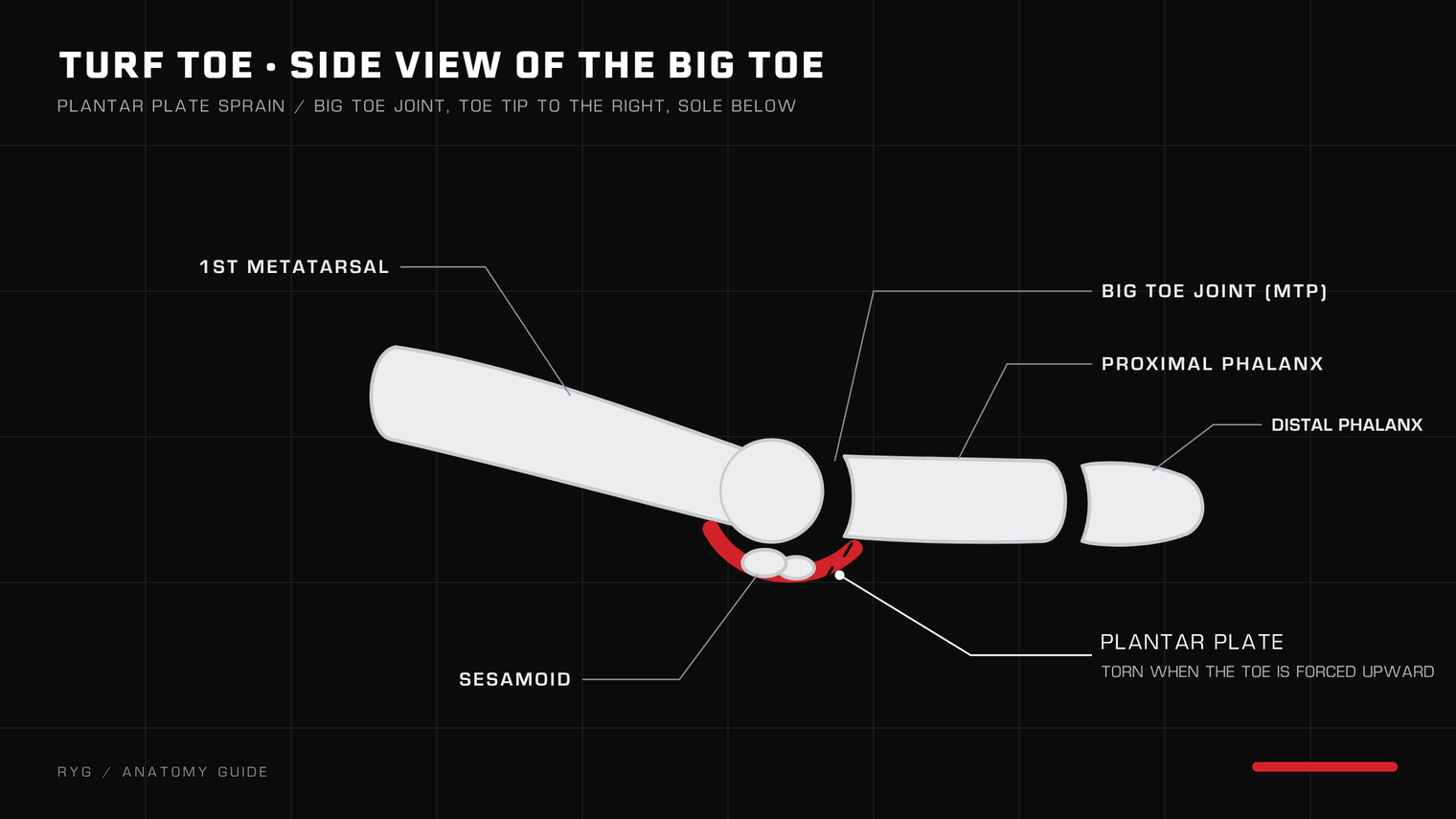
Turf toe sounds minor until you have it. It is a sprain of the ligaments under your big toe joint, usually from the toe getting bent upward past its limit, and it turns the simple act of pushing off into a wince. Baseball serves up the classic mechanisms constantly, a foot jamming into the base on a slide, a cleat catching in the dirt during a swing, or a hard push off where the toe gets levered back under full body weight.
What's actually going on
Why does such a small joint matter so much? Because the big toe is the last point of contact in every sprint stride and every pitch off the rubber. At push off, that joint bends up hard while transmitting large forces. The structures under the joint work like a pulley system for power transfer, and when they are sprained, your body instantly finds workarounds, rolling to the outside of the foot, shortening the stride, cutting the push short. Speed and drive quietly drain away, and the compensations start irritating the ankle, shin, and hip.
The research on this injury comes mostly from football, where the mechanism and the surface are well documented, and the lessons about grading and timelines carry straight over to baseball.
What the research says
- Turf toe is a hyperextension injury of the big toe joint in 85 percent of cases, and in the original professional football series 83 percent of players were first injured on artificial turf1.
- In college football, turf toe occurred at 0.062 per 1,000 athlete-exposures, nearly 14 times more often in games than practice, and cost an average of 10 days; rates were almost twice as high on modern artificial turf as on natural grass2.
- Fewer than 2 percent of turf toe injuries needed surgery; the rest are managed with protection, taping, and a graded return2,3.
- Recovery depends on grade: a grade I sprain returns as tolerated, a grade II partial tear takes about 2 weeks, and a grade III complete tear needs at least 10 to 16 weeks and sometimes surgical repair4.
- Players who needed surgical repair of a complete injury missed an average of 16.5 weeks but had good outcomes about 2 years later, with pain under 1 out of 10, and NFL players who returned from turf toe performed at the same level as uninjured peers over the next 2 seasons3,5.
- The injury leaves a mark. A past turf toe left the big toe joint with about 8 degrees less dorsiflexion, 40.6 versus 48.4 degrees, and higher peak pressure under the toe, which is why restoring motion and push-off strength matters6.
What we do about it
The first step is grading, because the grade sets the timeline and expectations4. We test the joint's stability, motion, and tenderness, and we look for the signs of a complete tear that needs a surgeon's opinion.
For grade I and II sprains, early care is protection that still lets you move: taping that limits the toe bending up, a stiff insole or plate in the cleat, and walking as tolerated. Then we restore motion in the joint and rebuild push-off strength through toe flexor work, calf raises with the toe loaded, and short-foot and arch exercises. The last phase retrains acceleration, the drive off the rubber, and base running, with the stiff plate kept in the cleat for the rest of the season as needed.
We measure big toe dorsiflexion on both sides before clearance, because the lost motion is what lingers and drives the compensations6. This is the progression we run in the clinic, with a test at every phase before you move on.
When to get it looked at
- A pop under the big toe with immediate inability to push off or bear weight on the forefoot.
- The toe feels loose, drifts, or cannot be pushed down against resistance, which can mean a complete tear.
- Significant swelling and bruising under the joint within hours.
- Big toe pain that started without an injury and is stiff rather than sprained, which can be joint arthritis instead of turf toe7.
- A sprain that is not clearly improving after 2 weeks of protection and loading.
Bottom line
Turf toe is a small joint with an outsized job, and the research says the grade decides the timeline, from days for a mild sprain to months for a complete tear. Most heal without surgery, but the lost motion lingers if the joint is not restored. If your big toe got bent back on a slide or a push off, an in-person evaluation can grade it and set the plan.
References
- Rodeo SA, O'Brien S, Warren RF, et al. Turf-toe: an analysis of metatarsophalangeal joint sprains in professional football players. Am J Sports Med. 1990;18(3):280-285. PubMed
- George E, Harris AH, Dragoo JL, et al. Incidence and risk factors for turf toe injuries in intercollegiate football: data from the national collegiate athletic association injury surveillance system. Foot Ankle Int. 2014;35(2):108-115. PubMed
- Smith K, Waldrop N. Operative Outcomes of Grade 3 Turf Toe Injuries in Competitive Football Players. Foot Ankle Int. 2018;39(9):1076-1081. PubMed
- McCormick JJ, Anderson RB. Turf toe: anatomy, diagnosis, and treatment. Sports Health. 2010;2(6):487-494. PubMed
- Tran A, Kappa J, Smith E, et al. The Effect of Turf Toe Injuries on Player Performance in the National Football League. Iowa Orthop J. 2019;39(2):35-39. PubMed
- Brophy RH, Gamradt SC, Ellis SJ, et al. Effect of turf toe on foot contact pressures in professional American football players. Foot Ankle Int. 2009;30(5):405-409. PubMed
- Roddy E, Thomas MJ, Marshall M, et al. The population prevalence of symptomatic radiographic foot osteoarthritis in community-dwelling older adults: cross-sectional findings from the clinical assessment study of the foot. Ann Rheum Dis. 2015;74(1):156-163. PubMed
My son saw Alex for an injury he had been suffering from for over a year. We tried several different treatments from dry needling, laser treatment, going to a different PT person, and the a foot dr. Alex was the only one who actually improved his pain completely. Not only did he explain how to improve the strength in his foot, but also how and why he was continuing to injure it. My high school son enjoyed working with him and respected his input. He had no issues doing the recommended exercises. We are thankful for his help and will definitely use him again if need! If you are struggling with an injury, don’t wait any longer!
I recommend RYG to anyone struggling with a lingering injury or chronic problem that has yet to be diagnosed. A mysterious non-muscular issue in my foot had been giving me trouble for months. I came to RYG and within 48 hours I had a detailed outlined plan for rehab, a specific diagnosis, and prevention methods for future flare ups. I recovered shortly and haven’t had trouble since. I just started my track season off with a win in the 55m at the UW-Whitewater meet. All thanks to RYG!
This article is for education and does not replace an evaluation. If you're dealing with an active injury, see a licensed medical provider.