
Wrist Pain in Baseball Players: Why Hitters and Fielders Should Not Swing Through It
 Baseball
The wrist is where every swing gets its final snap. Bat speed builds from the ground up, but the last link in the chain is a pair of wrists that whip the barrel through the zone and then absorb the shock of contact, especially on those stinging off center hits in cold April weather. Add in headfirst slides, diving stops, and catching balls in the palm, and baseball gives wrists plenty of chances to complain.
What's actually going on
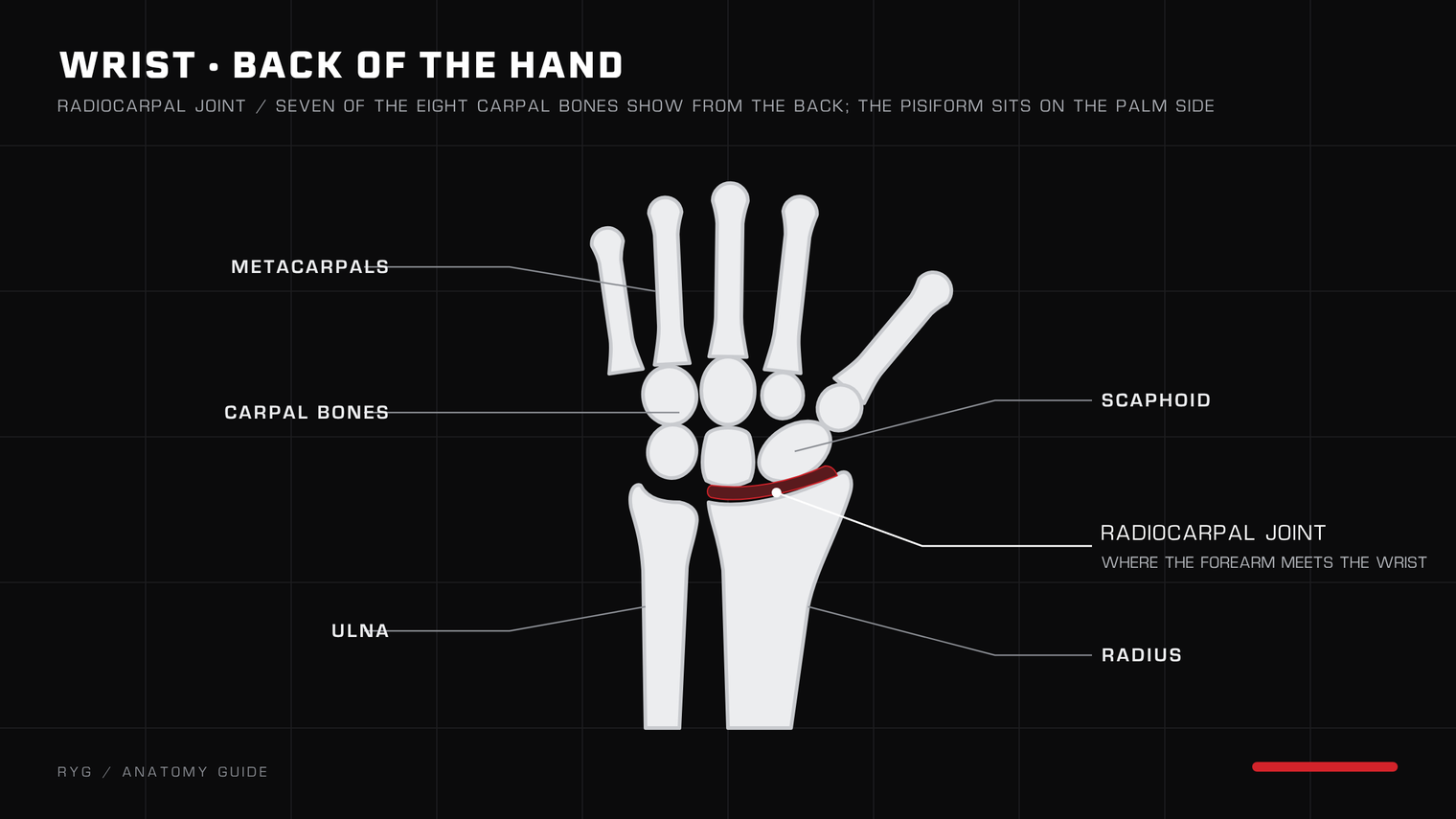
Most baseball wrist pain falls into a few buckets. Tendon irritation on the thumb side or pinky side from thousands of swings. Sprains from slides and dives where the wrist gets bent backward under body weight. And in hitters specifically, pain at the base of the palm on the bottom hand that can involve the hamate, a small hook shaped bone that the bat handle presses against on every swing.
The ones that matter most are the ones that get missed. A fall on an outstretched hand can crack the scaphoid, a small bone on the thumb side that heals poorly if it is played on. A hook of hamate fracture can hide behind weeks of vague palm pain. Both need a specific diagnosis, not a wrap and a week off1.
What the research says
- Hand and wrist injuries make up as much as 25 percent of all athletic injuries. In a review of 4,299 injuries in professional athletes, baseball was among the most common sports, only 18 percent of injuries needed surgery, and average return to play was 2.8 months, with most athletes getting back to their previous performance2.
- The hamate is a hitter's injury. In 261 professional baseball players who had the hook of the hamate removed, 96 percent of the fractures came from hitting and 86 percent were on the bottom hand of the swing3.
- After hamate excision, 84 percent returned to sport and 81 percent returned at the same or higher level, at a median of 48 days3.
- The scaphoid accounts for over 85 percent of sport-related carpal fractures. Cast treatment healed 85 percent of them over about 14 weeks, screw fixation healed 97 percent in about 10 weeks and returned athletes roughly 2 weeks sooner, and immediate return to sport in a cast should be avoided because of the risk of non-union4.
- Scans need context. In 103 volunteers with no wrist pain, 39 wrists showed TFCC abnormalities on MRI and 23 looked like complete tears, so an abnormal wrist MRI has to be matched to the exam and the story5.
- Most minor wrist problems in rotational sports can be managed by adjusting technique and practice volume so the athlete keeps playing, while structural injuries need a specific plan and time away6.
What we do about it
Step one is ruling out the injuries that cannot be swung through. A fall on the hand with thumb-side pain gets a scaphoid work-up, and bottom-hand palm pain in a hitter gets the hamate checked, because both are injuries where delay changes the outcome4,3.
For tendon irritation and sprains, the plan is load management rather than rest. We modify swing volume and grip pressure, then rebuild wrist and forearm strength through isometrics, heavy slow resistance for the flexors and extensors, and rotational loading that mimics contact. Hitting returns in stages, dry swings, tee, front toss, live, with each stage earned by a pain-free previous one. This is the progression we run in the clinic, with a test at every phase before you move on.
When to get it looked at
- Thumb-side wrist pain after a fall on an outstretched hand, especially with tenderness in the hollow at the base of the thumb.
- Deep palm pain on the bottom hand that hurts with every swing, which can be a hook of hamate fracture.
- Pinky-side pain with clicking or a feeling that the forearm bones are loose.
- Numbness, tingling, or weakness in the ring and little fingers.
- Wrist pain that has not improved after 2 weeks of modified swinging.
Bottom line
Most wrist pain in baseball is a tendon or sprain problem that improves with smart loading, but a few injuries, the scaphoid and the hamate above all, need to be named early. If your wrist hurts on a specific spot or a specific swing, an in-person evaluation can tell you whether to keep swinging or get an image.
References
- Rettig AC. Athletic injuries of the wrist and hand. Part I: traumatic injuries of the wrist. Am J Sports Med. 2003;31(6):1038-1048. PubMed
- Lehman JD, Krishnan KR, Stepan JG, et al. Prevalence and Treatment Outcomes of Hand and Wrist Injuries in Professional Athletes: A Systematic Review. HSS J. 2020;16(3):280-287. PubMed
- Erickson BJ, Mcelheny K, Chalmers PN, et al. Performance and Return to Sport After Excision of the Fractured Hook of the Hamate in Professional Baseball Players. Am J Sports Med. 2020;48(12):3066-3071. PubMed
- Goffin JS, Liao Q, Robertson GA. Return to sport following scaphoid fractures: A systematic review and meta-analysis. World J Orthop. 2019;10(2):101-114. PubMed
- Iordache SD, Rowan R, Garvin GJ, et al. Prevalence of triangular fibrocartilage complex abnormalities on MRI scans of asymptomatic wrists. J Hand Surg Am. 2012;37(1):98-103. PubMed
- Hawkes R, O'Connor P, Campbell D. The prevalence, variety and impact of wrist problems in elite professional golfers on the European Tour. Br J Sports Med. 2013;47(17):1075-1079. PubMed
Alex is very approachable and makes you feel comfortable. Wrote me a program to rehab my broken wrist that I had surgery on. You can tell he truly cares and takes his profession seriously.
This article is for education and does not replace an evaluation. If you're dealing with an active injury, see a licensed medical provider.