
AAU Workload and Injuries: Why Playing Five Games in a Weekend Breaks Young Bodies
 Basketball
Every spring the same wave rolls through our clinic. Knees that ache below the kneecap, heels that hurt with every step, backs that seized up on Sunday afternoon, and the story behind them is nearly identical. A tournament weekend with four or five games in two days, on top of a school season that just ended, on top of practices with two different teams. The individual games are not the problem. The math is, and the research on youth athletes puts numbers on it.
What's actually going on
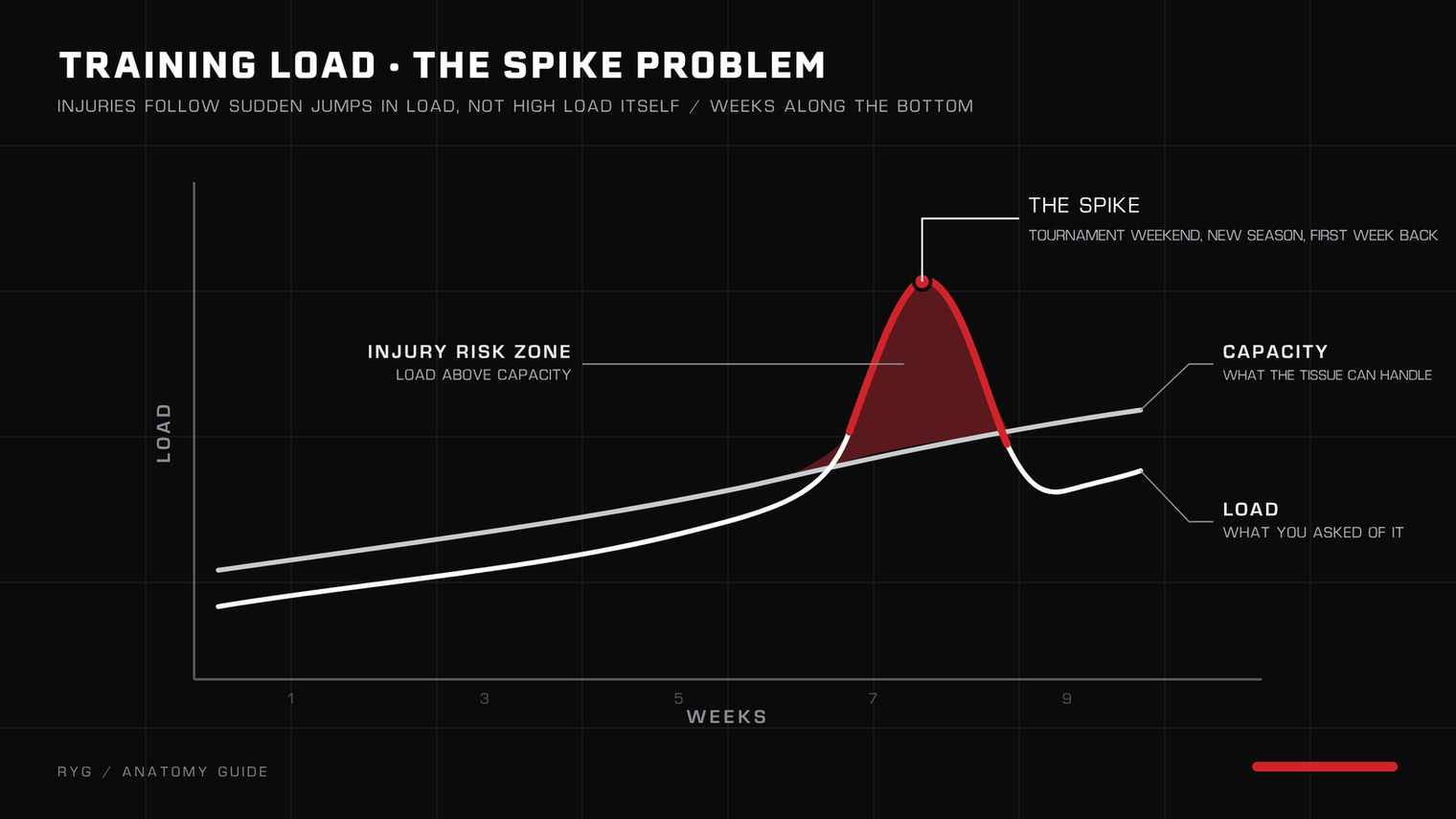
Tissues like tendon and bone adapt to load on a lag, getting stronger for weeks after training, but only when stress and recovery alternate. A normal week might ask a young player's patellar tendons and growth plates to handle one game and three practices with sleep between each. A tournament weekend can pack a month's worth of jumps and sprints into 48 hours, with hotel sleep and food-court fuel in between. Growing athletes are the most vulnerable because their growth plates are softer than the mature bone around them.
Non-contact injuries are rarely caused by training itself. They are caused by how fast the load changes relative to what the body is used to, and athletes who are accustomed to high loads actually get hurt less than under-trained athletes who spike1.
What the research says
- Between 46% and 54% of all youth sports injuries are overuse injuries, not acute ones2.
- A young athlete who spends more hours per week in organized sport than their age in years has about twice the odds of a serious overuse injury, and kids whose organized sport time outweighs free play by more than 2 to 1 have 1.9 times the odds3.
- High school athletes who played a sport year-round reported 42% more overuse injuries than those who played three seasons or fewer, and training more than 16 hours per week was linked to higher injury risk2.
- Among 1,544 Wisconsin high school athletes, high competition volume doubled the odds of a prior lower-extremity injury and playing club sports raised it 1.5 times4.
- Female youth basketball players were nearly 4 times more likely to report an overuse injury than their male counterparts5.
- In adolescent soccer players, a spike in that day's training load roughly doubled the odds of injury, and worse mood that day was an independent predictor as well6.
- Highly specialized young athletes have 1.8 times the risk of an overuse injury compared with kids who play multiple sports7, and fewer than 1 in 5 former NCAA athletes specialized before age 15, with early specializers no more likely to earn a scholarship but burning out at a higher rate8.
- Overtraining is a whole-body problem: it lowers performance, raises injury and illness risk, and disrupts hormonal, neurologic and psychological systems9.
What we do about it
None of this is an argument against AAU, which offers competition and exposure kids cannot get elsewhere. It is an argument for managing it like the physical stress it is, using the thresholds the research identified. Keep total organized basketball under the athlete's age in hours per week. Keep organized sport to free play under 2 to 1. Protect one full rest day weekly, and take a genuine off-season, keeping any single sport under about 8 months of the year, since year-round single-sport play is the working definition of specialization and a risk factor on its own10. Play a second sport if the athlete enjoys it, because the data say it lowers overuse risk and does not cost a scholarship.
During tournament weekends, prioritize sleep, real food, and easy movement between games, and afterward treat the following week as recovery rather than jumping straight into practices with the next team. We also track mood and soreness with a simple daily check-in for the athletes we work with, because the research says a bad-mood day is itself a warning sign. When an athlete does arrive with an overuse injury, the plan is a graded return built around load rather than full rest, with strength work added, since well-designed resistance training can cut overuse injuries in young athletes by roughly half11.
When to get it looked at
- Pain at the bump below the kneecap, the heel, or the low back that keeps tracking with the tournament calendar.
- A limp during or after games, or pain that lasts into the next day's school.
- Back pain in a young athlete that worsens with arching and has lasted more than two weeks.
- Declining performance, persistent fatigue, trouble sleeping or a change in mood alongside aches, which can signal overtraining.
- Any pain the athlete is hiding to keep playing.
Bottom line
The hardest part is that nobody in the system, coaches, tournament directors or the athlete, is positioned to say slow down. That job lands on parents, and the research gives you the numbers to do it: hours under age, free play protected, a real off-season, and recovery after the spike. If your athlete's aches keep tracking with the schedule, an in-person evaluation is a good place to start.
References
- Gabbett TJ. The training-injury prevention paradox: should athletes be training smarter and harder?. Br J Sports Med. 2016;50(5):273-280. PubMed
- DiFiori JP, Benjamin HJ, Brenner J, et al. Overuse injuries and burnout in youth sports: a position statement from the American Medical Society for Sports Medicine. Clin J Sport Med. 2014;24(1):3-20. PubMed
- Jayanthi NA, LaBella CR, Fischer D, et al. Sports-specialized intensive training and the risk of injury in young athletes: a clinical case-control study. Am J Sports Med. 2015;43(4):794-801. PubMed
- Post EG, Bell DR, Trigsted SM, et al. Association of Competition Volume, Club Sports, and Sport Specialization With Sex and Lower Extremity Injury History in High School Athletes. Sports Health. 2017;9(6):518-523. PubMed
- Post EG, Biese KM, Schaefer DA, et al. Sport-Specific Associations of Specialization and Sex With Overuse Injury in Youth Athletes. Sports Health. 2020;12(1):36-42. PubMed
- Watson A, Brickson S, Brooks A, et al. Subjective well-being and training load predict in-season injury and illness risk in female youth soccer players. Br J Sports Med. 2017;51(3):194-199. PubMed
- Bell DR, Post EG, Biese K, et al. Sport Specialization and Risk of Overuse Injuries: A Systematic Review With Meta-analysis. Pediatrics. 2018;142(3):e20180657. PubMed
- Rugg CM, Coughlan MJ, Li JN, et al. Early Sport Specialization Among Former National Collegiate Athletic Association Athletes: Trends, Scholarship Attainment, Injury, and Attrition. Am J Sports Med. 2021;49(4):1049-1058. PubMed
- Brenner JS, Watson A, Council on Sports Medicine and Fitness. Overuse Injuries, Overtraining, and Burnout in Young Athletes. Pediatrics. 2024;153(2):e2023065129. PubMed
- Myer GD, Jayanthi N, DiFiori JP, et al. Sport Specialization, Part I: Does Early Sports Specialization Increase Negative Outcomes and Reduce the Opportunity for Success in Young Athletes?. Sports Health. 2015;7(5):437-442. PubMed
- Lloyd RS, Faigenbaum AD, Stone MH, et al. Position statement on youth resistance training: the 2014 International Consensus. Br J Sports Med. 2014;48(7):498-505. PubMed
This article is for education and does not replace an evaluation. If you're dealing with an active injury, see a licensed medical provider.