
Achilles Pain in Basketball: Warning Signs, Smart Rehab, and What KD's Comeback Teaches Us
 Basketball
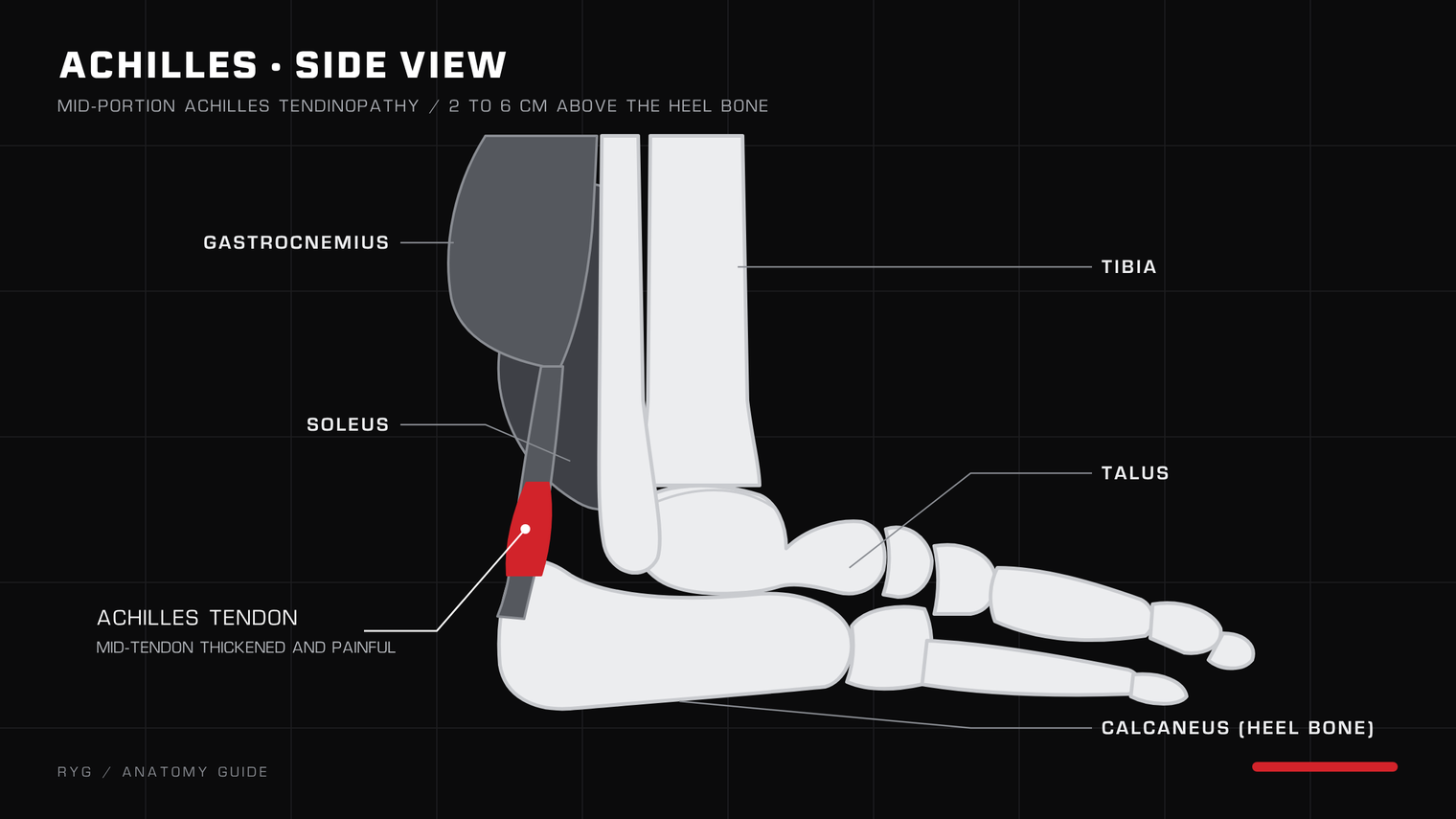
 players feel a special kind of dread about the Achilles, and the fear is not irrational, but it does need context. The vast majority of Achilles pain in basketball is tendinopathy, an overloaded, achy tendon, not a rupture waiting to happen. The pattern is familiar to anyone who has had it. Stiffness with the first steps out of bed, an ache that warms up during play and returns after, and tenderness when you pinch the tendon a few centimeters above the heel.
What's actually going on
The mechanism mirrors jumper's knee, one story lower. Your Achilles stores and releases energy like a spring on every jump and sprint. Tendon tissue adapts to load slowly, over weeks, and basketball's jump volume can outpace that adaptation, especially after a sudden spike: a new season, a minutes jump, or a return from time off. When loading beats adaptation for long enough, the tendon's structure changes and it starts to complain. The guideline frames the condition around three things: pain, stiffness, and a loss of calf power1. Rest alone quiets it but weakens it, so the ache comes back when play resumes.
What the research says
- Having had Achilles pain in the previous 12 months raises the odds of a new episode more than 6-fold, the strongest risk factor identified2.
- Roughly a third of runners with a new episode of Achilles tendinopathy still have symptoms a year later, which is why early loading-based rehab matters3.
- Athletes who kept running and jumping with pain monitored and capped at 5 out of 10 during rehab improved just as much at 12 months as those who stopped for 6 weeks, with no harm to the tendon4.
- Heavy slow resistance training and eccentric heel drops give equally good results that last a year, but heavy slow resistance had 92% session adherence versus 78% and 100% patient satisfaction at 12 weeks versus 80%5. Twelve weeks of loading also reduced tendon thickness and abnormal blood vessel growth on imaging5.
- Exercise should be given at least 3 months before other options are considered, and recovery can take up to a year6.
- For a complete rupture, surgery lowers re-rupture risk from 3.9% to 2.3% but raises complication risk from 1.6% to 4.9%, and with early-motion functional rehab the re-rupture difference disappears7.
- Nearly 1 in 3 professional athletes (30.6%) never returned to play after a surgically repaired Achilles rupture, and those who did played fewer games and performed below their pre-injury level in year 1, with performance matching uninjured peers by year 2. NBA players were the most affected league8.
What we do about it
The fix is progressive loading, and the research says you do not have to stop playing to do it. We use the pain-monitoring model from the trial: pain up to 5 out of 10 during and after activity is acceptable, it should settle by the next morning, and it should not be getting worse week over week4. Within those rules, players usually keep practicing in modified form.
The loading ladder starts with isometric calf holds, which settle pain and keep the calf working. Then heavy slow calf raises, both bent-knee and straight-knee, three times a week with the load climbing, which the research favors for adherence and satisfaction. Then spring-like work such as pogo hops, and finally full jumping and sprinting. Expect a two-to-four-month arc, with the morning stiffness usually improving first. Because a previous episode is the biggest risk factor for the next one, the calf program stays in the weekly routine after you are back. This is the progression we run in the clinic, with a test at every phase before you move on.
When to get it looked at
- A sudden pop at the back of the ankle with immediate push-off weakness, which is an emergency evaluation, not a wait and see.
- A tendon that is visibly thickened, with a gap or a lump you can feel.
- Pain that has not changed after 12 weeks of a proper loading program.
- Achilles pain alongside a recent calf strain, since the two deserve full rehab before high-stakes minutes.
- Pain at the heel bone itself rather than the tendon, which is a different problem.
Bottom line
Kevin Durant's story cuts both ways. He was returning from a calf injury when his Achilles ruptured in the Finals, a reminder that calf and Achilles problems deserve full rehab before high-stakes minutes, and after surgery and a long rehab he returned to play at an elite level, which the research says most pros manage but not all. For everyday players, the lesson is simpler. Achilles pain is a loading problem with a well-mapped solution. An in-person evaluation can help you figure out how irritated your tendon is right now.
References
- Martin RL, Chimenti R, Cuddeford T, et al. Achilles Pain, Stiffness, and Muscle Power Deficits: Midportion Achilles Tendinopathy Revision 2018. J Orthop Sports Phys Ther. 2018;48(5):A1-A38. PubMed
- Lagas IF, Fokkema T, Verhaar JAN, et al. Incidence of Achilles tendinopathy and associated risk factors in recreational runners: A large prospective cohort study. J Sci Med Sport. 2020;23(5):448-452. PubMed
- Lagas IF, Fokkema T, Bierma-Zeinstra SMA, et al. How many runners with new-onset Achilles tendinopathy develop persisting symptoms? A large prospective cohort study. Scand J Med Sci Sports. 2020;30(10):1939-1948. PubMed
- Silbernagel KG, Thomeé R, Eriksson BI, et al. Continued sports activity, using a pain-monitoring model, during rehabilitation in patients with Achilles tendinopathy: a randomized controlled study. Am J Sports Med. 2007;35(6):897-906. PubMed
- Beyer R, Kongsgaard M, Hougs Kjær B, et al. Heavy Slow Resistance Versus Eccentric Training as Treatment for Achilles Tendinopathy: A Randomized Controlled Trial. Am J Sports Med. 2015;43(7):1704-1711. PubMed
- Silbernagel KG, Crossley KM. A Proposed Return-to-Sport Program for Patients With Midportion Achilles Tendinopathy: Rationale and Implementation. J Orthop Sports Phys Ther. 2015;45(11):876-886. PubMed
- Ochen Y, Beks RB, van Heijl M, et al. Operative treatment versus nonoperative treatment of Achilles tendon ruptures: systematic review and meta-analysis. BMJ. 2019;364:k5120. PubMed
- Trofa DP, Miller JC, Jang ES, et al. Professional Athletes' Return to Play and Performance After Operative Repair of an Achilles Tendon Rupture. Am J Sports Med. 2017;45(12):2864-2871. PubMed
Alex is awesome. He's responsive to ongoing issues, and he works to formulate a plan to help you achieve your end-goals.
I had been having calf issues for years that went misdiagnosed or undiagnosed through by other providers. Now, he's clearly properly diagnosed the issue and helped me implement a plan that has kept the issue from coming back. Highly recommend!
I'm a runner, and I came in with Achilles and hip pain. Alex worked with me to figure out how to rebalance my strength on both sides. Most importantly, he listened. Each time we met, he tailored my training plan based on my actual progress and how I was feeling about the various exercises. Each session felt meaningful and worth my time and money. If you are dealing with an injury that is holding you back from your fitness goals, I highly recommend Regain Your Game to get back on track and set a new standard for yourself.
This article is for education and does not replace an evaluation. If you're dealing with an active injury, see a licensed medical provider.