
Ankle Sprains in Basketball: The Complete Guide to the Sport's Most Common Injury
 Basketball
No injury owns basketball like the ankle sprain. Every player knows the moment: coming down from a rebound onto someone's foot, the ankle rolling inward, the sharp pain up the outside. Here is the part that should change how seriously you take it. The research says roughly 1 in 3 athletes re-sprains within a year under usual care, and up to 40% of first sprains go on to chronic instability. That is not because sprains are doomed to linger. It is because most of them are never actually rehabbed.
What's actually going on
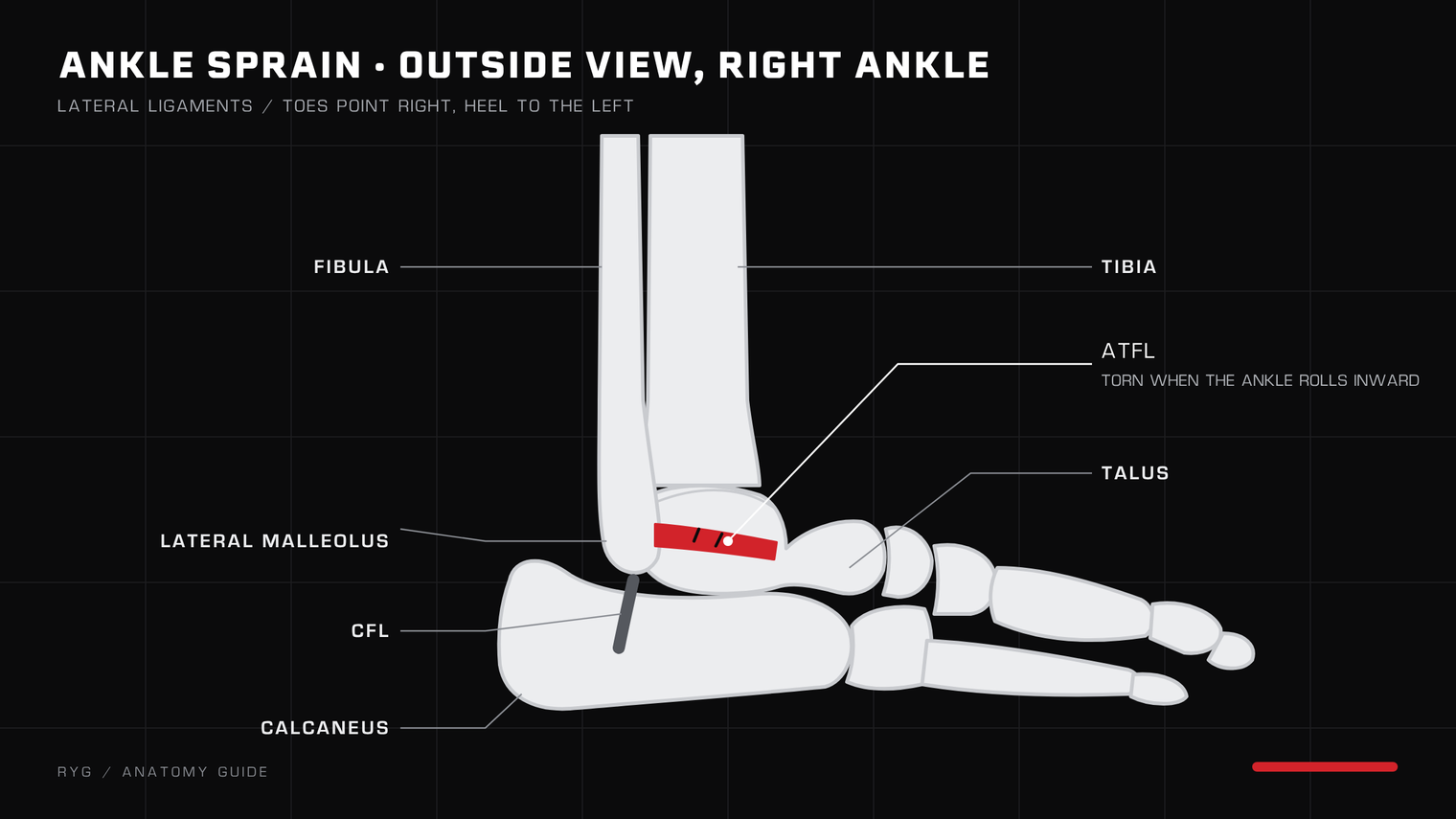
What tears in a typical sprain are the ligaments on the outside of the ankle, most often the ATFL, a small band connecting your fibula to your foot. Ligaments do two jobs. They hold bones together, and they are packed with sensors that tell your brain where your foot is in space. That second job is the one everyone forgets. After a sprain, even once the ligament heals, that position sense stays degraded unless it is retrained, which is why re-sprains so often happen on routine plays. The brain simply gets the foot's position wrong by a few degrees at landing.
What the research says
- Indoor and court sports carry the highest ankle sprain rate of any sport category, about 7 per 1,000 exposures, and female athletes sprain ankles at roughly twice the rate of males1.
- Up to 40% of people who sprain an ankle for the first time develop chronic ankle instability: repeated sprains, giving way, and persistent pain, swelling or weakness more than a year after the injury2.
- Under usual care, about 1 in 3 athletes (33%) re-sprains the same ankle within a year; adding an 8-week home balance program cut that to 22%, a 35% reduction3.
- Current guidelines favour a brace or tape plus a supervised exercise program over rest and passive treatments, with surgery reserved for sprains that fail thorough rehab4. Bracing has strong evidence and neuromuscular training moderate evidence for preventing a repeat sprain5.
- People who started exercise in the first week after a sprain had better function at weeks 1 and 2 than those who rested, iced, compressed and elevated, with the same 4% reinjury rate6. The physical therapy guideline gives its strongest grade to progressive weight bearing and structured exercise and only a Grade C to ice7.
- The severity of a sprain is judged most reliably by a hands-on exam 4 to 5 days after injury, once the initial swelling has settled, and guidelines caution that NSAIDs may suppress the natural healing process4.
- Being unable to do a single-leg drop landing or a drop jump 2 weeks after a first sprain predicts who will go on to chronic ankle instability8.
- In a randomized trial of 1,460 Wisconsin high school basketball players, lace-up ankle braces cut acute ankle injury rates from 1.41 to 0.47 per 1,000 exposures, including a 61% reduction in players who had already sprained an ankle before9.
What we do about it
The first week sets the tone: a brace or tape for support, progressive weight bearing from day one, and early movement rather than total immobilization, because the evidence says joints that start moving early recover faster. Being able to walk within a day or two is common with mild sprains and says nothing about whether the rehab is done. Pain quiets down in one to three weeks. The sensors and strength take four to eight, and that gap is exactly where the next sprain gets planted.
Real rehab has three pillars. Restore full motion, especially the knee-over-toes direction that sprained ankles quietly lose. Rebuild strength in the muscles that guard the ankle, particularly the peroneals along the outside of your shin. And retrain balance and landing, progressing from single-leg stands to hops, cuts and reactive landings on court, because balance training is what cut re-sprains by a third in the trial. We test the single-leg drop landing at two weeks because the research says it predicts who becomes unstable8. For players with a sprain history, a lace-up brace through the season is cheap insurance backed by a Wisconsin trial. This is the progression we run in the clinic, with a test at every phase before you move on.
When to get it looked at
- Inability to bear weight for four steps right after the injury, or pain directly on the ankle bones, which needs an X-ray.
- Numbness or tingling in the foot.
- Pain above the ankle joint that flares when you push off or twist, which may be a high ankle sprain.
- Swelling that is not settling after a week, or an ankle that still cannot do a single-leg hop at two weeks.
- A second sprain of the same ankle within a few months.
Bottom line
The difference between a two-week shrug and a full rehab is measured in future seasons. Brace it, move it early, then rebuild motion, strength and balance until the ankle passes a landing test. The research says that is what cuts the next sprain. An in-person evaluation shows you in minutes whether your old sprain ever truly finished healing.
References
- Doherty C, Delahunt E, Caulfield B, et al. The incidence and prevalence of ankle sprain injury: a systematic review and meta-analysis of prospective epidemiological studies. Sports Med. 2014;44(1):123-140. PubMed
- Hertel J, Corbett RO. An Updated Model of Chronic Ankle Instability. J Athl Train. 2019;54(6):572-588. PubMed
- Hupperets MD, Verhagen EA, van Mechelen W. Effect of unsupervised home based proprioceptive training on recurrences of ankle sprain: randomised controlled trial. BMJ. 2009;339:b2684. PubMed
- Vuurberg G, Hoorntje A, Wink LM, et al. Diagnosis, treatment and prevention of ankle sprains: update of an evidence-based clinical guideline. Br J Sports Med. 2018;52(15):956. PubMed
- Doherty C, Bleakley C, Delahunt E, et al. Treatment and prevention of acute and recurrent ankle sprain: an overview of systematic reviews with meta-analysis. Br J Sports Med. 2017;51(2):113-125. PubMed
- Bleakley CM, O'Connor SR, Tully MA, et al. Effect of accelerated rehabilitation on function after ankle sprain: randomised controlled trial. BMJ. 2010;340:c1964. PubMed
- Martin RL, Davenport TE, Fraser JJ, et al. Ankle Stability and Movement Coordination Impairments: Lateral Ankle Ligament Sprains Revision 2021. J Orthop Sports Phys Ther. 2021;51(4):CPG1-CPG80. PubMed
- Doherty C, Bleakley C, Hertel J, et al. Recovery From a First-Time Lateral Ankle Sprain and the Predictors of Chronic Ankle Instability: A Prospective Cohort Analysis. Am J Sports Med. 2016;44(4):995-1003. PubMed
- McGuine TA, Brooks A, Hetzel S. The effect of lace-up ankle braces on injury rates in high school basketball players. Am J Sports Med. 2011;39(9):1840-1848. PubMed
Our son broke his ankle in a hockey game. With his goal of being ready for spring TO’s we were on the hunt for a PT that knew the game and expectations of a hockey player. We were referred to Alex by a coach.
After meeting with/ Alex our son , wife and I were 100% this is the right guy to help our son. Alex put multiple pt plans together along with on ice plans to reintroduce skating. Most of all our son trusts and listens to Alex about the recovery process. Our son is ahead of schedule!
Pretty much the best experience we’ve ever had with a doctor.
Thank you
Lessner’s
Had an amazing time this summer rehabbing my ankle with Dr. Shuchuk. He is very knowledgeable in any area of PT and always willing and able to help any ailment you have! I thought my ankle could never be fixed, but after getting on a plan and staying consistent I have regained my game!
Thanks Shu
This article is for education and does not replace an evaluation. If you're dealing with an active injury, see a licensed medical provider.