
Ankle and Foot Prehab for Basketball: Ten Minutes That Protect Your Whole Season
 Basketball
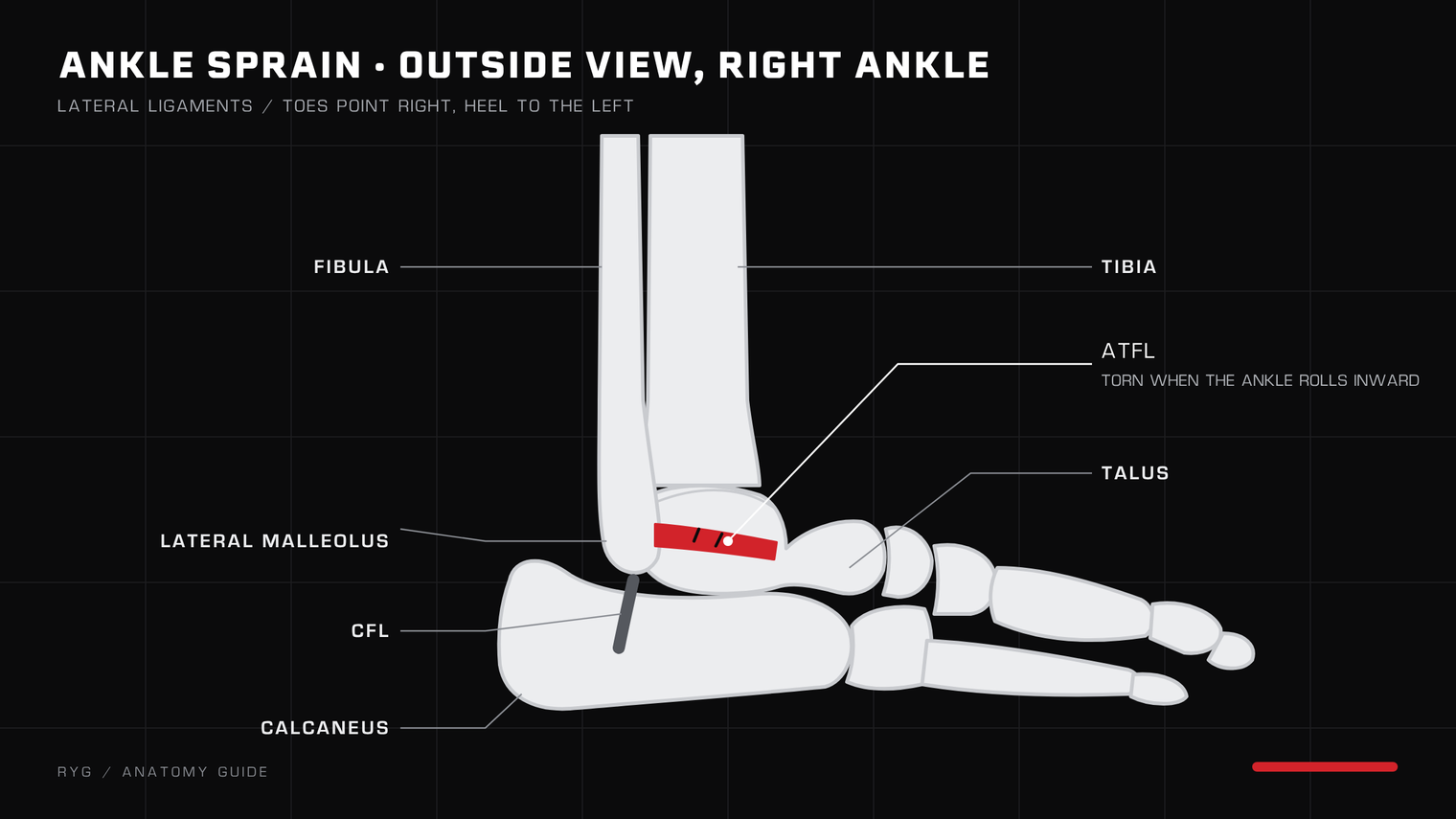
 players spend hours on their handle and their jumper and roughly zero minutes on the two structures every possession depends on, the ankles and feet. Meanwhile, ankle sprains remain the sport's most common injury, and the research verdict is unusually clear. Balance training cuts re-sprains by about a third, bracing cuts acute sprains by about two-thirds in high school basketball players, and strength training as a category cuts sports injuries to less than a third. Few things in sports medicine offer that much return on ten minutes a day.
What's actually going on
Most sprains are not strength failures. They are information failures. Your ankle's position at landing is managed by a reflex loop: sensors in the joint and muscles reporting to your brain, which fires corrections faster than conscious thought. Training balance sharpens that loop, so the foot arrives at the floor a few degrees safer and the muscles react a few milliseconds sooner. Those tiny margins are the difference between a normal landing and a rolled ankle on someone's shoe. Players who have sprained before have the most degraded loop and the most to gain.
What the research says
- Indoor and court sports carry the highest ankle sprain rate of any sport category, about 7 per 1,000 exposures, with higher rates in female and younger athletes1.
- An 8-week home balance program cut re-sprains from 33% to 22% over a year, a 35% reduction, and the benefit was greatest in athletes whose original sprain had not been medically treated2.
- Bracing has strong evidence and neuromuscular training moderate evidence for preventing a repeat ankle sprain3.
- In a randomized trial of 1,460 Wisconsin high school basketball players, lace-up braces cut acute ankle injury rates from 1.41 to 0.47 per 1,000 exposures, in players with and without a prior sprain, though braces did not reduce how severe the injuries were4.
- Four weeks of supervised single-leg balance training significantly improved function and balance in people with chronic ankle instability5, while strength training on its own did not produce clinically detectable changes, so the two have to be paired6.
- Across 25 randomized trials and 26,610 athletes, stretching alone did nothing to prevent injuries, while strength training cut sports injuries to less than one-third and almost halved overuse injuries7. The effect is dose-dependent: every 10% increase in strength training volume reduced injury risk by more than 4 percentage points8.
- Poor dynamic balance months after a first sprain, not just the original injury, predicts who becomes chronically unstable9.
What we do about it
A season-protecting routine has four parts, and each one maps to the evidence. One, single-leg balance that gets progressively harder: eyes closed, head turns, catching passes on one foot, then hops to a stick. This is the piece with the strongest prevention data. Two, calf and foot strength: heavy calf raises with the knee straight and bent, plus toe and arch work like short-foot holds and big-toe presses, because strength is what cuts injury rates across sports and it only works for the ankle when paired with balance. Three, ankle mobility, especially the knee-over-toes direction that stiff ankles lose. Four, landing practice: sticking single-leg hops in every direction and holding the landing for two full seconds.
The dosage is the best part. Ten minutes, three or four days a week, tucked into warm-ups, is enough to move the needle, and players with a sprain history benefit most. For those players we add a lace-up brace through the season, because the Wisconsin trial says it cuts sprains by about two-thirds and the rehab fixes what the brace cannot. This is the progression we run in the clinic, with a test at every phase before you move on.
When to get it looked at
- An ankle that has sprained more than once in the past year.
- An old sprain that still swells after games or feels wobbly on uneven landings.
- Inability to balance on one leg with eyes closed for 20 seconds, or to stick a single-leg hop landing.
- Noticeably less knee-over-toes motion on one ankle than the other.
- Any ankle pain that limits push-off or cutting.
Bottom line
Ankle prehab is the highest-yield ten minutes in basketball. The research says balance work cuts re-sprains, bracing cuts acute sprains, and strength cuts injuries across the board, as long as strength and balance are trained together. Start before the first sprain, and especially after it. An in-person evaluation can screen your ankles and set up the routine in one visit.
References
- Doherty C, Delahunt E, Caulfield B, et al. The incidence and prevalence of ankle sprain injury: a systematic review and meta-analysis of prospective epidemiological studies. Sports Med. 2014;44(1):123-140. PubMed
- Hupperets MD, Verhagen EA, van Mechelen W. Effect of unsupervised home based proprioceptive training on recurrences of ankle sprain: randomised controlled trial. BMJ. 2009;339:b2684. PubMed
- Doherty C, Bleakley C, Delahunt E, et al. Treatment and prevention of acute and recurrent ankle sprain: an overview of systematic reviews with meta-analysis. Br J Sports Med. 2017;51(2):113-125. PubMed
- McGuine TA, Brooks A, Hetzel S. The effect of lace-up ankle braces on injury rates in high school basketball players. Am J Sports Med. 2011;39(9):1840-1848. PubMed
- McKeon PO, Ingersoll CD, Kerrigan DC, et al. Balance training improves function and postural control in those with chronic ankle instability. Med Sci Sports Exerc. 2008;40(10):1810-1819. PubMed
- Luan L, Adams R, Witchalls J, et al. Does Strength Training for Chronic Ankle Instability Improve Balance and Patient-Reported Outcomes and by Clinically Detectable Amounts? A Systematic Review and Meta-Analysis. Phys Ther. 2021;101(7):pzab046. PubMed
- Lauersen JB, Bertelsen DM, Andersen LB. The effectiveness of exercise interventions to prevent sports injuries: a systematic review and meta-analysis of randomised controlled trials. Br J Sports Med. 2014;48(11):871-877. PubMed
- Lauersen JB, Andersen TE, Andersen LB. Strength training as superior, dose-dependent and safe prevention of acute and overuse sports injuries: a systematic review, qualitative analysis and meta-analysis. Br J Sports Med. 2018;52(24):1557-1563. PubMed
- Doherty C, Bleakley C, Hertel J, et al. Recovery From a First-Time Lateral Ankle Sprain and the Predictors of Chronic Ankle Instability: A Prospective Cohort Analysis. Am J Sports Med. 2016;44(4):995-1003. PubMed
We had a great experience with Alex and Regain Your Game. My son had a high ankle sprain and we worked with Alex and had a quick recovery. We particularly valued his availability, flexibility, and professionalism.
Alex is truly the best. He spends quality time with you listening and assessing the situation intently. He's very knowledgeable. He's helped me with a bum ankle and dry needling on a chronically bad back. He even came in on a Sumday on 12 hours notice to help my son with a hip flex, who was in the middle of track season. The best!
This article is for education and does not replace an evaluation. If you're dealing with an active injury, see a licensed medical provider.