
Wrist Pain in Basketball Players: Falls, Follow Throughs, and When to Get an X-ray
 Basketball
The wrist is basketball's quiet workhorse. Every shot ends with a wrist snap, every dribble loads it, and when you get knocked off balance, your wrist is usually what hits the floor first. So it is no surprise that wrist pain shows up constantly in this sport, in two very different flavors that deserve very different responses.
What's actually going on
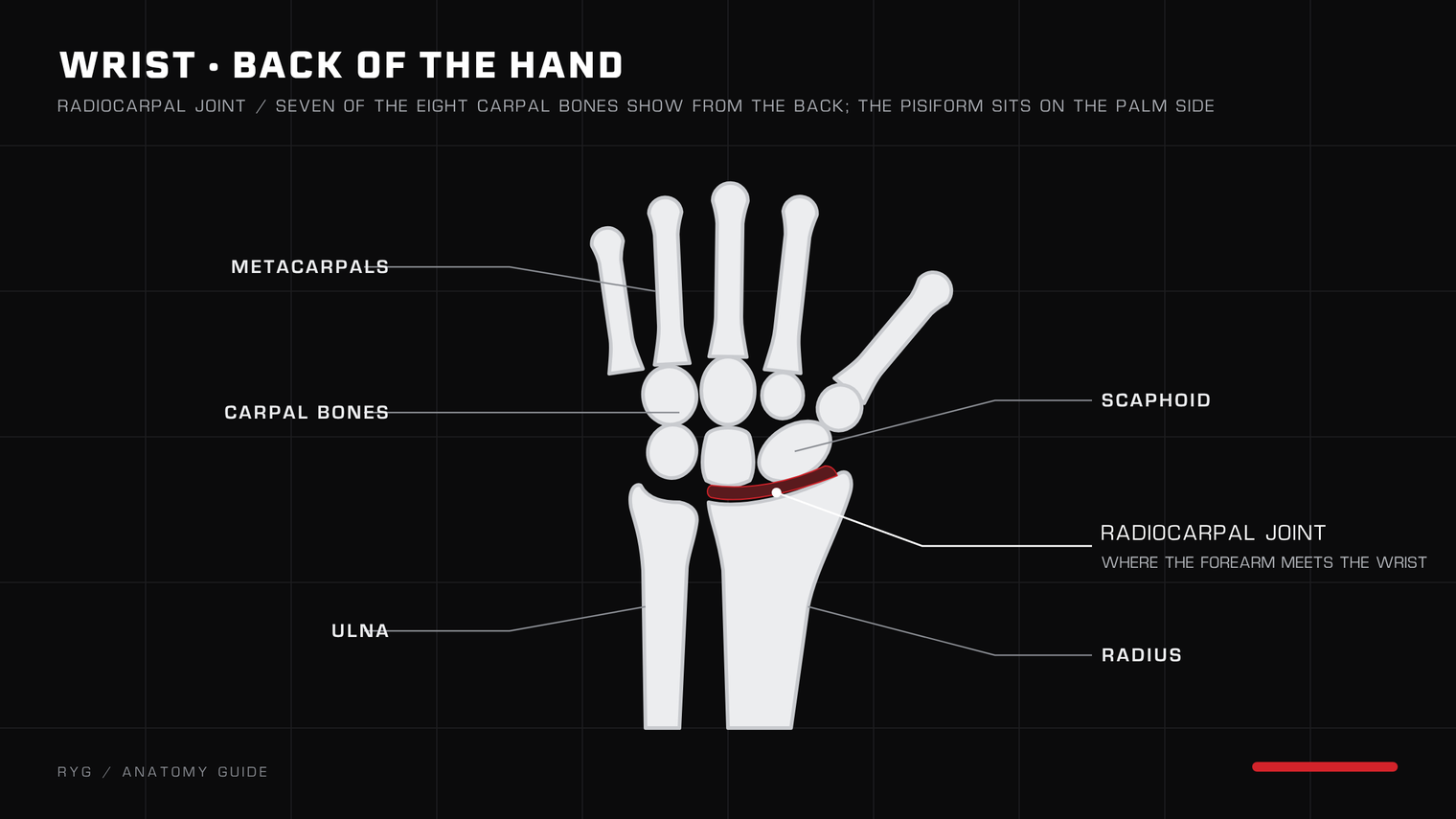
Flavor one is the fall. A player braces a fall on an outstretched hand, feels a jolt, and shakes it off. One small bone in the wrist, the scaphoid, sits at the base of the thumb and has a famously poor blood supply. A scaphoid fracture can hurt only mildly, get dismissed as a sprain, and then fail to heal for months because nobody looked. Wrist ligaments can also be sprained in the same fall, and the two can feel similar early.
Flavor two is overuse. Thousands of shots and dribbles load the tendons crossing the wrist, and during heavy stretches of the season those tendons get irritated and achy, usually on the thumb side or the back of the wrist. This version builds gradually, warms up during play, and aches afterward.
What the research says
- Hand and wrist injuries account for up to 25% of all sports injuries. In professional athletes only about 18% need surgery, average return to play is 2.8 months, and most athletes get back to their previous performance1.
- Among professional athletes, the most common specific injuries are metacarpal fractures, thumb collateral ligament injuries, finger fractures and scaphoid fractures, and basketball is one of the sports most often studied1.
- The scaphoid accounts for over 85% of sport-related wrist bone fractures2.
- Scaphoid fractures treated in a cast heal in 85% of cases over about 14 weeks, while screw fixation heals 97% in about 10 weeks and gets athletes back roughly 2 weeks sooner; playing immediately in a cast carries a significant risk of non-union2.
- Most hand and wrist injuries in college football (a useful comparison for contact and falls) cost no time at all, but fractures caused the greatest time loss, in some cases months3.
What we do about it
For a fall injury, step one is deciding whether you need an X-ray, and we err on the side of yes when there is tenderness in the little hollow at the thumb-side base of the wrist, pain with gripping, or pain pushing up from a chair. A scaphoid fracture that is caught early and managed properly heals in the large majority of cases; one that is missed can become a long problem2. If imaging is clear, a sprain is managed with short-term protection, then progressive motion and strength.
For the overuse version, rehab follows a load-management plan. Short term, we trim the biggest spikes in shooting volume without shutting shooting down. Then we rebuild the forearm, because a stronger forearm spreads force across muscle instead of dumping it into tendon and joint. Wrist curls and extensions, rice bucket drills, grip work, and loaded carries are the core of it, progressing to full shooting volume over a few weeks. This is the progression we run in the clinic, with a test at every phase before you move on.
When to get it looked at
- Tenderness at the thumb-side base of the wrist after a fall, even if the pain is mild. This needs an X-ray.
- Swelling, bruising or an obvious deformity after a fall.
- Pain with gripping or pushing through the hand that has not settled within a few days of a fall.
- Numbness or tingling in the fingers.
- An overuse ache that has lasted more than a couple of weeks despite reducing volume.
Bottom line
Two wrists, two plans. A fall with thumb-side tenderness gets an X-ray, because missing a scaphoid fracture is the expensive mistake. An overuse ache gets load management and forearm strength. Most wrist injuries in athletes heal without surgery and performance comes back. If you are not sure which one you have, an in-person evaluation can sort sprain from something more.
References
- Lehman JD, Krishnan KR, Stepan JG, et al. Prevalence and Treatment Outcomes of Hand and Wrist Injuries in Professional Athletes: A Systematic Review. HSS J. 2020;16(3):280-287. PubMed
- Goffin JS, Liao Q, Robertson GA. Return to sport following scaphoid fractures: A systematic review and meta-analysis. World J Orthop. 2019;10(2):101-114. PubMed
- Bartels DW, Hevesi M, Wyles C, et al. Epidemiology of Hand and Wrist Injuries in NCAA Men's Football: 2009-2010 to 2013-2014. Orthop J Sports Med. 2019;7(4):2325967119835375. PubMed
Alex is very approachable and makes you feel comfortable. Wrote me a program to rehab my broken wrist that I had surgery on. You can tell he truly cares and takes his profession seriously.
This article is for education and does not replace an evaluation. If you're dealing with an active injury, see a licensed medical provider.