
Early Sport Specialization: Is One Sport Year-Round Hurting Your Kid?
 Any sport
Somewhere along the way, youth sports absorbed the idea that the path to a college scholarship is picking one sport early and playing it all year. The research says close to the opposite. Kids who specialize early get injured more, burn out more, and don't out-develop their multi-sport peers. Some of the best data on this comes from Wisconsin high schools.
What's actually going on
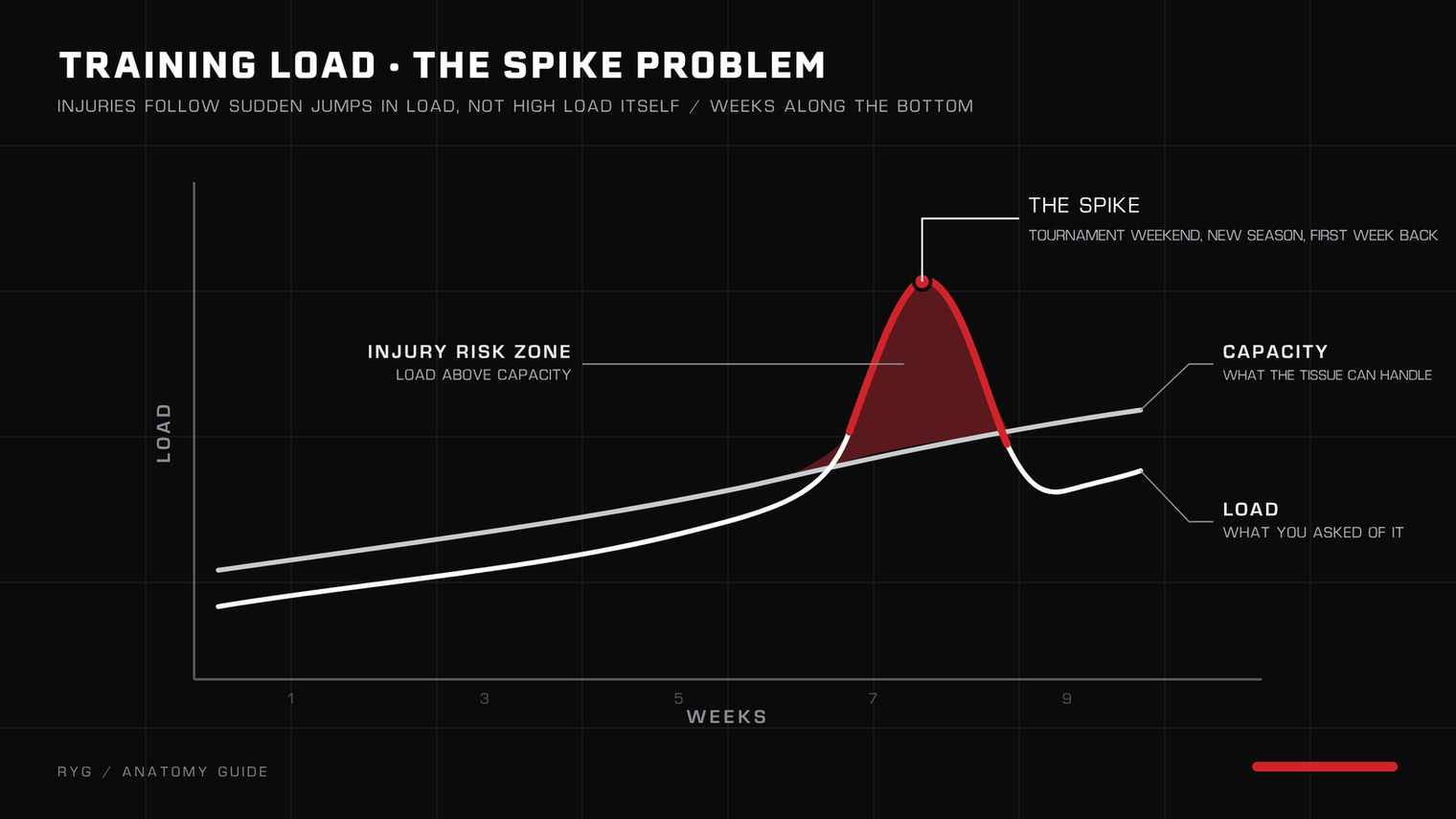
Every sport loads the body in a signature pattern. Pitching stresses the same elbow ligament every outing, soccer hammers the same hip and knee angles, swimming repeats the same shoulder arc thousands of times a week. Growing bodies handle stress well, but they handle repetitive identical stress poorly, because growth plates and developing tendons need recovery windows that a year-round single sport never provides. A kid who plays basketball in winter and runs track in spring is still training hard, but the load keeps moving to different tissues, which is exactly what a young body wants. Variety also builds better athletes. Different sports develop different footwork, timing and coordination, and that broad base shows up later as adaptability. Patrick Mahomes was a good enough baseball player to be drafted by a major league team before he ever became an MVP quarterback.
What the research says
- A meta-analysis of athletes 18 and under found highly specialized athletes had 1.8 times the risk of an overuse injury compared with kids who played multiple sports, and even moderate specialization raised the risk 1.4-fold1.
- In a one-year study of 1,544 athletes from 29 Wisconsin high schools, highly specialized athletes were 1.85 times more likely to suffer a lower-extremity injury than low-specialization peers, and moderately specialized athletes 1.5 times2.
- Specialization is a risk on its own, not just a proxy for hours. After accounting for age and weekly hours of sport, specialized athletes still had 1.36 times the odds of a serious overuse injury3.
- Growth spurts don't explain it. Injured and uninjured young athletes grew at the same rate, 4.8 cm per year, but the injured ones logged more hours of organized sport3.
- The scholarship story doesn't hold up either. Of 1,550 former NCAA athletes surveyed, fewer than 1 in 5 specialized before age 15, early specializers were no more likely to have earned a scholarship, and they burned out at a higher rate (10.5 versus 7.0 percent)4.
- The AOSSM consensus found no evidence that young children benefit from early specialization in most sports and states that playing multiple sports will not hold an athlete back from long-term competitive success5. The working definition of specialization is playing one sport more than 8 months of the year, and that year-round pattern is itself a risk factor for serious overuse injury6.
What we do about it
- Build a true off-season. The experts recommend delaying exclusive single-sport training until late adolescence, and even then, every year needs a block where the main sport's load drops and something else fills it7.
- Count hours, not just seasons. A simple rule from the workload research: a kid who spends more hours per week in organized sport than their age in years has about twice the odds of a serious overuse injury8.
- Add strength, not more reps. General strength work is the most protective thing a young athlete can add, and it's the thing a specialized schedule usually crowds out.
- Treat the first nagging pain as a load problem. When an overuse injury does show up, we rebuild the tissue with progressive loading and fix the schedule that caused it, rather than resting until it fades and sending the same calendar back out.
When to get it looked at
- Pain in the same spot that shows up at every practice and lingers past warm-up
- Soreness that moves around the body and never fully clears between sessions
- A young athlete who used to bug you about practice and is suddenly quiet in the car, or dreading it
- Any bone-area pain in a growing athlete that lasts more than two weeks
- Night pain, swelling, or pain that changes how they walk or run
Bottom line
None of this means your 15 year old who loves one sport is doomed. It means the year needs variety and real rest built into it, and the research says that costs nothing in long-term development. If your young athlete is already showing the warning signs, that's the moment to act, and an in-person evaluation is a good first step for a parent trying to sort soreness from something more.
References
- Bell DR, Post EG, Biese K, et al. Sport Specialization and Risk of Overuse Injuries: A Systematic Review With Meta-analysis. Pediatrics. 2018;142(3):e20180657. PubMed
- McGuine TA, Post EG, Hetzel SJ, et al. A Prospective Study on the Effect of Sport Specialization on Lower Extremity Injury Rates in High School Athletes. Am J Sports Med. 2017;45(12):2706-2712. PubMed
- Jayanthi NA, LaBella CR, Fischer D, et al. Sports-specialized intensive training and the risk of injury in young athletes: a clinical case-control study. Am J Sports Med. 2015;43(4):794-801. PubMed
- Rugg CM, Coughlan MJ, Li JN, et al. Early Sport Specialization Among Former National Collegiate Athletic Association Athletes: Trends, Scholarship Attainment, Injury, and Attrition. Am J Sports Med. 2021;49(4):1049-1058. PubMed
- LaPrade RF, Agel J, Baker J, et al. AOSSM Early Sport Specialization Consensus Statement. Orthop J Sports Med. 2016;4(4):2325967116644241. PubMed
- Myer GD, Jayanthi N, DiFiori JP, et al. Sport Specialization, Part I: Does Early Sports Specialization Increase Negative Outcomes and Reduce the Opportunity for Success in Young Athletes?. Sports Health. 2015;7(5):437-442. PubMed
- Jayanthi N, Pinkham C, Dugas L, et al. Sports specialization in young athletes: evidence-based recommendations. Sports Health. 2013;5(3):251-257. PubMed
- Jayanthi NA, LaBella CR, Fischer D, et al. Sports-specialized intensive training and the risk of injury in young athletes: a clinical case-control study. Am J Sports Med. 2015;43(4):794-801. PubMed
This article is for education and does not replace an evaluation. If you're dealing with an active injury, see a licensed medical provider.