
How Much Is Too Much? A Parent's Guide to Youth Athlete Workload
 Any sport
Add it up sometime. School practice, club practice, a weekend tournament, a private lesson, and maybe a second sport on top. Many youth athletes are logging more focused training hours than college athletes, without the recovery support college athletes get. The driver of most youth overuse injuries isn't one bad movement. It's simple accumulation, too much load with too little recovery for too long.
What's actually going on
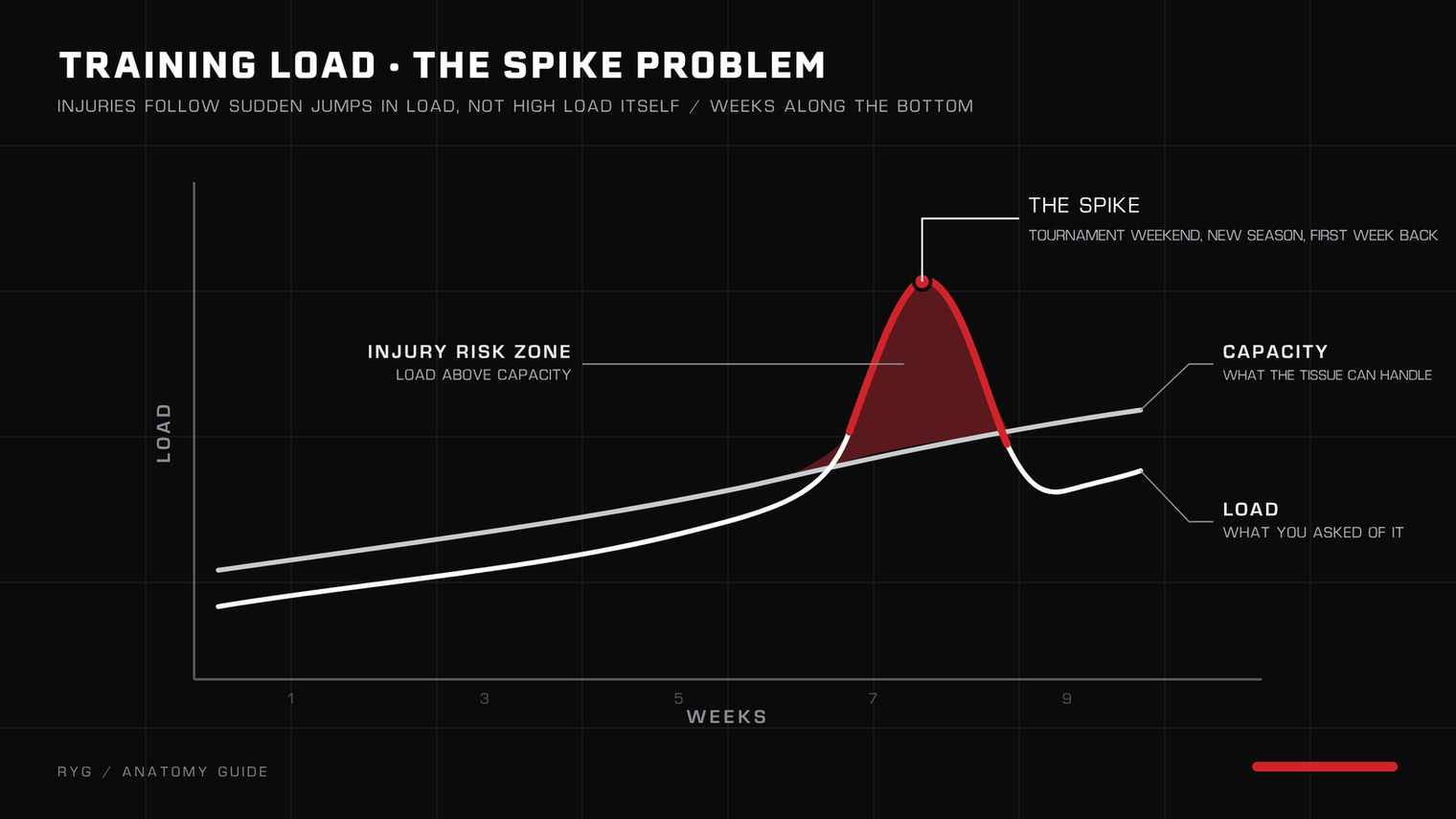
Tissues adapt to what they're used to, and they get hurt when demand jumps far above that baseline. This is the load spike, and it's the most useful idea in the research. A tendon that handles ten hours a week comfortably can get into trouble with the first tournament weekend, the new club team with double the practices, or the January "get serious" phase. It's rarely the total alone, it's how fast you got there. Underneath the spike there's a slower problem. When training consistently exceeds recovery for weeks, performance flattens while effort rises, sleep and mood get worse, and the whole system starts to run down. Overtraining is a whole-body problem that lowers performance, raises injury and illness risk, and disrupts hormonal, neurologic and psychological systems1.
What the research says
- Between 46 and 54 percent of all youth sports injuries are overuse injuries, not acute ones2.
- A young athlete who spends more hours per week in organized sport than their age in years has about twice the odds of a serious overuse injury, and kids whose organized sport time outweighs free play by more than 2 to 1 have 1.9 times the odds3.
- High school athletes who played a sport year-round reported 42 percent more overuse injuries than those who played three seasons or fewer, and training more than 16 hours per week was linked to higher injury risk2.
- Spikes matter day to day. In adolescent soccer players tracked across a 20-week season, a higher same-day training load roughly doubled the odds of injury, and worse mood that day was an independent predictor as well4.
- Elite junior tennis players training about 9 hours a week had an overuse injury present in 12 percent of players during any given week of the season5.
- Overreaching, a short-term dip in performance from training that outruns recovery, was found in 30 to 35 percent of adolescent athletes2.
The flip side is just as important. Non-contact injuries are rarely caused by training itself; they're caused by excessive and rapid increases in load, and athletes who are used to high training loads actually get injured less than athletes who train less6. The goal is not less sport. It's a load that climbs gradually and gets maintained.
What we do about it
- Count the hours. Total organized sport hours per week, across every team and lesson, compared against the athlete's age. That one number flags most of the problem schedules.
- Watch for spikes. Any week that lands far above the previous month's average is a spike, and it's worth trimming the next week rather than stacking another on top.
- Protect free play and a day off. The organized-to-free-play ratio is a real risk factor, and a full rest day each week is cheap insurance.
- Track the soft signals. Sleep getting worse, soreness that hangs around past a day or two, performance flattening while effort rises, and a kid who has gone quiet about practice.
- Rebuild, don't just rest. When an overuse injury has already started, we use progressive loading to restore the tissue's capacity and strength work to raise the ceiling, while adjusting the schedule that caused it.
When to get it looked at
- Pain in the same spot at every practice that lingers past warm-up
- Soreness that is still there after two days of normal activity, week after week
- Performance dropping while effort and hours go up
- Sleep, mood or appetite changing alongside a heavy schedule
- Any bone-area pain in a growing athlete, or back pain that lasts more than two weeks
Bottom line
The research gives parents real numbers to work with: hours per week against age, a cap around 16 hours, a true off-season, and no sudden spikes. The goal isn't less sport, it's sustainable sport, the kind a kid can still love at 18. If your athlete's schedule is stacking up or a nagging pain has already started, an in-person evaluation makes the next step clear.
References
- Brenner JS, Watson A, Council on Sports Medicine and Fitness. Overuse Injuries, Overtraining, and Burnout in Young Athletes. Pediatrics. 2024;153(2):e2023065129. PubMed
- DiFiori JP, Benjamin HJ, Brenner J, et al. Overuse injuries and burnout in youth sports: a position statement from the American Medical Society for Sports Medicine. Clin J Sport Med. 2014;24(1):3-20. PubMed
- Jayanthi NA, LaBella CR, Fischer D, et al. Sports-specialized intensive training and the risk of injury in young athletes: a clinical case-control study. Am J Sports Med. 2015;43(4):794-801. PubMed
- Watson A, Brickson S, Brooks A, et al. Subjective well-being and training load predict in-season injury and illness risk in female youth soccer players. Br J Sports Med. 2017;51(3):194-199. PubMed
- Pluim BM, Loeffen FG, Clarsen B, et al. A one-season prospective study of injuries and illness in elite junior tennis. Scand J Med Sci Sports. 2016;26(5):564-571. PubMed
- Gabbett TJ. The training-injury prevention paradox: should athletes be training smarter and harder?. Br J Sports Med. 2016;50(5):273-280. PubMed
This article is for education and does not replace an evaluation. If you're dealing with an active injury, see a licensed medical provider.