
Achilles Tendon Pain in Football: The Warning System You Should Not Ignore
 Football
The Achilles is the thickest, strongest tendon in your body, and it needs to be, because sprinting and jumping route forces of several times bodyweight through it on every step. Achilles pain in football players usually means tendinopathy, a tendon whose maintenance has fallen behind its workload. The classic pattern is stiffness and pain with the first steps in the morning, aching at the back of the heel cord after hard sessions, and a tendon that warms up during practice, then complains louder that night.
What's actually going on
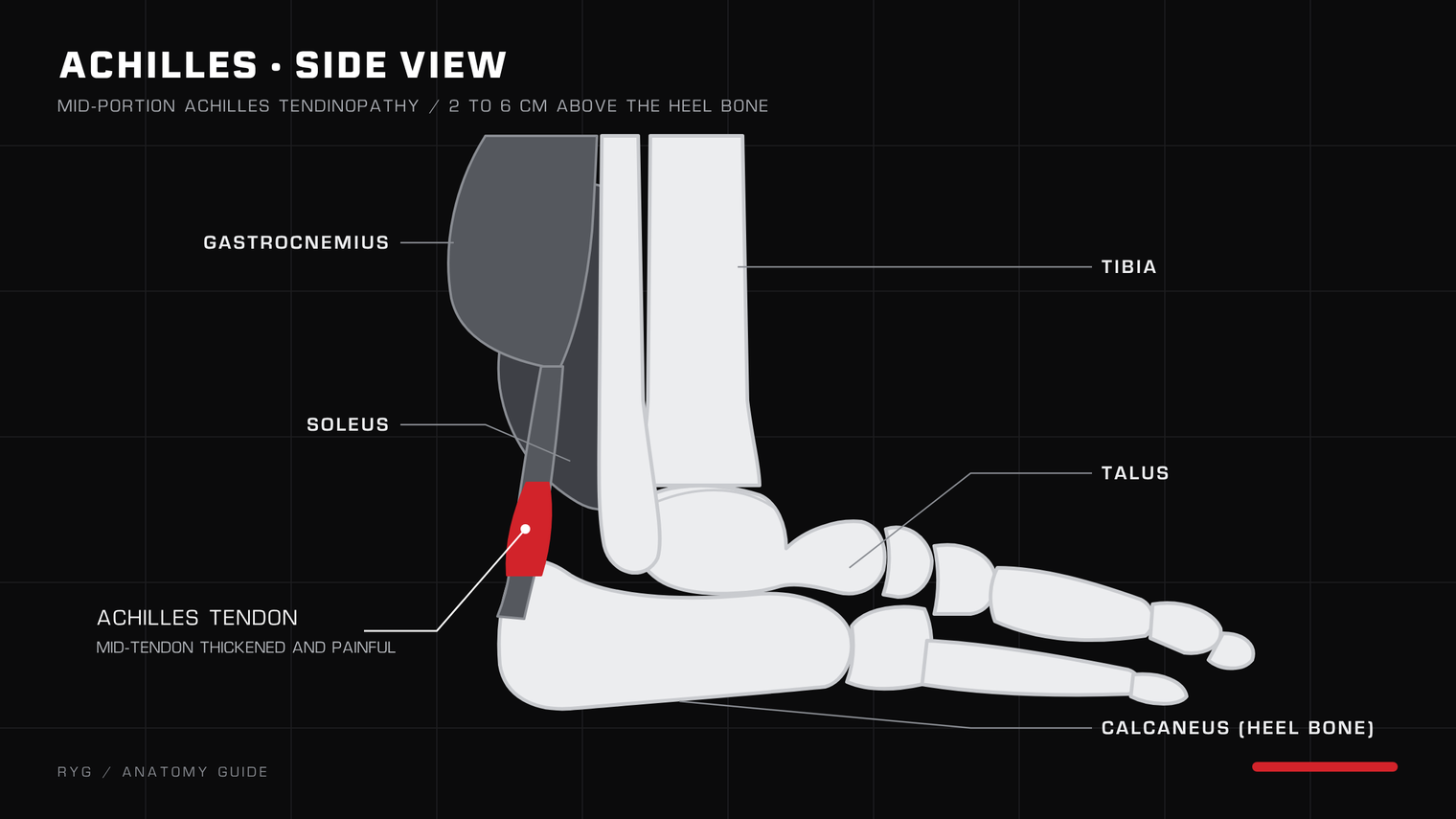
The Achilles connects both calf muscles to the heel and works as a spring, storing energy as the ankle bends under load and returning it at push-off. Tendons adapt to load slowly, over weeks, while a football summer can double sprint and plyometric volume in days. When loading outpaces adaptation, the tendon's collagen disorganizes, it thickens, and it becomes painful in its mid-portion a few centimeters above the heel, or at the heel bone itself. This is a degenerative process, not an inflammatory one, which is why a week off and anti-inflammatories bring short relief and no fix. The tendon has not lost its ability to adapt; it needs the right dose of load applied consistently.
What the research says
- Having had Achilles pain in the previous 12 months raises the odds of a new episode more than 6-fold, the strongest risk factor identified1. Roughly a third of runners with a new episode still have symptoms a year later, which is why early loading-based rehab matters2.
- Athletes who kept running and jumping with pain monitored and capped during rehab improved just as much at 12 months as those who stopped for 6 weeks, with no harm to the tendon3. The rule: pain up to 5 out of 10 during and after exercise is acceptable, it should settle by the next morning, and it should not be getting worse week over week4.
- Heavy slow resistance training and eccentric heel drops gave equally good results that lasted a year, but heavy slow resistance had 92% session adherence versus 78% and 100% patient satisfaction at 12 weeks versus 80%5. Twelve weeks of loading also reduced tendon thickness and abnormal blood vessel growth on imaging5.
- Exercise is the first-line treatment and should be given at least 3 months before other options are considered; recovery can take up to a year6.
- The clinical practice guideline frames midportion Achilles tendinopathy around three findings: pain, stiffness, and calf muscle power deficits7.
- The rupture numbers are the reason to respect the warning: nearly 1 in 3 professional athletes (30.6%) never returned to play after a surgically repaired Achilles rupture, and those who did played fewer games and performed below their pre-injury level in year 18.
What we do about it
The exam confirms mid-portion versus insertional tendinopathy, measures calf strength and endurance on each side, and reviews your recent training load, because the spike that caused it is usually visible in the calendar.
Rehab does not stop practice. Stage one uses heavy isometric calf holds to drop pain and starts tracking the next-morning rule. Stage two is heavy slow resistance: slow, loaded calf raises through full range, bent-knee and straight-knee, three times a week for at least 12 weeks, with weight added as the tendon tolerates it. Stage three restores spring: pogo hops, skipping and bounding with volume counted. Stage four is sprinting and cutting at full intensity in cleats. For insertional pain we avoid loading the tendon in deep stretch early on. This is the progression we run in the clinic, with a test at every phase before you move on.
When to get it looked at
- A sudden pop at the back of the ankle with a feeling of being kicked, followed by weakness pushing off, which needs same-day evaluation for a rupture.
- A visible gap or dent in the tendon, or inability to rise onto the toes on that leg.
- Morning stiffness or pain that is getting worse week over week despite reducing load.
- Tendon pain that has not improved after 12 weeks of a structured loading program.
Bottom line
Achilles pain is a tendon telling you the workload got ahead of it, and the research says you can keep training within a pain cap while heavy slow loading rebuilds it over about 3 months. Rest alone does not change the tendon, and a rupture is the outcome nobody wants. Get the loading plan started and the training load looked at while the tendon is still just sore.
References
- Lagas IF, Fokkema T, Verhaar JAN, et al. Incidence of Achilles tendinopathy and associated risk factors in recreational runners: A large prospective cohort study. J Sci Med Sport. 2020;23(5):448-452. PubMed
- Lagas IF, Fokkema T, Bierma-Zeinstra SMA, et al. How many runners with new-onset Achilles tendinopathy develop persisting symptoms? A large prospective cohort study. Scand J Med Sci Sports. 2020;30(10):1939-1948. PubMed
- Silbernagel KG, Thomeé R, Eriksson BI, et al. Continued sports activity, using a pain-monitoring model, during rehabilitation in patients with Achilles tendinopathy: a randomized controlled study. Am J Sports Med. 2007;35(6):897-906. PubMed
- Silbernagel KG, Thomeé R, Eriksson BI, et al. Continued sports activity, using a pain-monitoring model, during rehabilitation in patients with Achilles tendinopathy: a randomized controlled study. Am J Sports Med. 2007;35(6):897-906. PubMed
- Beyer R, Kongsgaard M, Hougs Kjær B, et al. Heavy Slow Resistance Versus Eccentric Training as Treatment for Achilles Tendinopathy: A Randomized Controlled Trial. Am J Sports Med. 2015;43(7):1704-1711. PubMed
- Silbernagel KG, Crossley KM. A Proposed Return-to-Sport Program for Patients With Midportion Achilles Tendinopathy: Rationale and Implementation. J Orthop Sports Phys Ther. 2015;45(11):876-886. PubMed
- Martin RL, Chimenti R, Cuddeford T, et al. Achilles Pain, Stiffness, and Muscle Power Deficits: Midportion Achilles Tendinopathy Revision 2018. J Orthop Sports Phys Ther. 2018;48(5):A1-A38. PubMed
- Trofa DP, Miller JC, Jang ES, et al. Professional Athletes' Return to Play and Performance After Operative Repair of an Achilles Tendon Rupture. Am J Sports Med. 2017;45(12):2864-2871. PubMed
Alex is awesome. He's responsive to ongoing issues, and he works to formulate a plan to help you achieve your end-goals.
I had been having calf issues for years that went misdiagnosed or undiagnosed through by other providers. Now, he's clearly properly diagnosed the issue and helped me implement a plan that has kept the issue from coming back. Highly recommend!
Alex does amazing work and had me feeling better in no time! I had alot of tightness in my hamstrings and calves and used needles and a lot of soft tissue work to loosen them up!
This article is for education and does not replace an evaluation. If you're dealing with an active injury, see a licensed medical provider.