
Ankle Sprains in Football: Regular Sprains, High Ankle Sprains, and Why They Are So Different
 Football
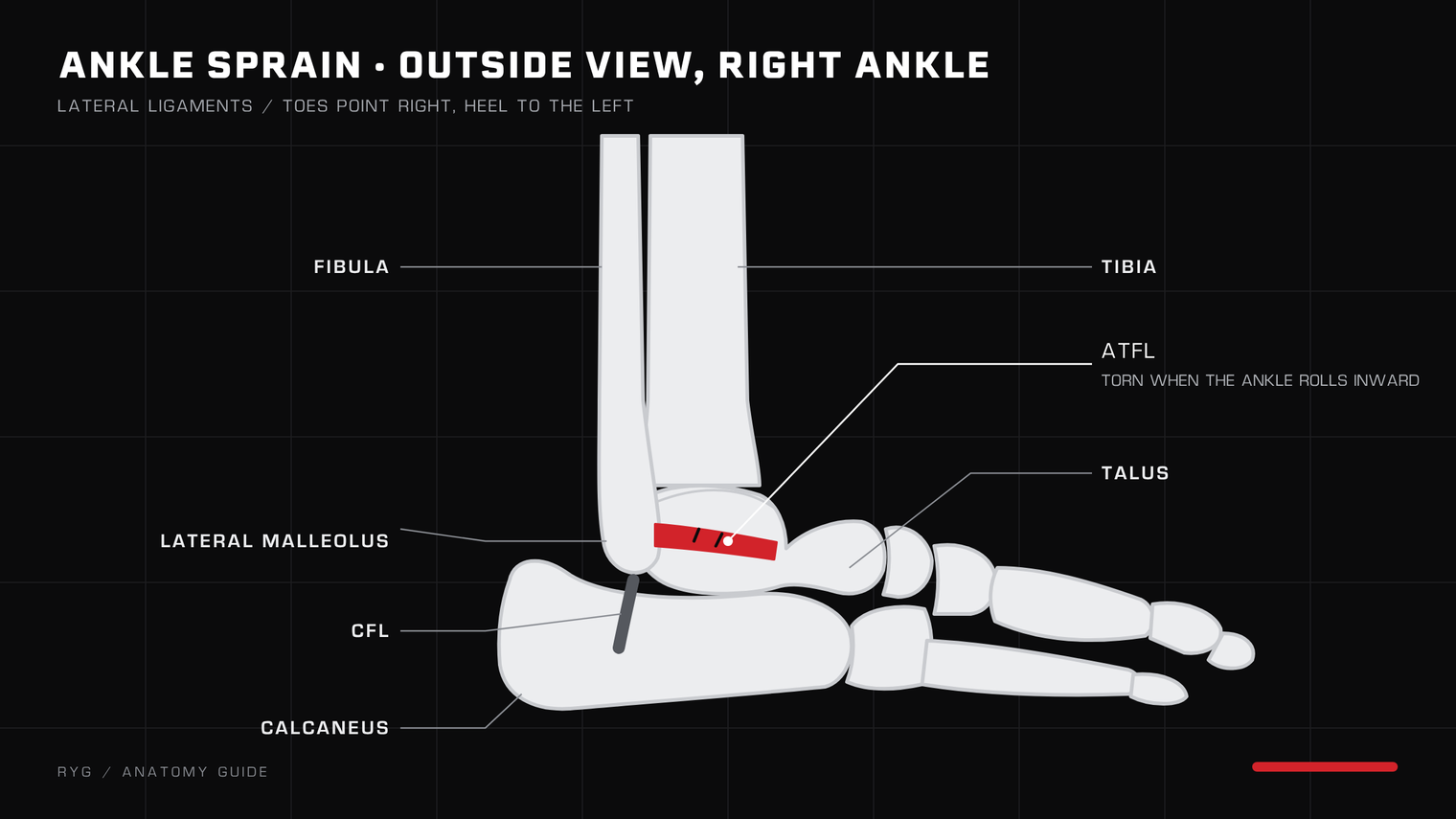
The ankle sprain is football's everyday injury, but the word sprain hides two very different problems. The common version is the lateral sprain: rolling the ankle so the sole turns inward and the ligaments on the outside get stretched or torn. The other is the high ankle sprain, which injures the syndesmosis, the fibrous connection binding your two lower leg bones together just above the ankle joint. Football produces high ankle sprains at unusual rates because they come from piles: a foot planted while the leg gets twisted outward, or another body rolling over the back of the leg.
What's actually going on
The outside of the ankle is held by three small ligaments, and the front one takes the hit in a classic roll. It heals over weeks, but it also carries nerve endings that tell your brain where your foot is, and that sense gets damaged along with the ligament. That is why ankles that were 'fine' roll again. The syndesmosis is different. It is the ligament complex that keeps the tibia and fibula clamped together so the ankle joint stays tight; when it is sprained, the joint can splay slightly with every step, which is why high ankle sprains hurt with push-off, take longer, and sometimes need a screw or a tightrope to hold the bones together while they heal.
What the research says
- High ankle sprains occur at 1 per 10,000 athlete-exposures in college sports, with football the highest at 2.42; 60% come from player contact and nearly half cost 7 or more days out1.
- Under usual care, about 1 in 3 athletes (33%) re-sprains the same ankle within a year; adding an 8-week home balance program cut that to 22%, a 35% reduction2.
- Current guidelines favor a brace or tape plus a supervised exercise program over rest and passive treatments, with surgery reserved for sprains that fail thorough rehab; bracing has strong evidence and neuromuscular training moderate evidence for preventing a repeat sprain3,4.
- After an ankle sprain, people who started exercise in the first week had better function at weeks 1 and 2 than those who rested, iced, compressed and elevated, with the same 4% re-injury rate5. The JOSPT ankle sprain guideline gives its strongest grade to progressive weight bearing and structured exercise and only a Grade C to ice6.
- The severity of a sprain is judged most reliably by a hands-on exam 4 to 5 days after injury, once the initial swelling has settled3.
- Being unable to do a single-leg drop landing or a drop jump 2 weeks after a first sprain predicts who will go on to chronic ankle instability7.
- NSAIDs ease pain and swelling, but guidelines caution they may suppress the natural healing process3.
What we do about it
The first visit figures out which sprain you have, because the plans diverge fast. Lateral sprains get tested for ligament laxity and fracture signs; high ankle sprains get the squeeze and external rotation tests and, when the syndesmosis is unstable, an imaging referral to decide whether it needs fixation.
For a lateral sprain, rehab starts the same week: weight bearing as tolerated in a brace, ankle motion, and calf and peroneal strengthening with isometrics first. Then balance and landing work, because that is what the trial data say actually prevents the next one. Then hopping, cutting and reactive drills in cleats. Clearance is a symmetric single-leg hop and drop-landing test, not a swelling-free ankle. High ankle sprains get a longer protected period, then the same progression with push-off strength added carefully, since that is the movement that splays the joint. This is the progression we run in the clinic, with a test at every phase before you move on.
When to get it looked at
- Inability to bear weight for four steps right after the injury, or tenderness on the bone of the ankle or the outside of the foot, which needs an X-ray.
- Pain above the ankle that is worse with push-off or when the lower leg is squeezed, which suggests a high ankle sprain.
- Numbness, coldness or a foot that looks out of place.
- An ankle that still swells or gives way 2 weeks after a 'minor' sprain.
Bottom line
A rolled ankle is a ligament injury and a balance injury, and the research says the second part is what decides whether it happens again. Rest and ice are not the plan; weight bearing, strengthening and balance training are, with a brace for the season. If the pain is above the ankle, get it examined early, because high ankle sprains play by different rules.
References
- Mauntel TC, Wikstrom EA, Roos KG, et al. The Epidemiology of High Ankle Sprains in National Collegiate Athletic Association Sports. Am J Sports Med. 2017;45(9):2156-2163. PubMed
- Hupperets MD, Verhagen EA, van Mechelen W. Effect of unsupervised home based proprioceptive training on recurrences of ankle sprain: randomised controlled trial. BMJ. 2009;339:b2684. PubMed
- Vuurberg G, Hoorntje A, Wink LM, et al. Diagnosis, treatment and prevention of ankle sprains: update of an evidence-based clinical guideline. Br J Sports Med. 2018;52(15):956. PubMed
- Doherty C, Bleakley C, Delahunt E, et al. Treatment and prevention of acute and recurrent ankle sprain: an overview of systematic reviews with meta-analysis. Br J Sports Med. 2017;51(2):113-125. PubMed
- Bleakley CM, O'Connor SR, Tully MA, et al. Effect of accelerated rehabilitation on function after ankle sprain: randomised controlled trial. BMJ. 2010;340:c1964. PubMed
- Martin RL, Davenport TE, Fraser JJ, et al. Ankle Stability and Movement Coordination Impairments: Lateral Ankle Ligament Sprains Revision 2021. J Orthop Sports Phys Ther. 2021;51(4):CPG1-CPG80. PubMed
- Doherty C, Bleakley C, Hertel J, et al. Recovery From a First-Time Lateral Ankle Sprain and the Predictors of Chronic Ankle Instability: A Prospective Cohort Analysis. Am J Sports Med. 2016;44(4):995-1003. PubMed
Our son broke his ankle in a hockey game. With his goal of being ready for spring TO’s we were on the hunt for a PT that knew the game and expectations of a hockey player. We were referred to Alex by a coach.
After meeting with/ Alex our son , wife and I were 100% this is the right guy to help our son. Alex put multiple pt plans together along with on ice plans to reintroduce skating. Most of all our son trusts and listens to Alex about the recovery process. Our son is ahead of schedule!
Pretty much the best experience we’ve ever had with a doctor.
Thank you
Lessner’s
Had an amazing time this summer rehabbing my ankle with Dr. Shuchuk. He is very knowledgeable in any area of PT and always willing and able to help any ailment you have! I thought my ankle could never be fixed, but after getting on a plan and staying consistent I have regained my game!
Thanks Shu
This article is for education and does not replace an evaluation. If you're dealing with an active injury, see a licensed medical provider.