
Ankle and Foot Prehab for Football: Ten Minutes a Week That Keeps You on the Field
 Football
Every play in football starts and ends at the ground, which means your ankles and feet are involved in every rep of every practice all season. They are also the most injured region in the sport, with ankle sprains leading the injury reports at every level year after year. The case for prehab, small doses of preventive training done before injury, is stronger for the ankle and foot than for any other body part, because the research on balance training and bracing is some of the most consistent in sports medicine.
What's actually going on
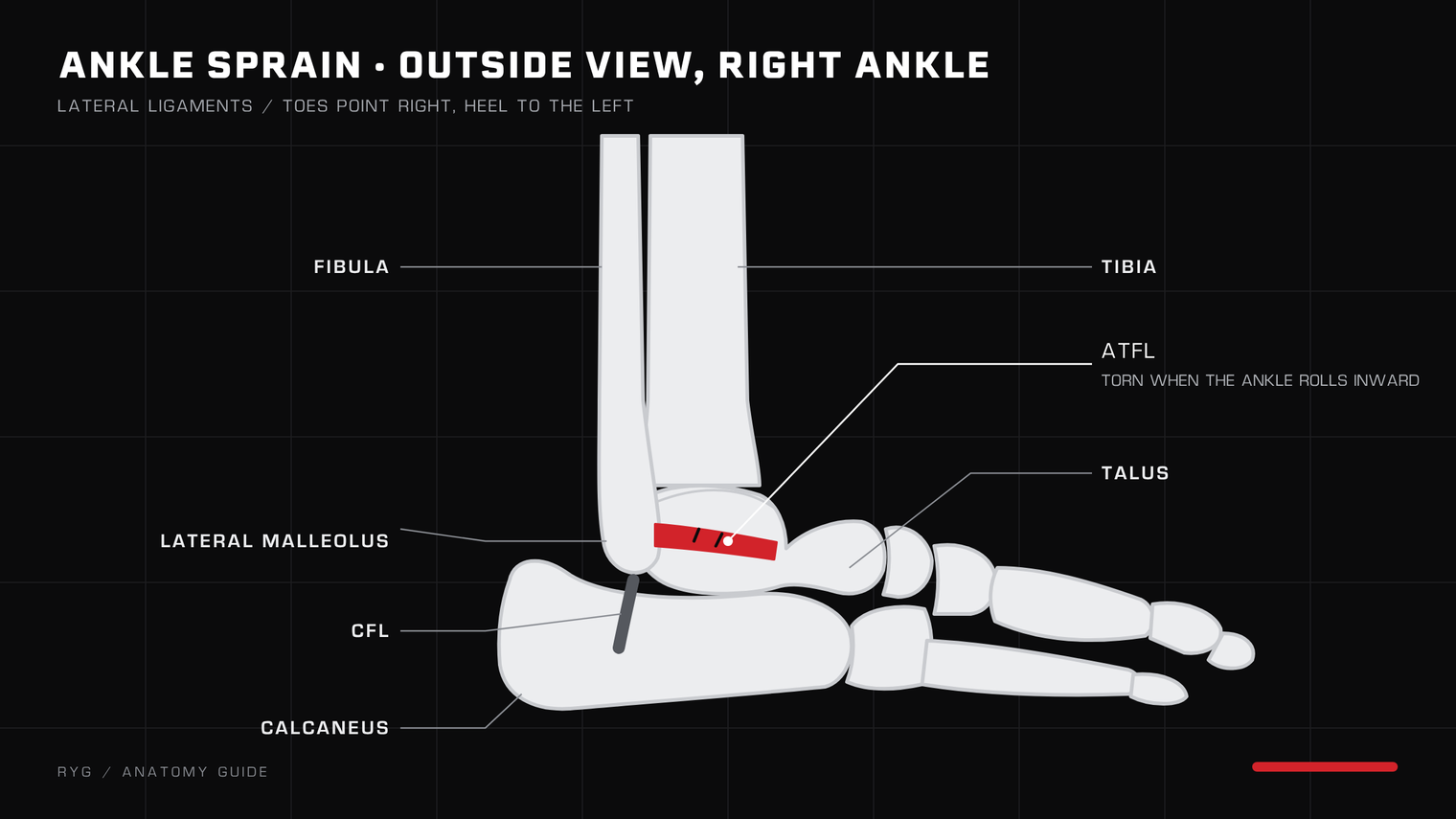
A sprain happens when the foot lands on an edge, a cleat, or a defender's foot and rolls faster than the peroneal muscles on the outside of the leg can catch it. The ligaments tear, and with them the sensors that tell your brain where the foot is. That is why the most reliable predictor of an ankle sprain is a previous one: the reaction system never got retrained. Prehab targets the three things that matter: the speed of that reaction, the strength of the muscles that do the catching, and the way you land and cut so the foot stays under you in traffic.
What the research says
- Across 16 years and 182,000 college injuries in 15 sports, ankle sprains alone made up 15%, the single most common injury in college sport1.
- Under usual care, about 1 in 3 athletes re-sprains the same ankle within a year; an 8-week home balance program cut that to 22%, a 35% reduction2.
- In a randomized trial of 1,460 Wisconsin high school basketball players, lace-up braces cut acute ankle injury rates from 1.41 to 0.47 per 1,000 exposures, including a 61% reduction in players who had already sprained an ankle before, although braces did not change injury severity3.
- Bracing has strong evidence and neuromuscular training moderate evidence for preventing a repeat ankle sprain4.
- Up to 40% of people who sprain an ankle for the first time develop chronic ankle instability, and strength training alone does not improve it; it needs to be paired with balance and neuromuscular training5,6.
- In the NFL, lower-extremity injuries were 16% more frequent per play on synthetic turf, and non-contact injuries up to twice as frequent, which is why ankle strength and landing work is the priority for athletes who play on turf regularly7,8.
- Across 25 randomized trials and 26,610 athletes, strength-based prevention programs cut injuries to less than a third and almost halved overuse injuries, while stretching alone did nothing9.
What we do about it
A football ankle prehab routine fits in ten minutes and belongs in the warm-up, not in a separate session nobody does. The first piece is balance under challenge: single-leg stance progressing to reaching, catching a ball, and reacting to a partner's push, done a few times a week. The second is strength: banded eversion for the peroneals, heavy single-leg calf raises, and foot intrinsic work like short-foot holds and toe-loaded raises. The third is landing and cutting mechanics: single-leg hops with a stuck landing, lateral bounds, and cut drills where the foot stays flat and under the hip.
For players with a sprain history, the brace goes on for practices and games because the trial data are strong, and the prehab routine runs at a higher dose. We test single-leg balance and drop-landing control at the start of the season and recheck mid-season, because the athletes who fail those tests are the ones headed for an instability problem. This is the progression we run in the clinic, with a test at every phase before you move on.
When to get it looked at
- Any ankle that has been sprained more than once, which has earned a proper assessment rather than more tape.
- An ankle that still swells or feels unsure 2 weeks after what seemed like a minor sprain.
- Inability to balance on one leg for 30 seconds with eyes closed, or a drop landing that wobbles, which predicts trouble.
- Foot or heel pain that is present most mornings or after every practice.
Bottom line
Ankle sprains are football's most common injury, and the research says a short balance and strength routine cuts re-sprains by about a third while a brace cuts injury rates by more than half in players with a history. Ten minutes in the warm-up is the cheapest injury insurance in the sport. If you have rolled it before, start now.
References
- Hootman JM, Dick R, Agel J. Epidemiology of collegiate injuries for 15 sports: summary and recommendations for injury prevention initiatives. J Athl Train. 2007;42(2):311-319. PubMed
- Hupperets MD, Verhagen EA, van Mechelen W. Effect of unsupervised home based proprioceptive training on recurrences of ankle sprain: randomised controlled trial. BMJ. 2009;339:b2684. PubMed
- McGuine TA, Brooks A, Hetzel S. The effect of lace-up ankle braces on injury rates in high school basketball players. Am J Sports Med. 2011;39(9):1840-1848. PubMed
- Doherty C, Bleakley C, Delahunt E, et al. Treatment and prevention of acute and recurrent ankle sprain: an overview of systematic reviews with meta-analysis. Br J Sports Med. 2017;51(2):113-125. PubMed
- Hertel J, Corbett RO. An Updated Model of Chronic Ankle Instability. J Athl Train. 2019;54(6):572-588. PubMed
- Luan L, Adams R, Witchalls J, et al. Does Strength Training for Chronic Ankle Instability Improve Balance and Patient-Reported Outcomes and by Clinically Detectable Amounts? A Systematic Review and Meta-Analysis. Phys Ther. 2021;101(7):pzab046. PubMed
- Mack CD, Hershman EB, Anderson RB, et al. Higher Rates of Lower Extremity Injury on Synthetic Turf Compared With Natural Turf Among National Football League Athletes: Epidemiologic Confirmation of a Biomechanical Hypothesis. Am J Sports Med. 2019;47(1):189-196. PubMed
- Gould HP, Lostetter SJ, Samuelson ER, et al. Lower Extremity Injury Rates on Artificial Turf Versus Natural Grass Playing Surfaces: A Systematic Review. Am J Sports Med. 2023;51(6):1615-1621. PubMed
- Lauersen JB, Bertelsen DM, Andersen LB. The effectiveness of exercise interventions to prevent sports injuries: a systematic review and meta-analysis of randomised controlled trials. Br J Sports Med. 2014;48(11):871-877. PubMed
Had an amazing time this summer rehabbing my ankle with Dr. Shuchuk. He is very knowledgeable in any area of PT and always willing and able to help any ailment you have! I thought my ankle could never be fixed, but after getting on a plan and staying consistent I have regained my game!
Thanks Shu
Alex worked with our son on his ankle after a bad sprain and was able to help him strengthen his ankle to be back on the field in a shorter time frame. Alex was great at communication with our family and his coaching staff throughout the whole process. Definitely recommend.
This article is for education and does not replace an evaluation. If you're dealing with an active injury, see a licensed medical provider.