
Achilles Tendon Pain in Golf: Why Your Heel Cord Aches on Walking Days
 Golf
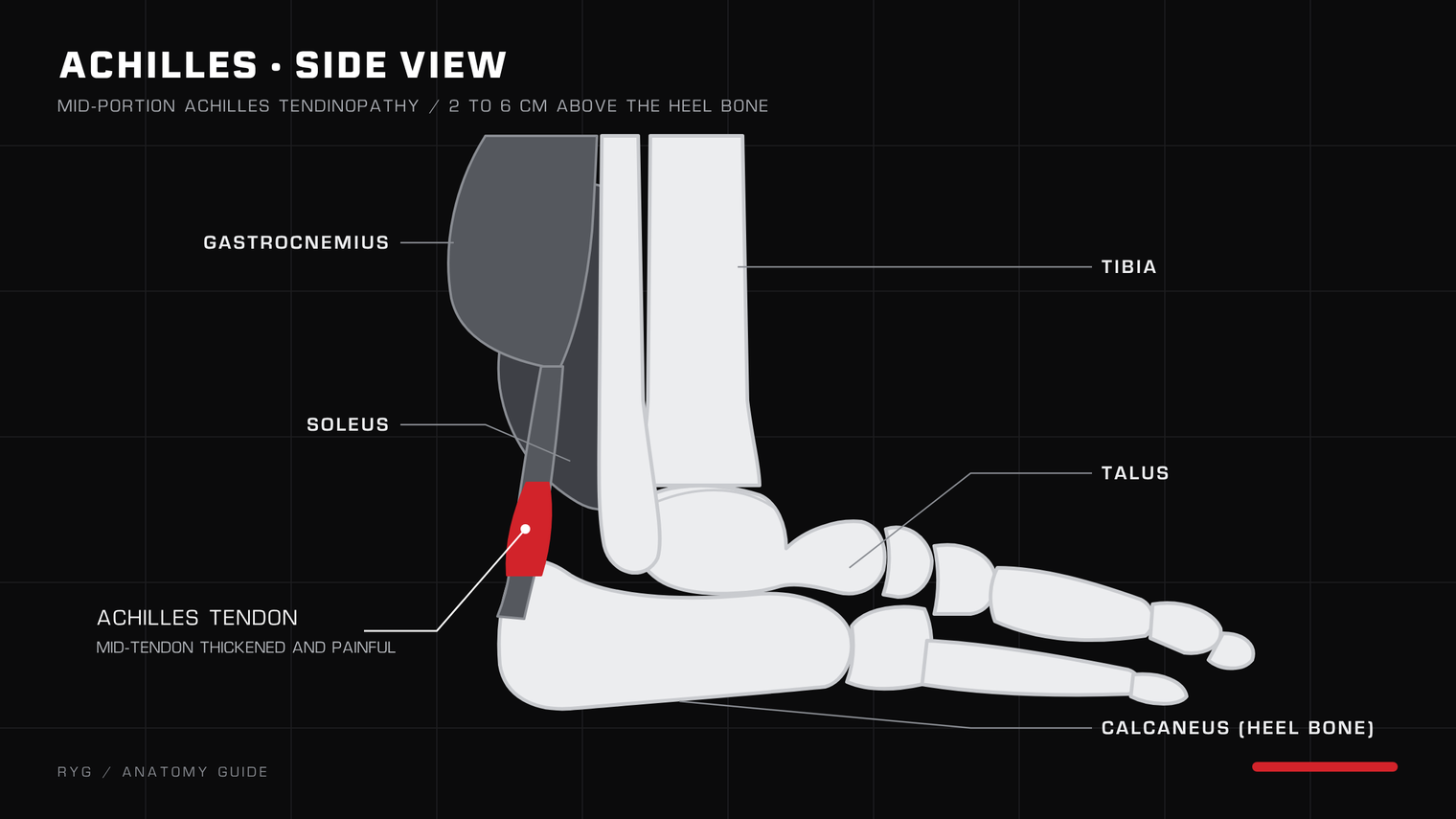
The Achilles is the thick cord connecting your calf to your heel, and it is the strongest tendon in your body for a reason: it transmits the force of every step, climb and push off you take. Golfers usually meet Achilles trouble through the walking, not the swing. A walked round is thousands of loading cycles, and when that volume jumps quickly, think league season starting or a golf trip with 36 hole days, the tendon can fall behind its adaptation curve and become painful. The tell tale signs are morning stiffness in the tendon, pain in the first minutes of walking that eases as you warm up, and tenderness when you pinch the cord a few centimeters above the heel.
The treatment evidence here is among the strongest in all of rehab, and it says something most golfers do not expect: you can usually keep playing.
What's actually going on
An overloaded tendon's structure changes. The collagen gets slightly disorganized and the tissue swells, and after a night of stillness it starts the day stiff and sensitive until movement gets it moving. The warm up then worse later cycle is the same one we see in other tendon problems, and it is the signal that the tendon's capacity is currently below your demands.
Rest alone reliably fails, because an unloaded tendon quietly loses even more capacity. The way through is loading that is heavy enough to make the tendon adapt and controlled enough not to flare it.
What the research says
- About 1 in 20 recreational runners develops Achilles tendinopathy during a race build up, and having had Achilles pain in the previous 12 months raises the odds of a new episode more than 6 fold, the strongest risk factor identified1.
- Roughly a third of runners with a new episode still have symptoms a year later, which is why early loading based rehab matters2.
- Athletes who kept running and jumping with pain capped at 5 out of 10 during rehab improved just as much at 12 months as those who stopped for 6 weeks, with no harm to the tendon3. The rule from that work: pain up to 5 out of 10 during and after exercise is acceptable, it should settle by the next morning, and it should not be getting worse week over week4.
- Heavy slow resistance training and eccentric heel drops give equally good results that last a year, but heavy slow resistance had 92% session adherence versus 78% and 100% patient satisfaction at 12 weeks versus 80%5. Twelve weeks of loading also reduced tendon thickness and abnormal blood vessel growth on imaging5.
- Exercise is the first line treatment for Achilles tendinopathy and should be given at least 3 months before other options are considered; recovery can take up to a year6.
- For a complete rupture, the picture is different: surgery lowers re-rupture risk from 3.9% to 2.3% but raises complication risk from 1.6% to 4.9%, and with early motion functional rehab the re-rupture difference disappears7.
- The clinical practice guideline frames midportion Achilles tendinopathy around three findings: pain, stiffness, and calf muscle power deficits8.
What we do about it
Start with isometrics and a load audit. Heavy calf isometric holds daily for pain, and an honest look at the walking volume spike that started this. A small heel lift in the shoe can trim tendon load short term.
Heavy slow resistance, 3 times a week. Calf raises on a step, straight knee and bent knee, progressed in load every week the tendon allows, for 12 weeks minimum. This is the protocol with the adherence and satisfaction numbers behind it.
Keep golfing under the pain rule. Ride some rounds, split the walking days, and keep pain at or below 5 out of 10 and settling by morning. The trial says continued activity under those rules does not slow recovery.
Reintroduce spring. Hops, quick push offs and hilly walked rounds only after the heavy work has built capacity, typically from week 8 onward. This is the progression we run in the clinic, with a test at every phase before you move on.
When to get it looked at
- A sudden pop in the back of the ankle with immediate weakness pushing off, which needs same day care to rule out a rupture.
- Pain and swelling right at the heel bone rather than a few centimeters above it, which is a different version with its own plan.
- Redness, warmth, or pain at rest that is not tied to activity.
- No improvement after 12 weeks of consistent heavy loading.
- Achilles pain in someone recently prescribed a fluoroquinolone antibiotic or on long term steroids.
Bottom line
Achilles pain in a walking golfer is a tendon that fell behind a jump in step count, and the research is clear that loading beats rest, that heavy slow resistance is the version people stick with, and that you can keep playing under a simple pain rule. Give it 12 weeks of consistent work. If your Achilles has started rationing your walking days, an in-person evaluation shows you where your tendon's capacity stands today.
References
- Lagas IF, Fokkema T, Verhaar JAN, et al. Incidence of Achilles tendinopathy and associated risk factors in recreational runners: A large prospective cohort study. J Sci Med Sport. 2020;23(5):448-452. PubMed
- Lagas IF, Fokkema T, Bierma-Zeinstra SMA, et al. How many runners with new-onset Achilles tendinopathy develop persisting symptoms? A large prospective cohort study. Scand J Med Sci Sports. 2020;30(10):1939-1948. PubMed
- Silbernagel KG, Thomeé R, Eriksson BI, et al. Continued sports activity, using a pain-monitoring model, during rehabilitation in patients with Achilles tendinopathy: a randomized controlled study. Am J Sports Med. 2007;35(6):897-906. PubMed
- Silbernagel KG, Thomeé R, Eriksson BI, et al. Continued sports activity, using a pain-monitoring model, during rehabilitation in patients with Achilles tendinopathy: a randomized controlled study. Am J Sports Med. 2007;35(6):897-906. PubMed
- Beyer R, Kongsgaard M, Hougs Kjær B, et al. Heavy Slow Resistance Versus Eccentric Training as Treatment for Achilles Tendinopathy: A Randomized Controlled Trial. Am J Sports Med. 2015;43(7):1704-1711. PubMed
- Silbernagel KG, Crossley KM. A Proposed Return-to-Sport Program for Patients With Midportion Achilles Tendinopathy: Rationale and Implementation. J Orthop Sports Phys Ther. 2015;45(11):876-886. PubMed
- Ochen Y, Beks RB, van Heijl M, et al. Operative treatment versus nonoperative treatment of Achilles tendon ruptures: systematic review and meta-analysis. BMJ. 2019;364:k5120. PubMed
- Martin RL, Chimenti R, Cuddeford T, et al. Achilles Pain, Stiffness, and Muscle Power Deficits: Midportion Achilles Tendinopathy Revision 2018. J Orthop Sports Phys Ther. 2018;48(5):A1-A38. PubMed
Alex is awesome. He's responsive to ongoing issues, and he works to formulate a plan to help you achieve your end-goals.
I had been having calf issues for years that went misdiagnosed or undiagnosed through by other providers. Now, he's clearly properly diagnosed the issue and helped me implement a plan that has kept the issue from coming back. Highly recommend!
I'm a runner, and I came in with Achilles and hip pain. Alex worked with me to figure out how to rebalance my strength on both sides. Most importantly, he listened. Each time we met, he tailored my training plan based on my actual progress and how I was feeling about the various exercises. Each session felt meaningful and worth my time and money. If you are dealing with an injury that is holding you back from your fitness goals, I highly recommend Regain Your Game to get back on track and set a new standard for yourself.
This article is for education and does not replace an evaluation. If you're dealing with an active injury, see a licensed medical provider.