
Ankle Sprains and Golf: Uneven Lies, Wet Slopes, and the Comeback Done Right
 Golf
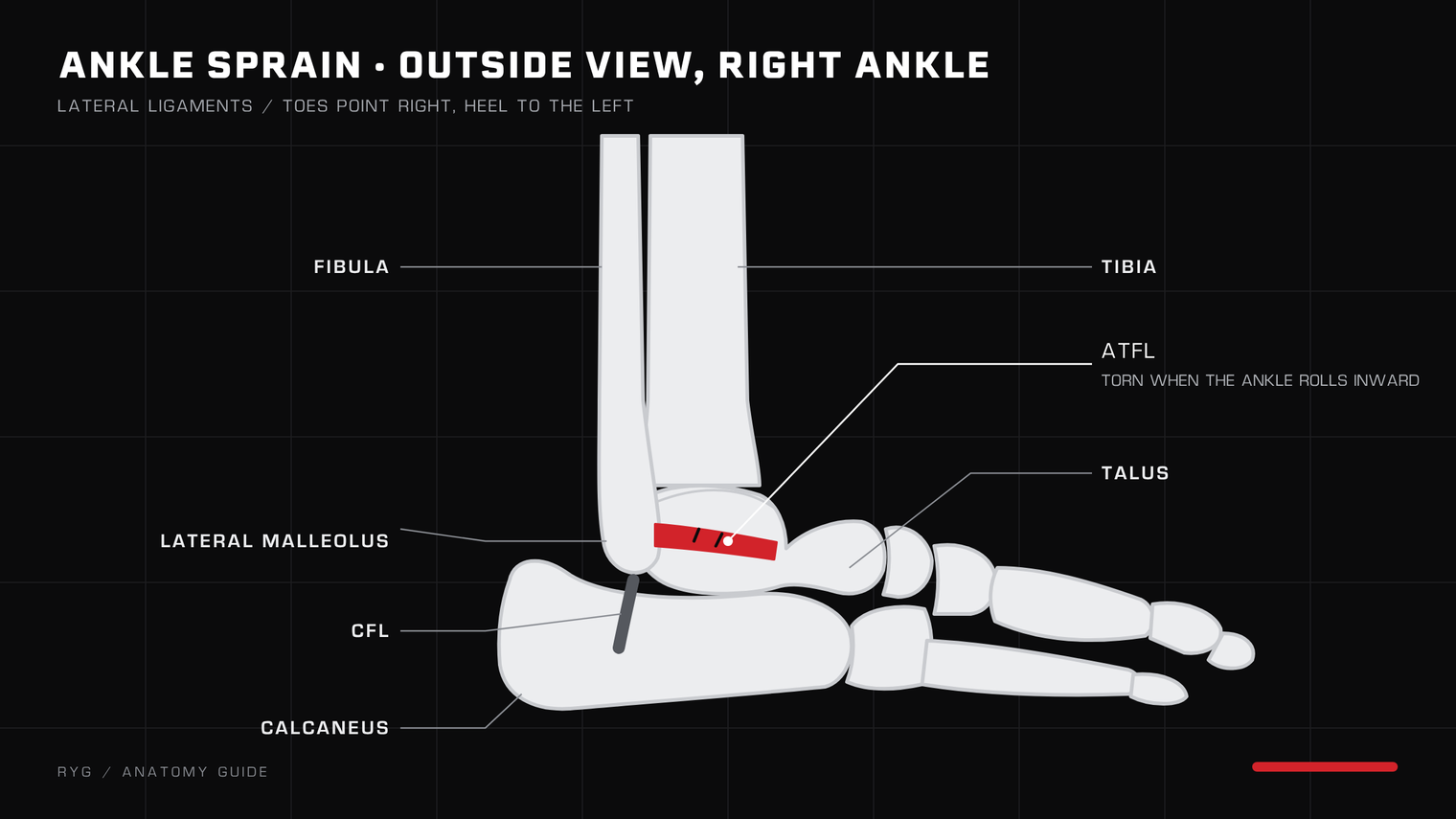
A golf course is basically an ankle sprain obstacle course dressed up beautifully. Sidehill lies, wet grass slopes, bunker edges, tree roots in the rough and cart path curbs all offer the same opportunity: a moment where your foot lands on an angle and rolls inward while your body weight keeps moving. That inward roll overstretches the ligaments on the outside of the ankle, and the most commonly injured one is the ATFL, a small ligament on the front outer ankle that is the weak link in nearly every rolled ankle in sports.
The sprain itself is rarely the problem. What happens in the eight weeks afterward decides whether it becomes a one time event or a recurring theme.
What's actually going on
Ankle sprains feel better long before they are actually better. Swelling fades and walking normalizes within a week or two for a mild sprain, but two crucial things lag behind: the ligament's full healing, and your balance system. Ankle ligaments are loaded with position sensors that feed your brain constant updates about where your foot is, and a sprain scrambles that signal. Skip the retraining and you are left with an ankle that reacts a fraction slower on the next uneven lie, which is exactly how one sprain becomes four.
Golf is unusual in how much of it is played on sloped ground, and the swing itself depends on a stable base. An ankle that does not trust itself on a sidehill lie costs you more than a sore joint.
What the research says
- Under usual care, about 1 in 3 athletes (33%) re-sprains the same ankle within a year; adding an 8 week home balance program cut that to 22%, a 35% reduction, and the benefit was greatest in athletes whose original sprain had not been medically treated1.
- Up to 40% of people who sprain an ankle for the first time develop chronic ankle instability: repeated sprains, giving way, and persistent pain, swelling or weakness more than a year after the injury2.
- Current guidelines favor a brace or tape plus a supervised exercise program over rest and passive treatments, with surgery reserved for sprains that fail thorough rehab3,4. Bracing has strong evidence and neuromuscular training moderate evidence for preventing a repeat sprain4.
- The severity of a sprain is judged most reliably by a hands on exam 4 to 5 days after injury, once the initial swelling has settled3. NSAIDs ease pain and swelling, but guidelines caution they may suppress the natural healing process3.
- Early movement beats rest: people who started exercise in the first week after an ankle sprain had better function at weeks 1 and 2 than those who rested, iced, compressed and elevated, with the same reinjury rate5.
- Being unable to do a single leg drop landing or a drop jump 2 weeks after a first sprain predicts who will go on to chronic ankle instability, and poorer balance reach at 6 months predicts it even more strongly6.
What we do about it
Days 1 to 5: protect and move. A brace or tape, weight bearing as tolerated, and ankle motion from day one. We examine the ligaments properly around day 4 or 5 when the exam is reliable, and we skip long stretches of ice and ibuprofen.
Weeks 1 to 3: strength and balance. Calf and peroneal strengthening, then single leg balance progressing to unstable surfaces, eyes closed, and head turns. This is the part most golfers skip and the part the re-sprain data is about.
Weeks 3 to 8: react and land. Hopping, landing and quick direction change drills so the reflexes fire at real world speed. Then sidehill lies, bunker edges and wet slopes on purpose.
After: the recurrence plan. A brace for the first season back on rough terrain, and a few minutes of balance work in the warm up. This is the progression we run in the clinic, with a test at every phase before you move on.
When to get it looked at
- Inability to take four steps right after the injury, or tenderness on the bone at the back edge of either ankle knob, which needs an X-ray.
- Numbness, a foot that looks deformed, or skin that is tight, pale or cold.
- Pain high up between the shin bones that is worse pushing off, which can be a high ankle sprain and takes longer.
- A sprain that is not clearly improving after 2 weeks, or your third roll of the season.
- A feeling of giving way or an ankle you do not trust months after the injury.
Bottom line
A rolled ankle on the course heals, but the research says a third of them roll again within a year unless the balance system is retrained, and up to 40% go on to lasting instability. The comeback is brace plus exercise, not rest, with balance and landing work at the center. If you have rolled an ankle recently, an in-person evaluation takes less than a visit to the turn and sets the plan.
References
- Hupperets MD, Verhagen EA, van Mechelen W. Effect of unsupervised home based proprioceptive training on recurrences of ankle sprain: randomised controlled trial. BMJ. 2009;339:b2684. PubMed
- Hertel J, Corbett RO. An Updated Model of Chronic Ankle Instability. J Athl Train. 2019;54(6):572-588. PubMed
- Vuurberg G, Hoorntje A, Wink LM, et al. Diagnosis, treatment and prevention of ankle sprains: update of an evidence-based clinical guideline. Br J Sports Med. 2018;52(15):956. PubMed
- Doherty C, Bleakley C, Delahunt E, et al. Treatment and prevention of acute and recurrent ankle sprain: an overview of systematic reviews with meta-analysis. Br J Sports Med. 2017;51(2):113-125. PubMed
- Bleakley CM, O'Connor SR, Tully MA, et al. Effect of accelerated rehabilitation on function after ankle sprain: randomised controlled trial. BMJ. 2010;340:c1964. PubMed
- Doherty C, Bleakley C, Hertel J, et al. Recovery From a First-Time Lateral Ankle Sprain and the Predictors of Chronic Ankle Instability: A Prospective Cohort Analysis. Am J Sports Med. 2016;44(4):995-1003. PubMed
Alex worked with our son on his ankle after a bad sprain and was able to help him strengthen his ankle to be back on the field in a shorter time frame. Alex was great at communication with our family and his coaching staff throughout the whole process. Definitely recommend.
Over the years I’ve been going to see Alex he has not only helped me quickly and efficiently get back to normal, but coming back stronger. He’s helped me with my knees and hips so that they are no longer any issue and my ankle when I sprained it. Highly recommended.
This article is for education and does not replace an evaluation. If you're dealing with an active injury, see a licensed medical provider.