
Wrist Pain in Golf: What That Ache at the Top of Your Swing Really Means
 Golf
Your wrists are the last link between your body and the club, and everything your swing produces funnels through them twice: once as your wrists hinge and unhinge to deliver speed, and once at impact when the club meets ball and ground. So when a wrist starts hurting, golf gets miserable fast. The good news is that most golf wrist pain falls into a few recognizable patterns, and each has a clear path forward.
The less good news is that the wrist is one area where the specific diagnosis changes the plan, so guessing is expensive.
What's actually going on
The most common pattern is tendon overload on the thumb side or the back of the wrist, usually from a spike in practice volume or a lot of shots off mats. The tendons that hinge and stabilize the wrist work on every swing, and when volume jumps faster than they can adapt they get painful and sometimes creaky with movement.
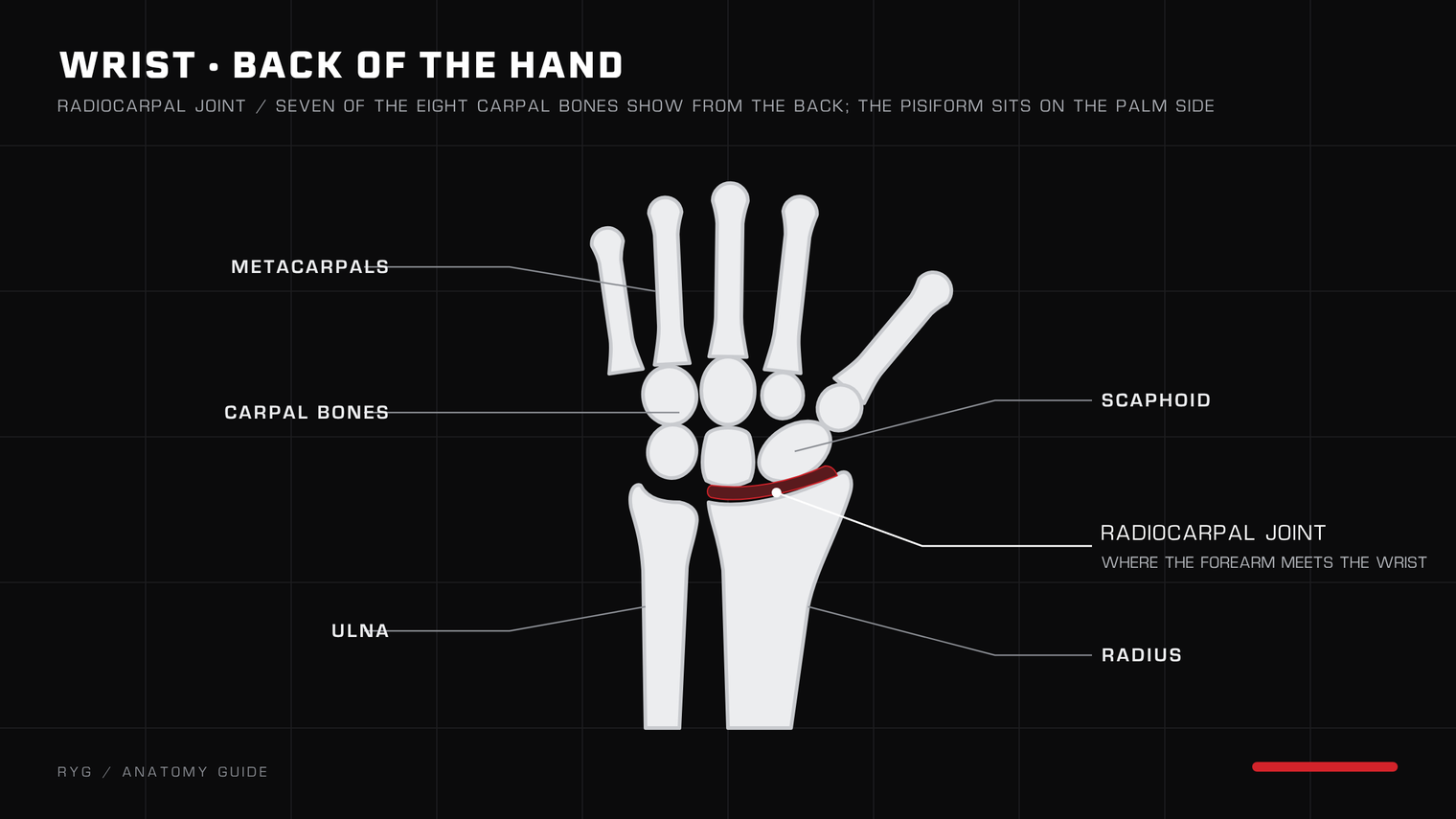
A second pattern is pain on the pinky side of the lead wrist. That area holds the TFCC, a cartilage disc we cover in its own post, and the tendon that runs along the outside of the wrist, which can get irritated or even slip out of its groove. A third pattern is pain after a single hard strike into a root, a mat or heavy turf. That is an impact injury, and the bones of the wrist are what we worry about there.
Why the lead wrist? At impact it is holding the clubface stable while the ground pushes back through the shaft. Golfers who flip or scoop at the ball load it even more, because the wrist arrives at impact moving instead of firm. A swing flaw and an injury feeding each other is why our rehab often overlaps with what your coach is already saying.
What the research says
- In a survey of 128 European Tour golfers, 30% reported a wrist problem; 67% of injuries were in the lead wrist, the ulnar (pinky) side was the most common location, and the injury that cost the most tournaments was subluxation of the ECU tendon on the outside of the wrist1.
- The same survey found many minor golf wrist problems can be managed by adjusting technique or practice volume so the golfer keeps playing during recovery, while structural injuries need a specific treatment plan and time away1.
- Hand and wrist injuries account for up to 25% of all sports injuries, and in professional athletes only about 18% need surgery; average return to play is 2.8 months and most athletes get back to their previous performance2.
- The scaphoid is the wrist bone to worry about after a fall on an outstretched hand: it accounts for over 85% of sport related wrist bone fractures, and playing on immediately in a cast carries a significant risk of the bone never healing3.
- Grip and wrist position shape where the pain lands. In tennis, the grip predicts the side of the wrist that gets injured, with topspin grips going with pinky side injuries and the Eastern grip with thumb side problems4. Golf has the same logic: a strong lead hand grip and a cupped or bowed wrist at impact shift the load from one side to the other.
- Imaging needs a careful read. In 103 people with no wrist pain, 39 wrists showed TFCC abnormalities on MRI and 23 looked like complete tears, so a scan has to be matched to the exam and the story5.
What we do about it
Sort the pattern. A hands on exam that loads each tendon, the TFCC, and the small bones, plus the history of how it started. Sudden pain after one strike and tenderness over bone gets imaged. Gradual pain with practice volume usually does not.
Cut the right volume. Range balls before rounds, mats before grass, hard impact shots before the rest. Most golfers keep playing something.
Strengthen in the positions golf demands. Wrist flexion and extension, radial and ulnar deviation, forearm rotation, and grip work, starting with isometrics and progressing to slow heavy loading over 4 to 8 weeks. The tendon that stabilizes the outside of the wrist gets special attention because it is the one that cost Tour players the most time.
Fix the impact. If you flip or scoop, the wrist arrives at impact moving, and we work with your coach on a firmer lead wrist. Then short shots off a tee, then turf, then full volume. This is the progression we run in the clinic, with a test at every phase before you move on.
When to get it looked at
- Pain and tenderness over the thumb side wrist bone after a fall or a hard strike, which needs an X-ray.
- Clicking or a tendon that visibly snaps on the outside of the wrist with rotation.
- Swelling that does not settle in a few days, or a wrist you cannot bear weight on.
- Pinky side pain with rotation and impact that has not settled in 2 to 3 weeks.
- Numbness, tingling or weakness in the hand.
Bottom line
Most golf wrist pain is a tendon that fell behind practice volume, and that version responds to smart volume cuts and progressive strengthening. The exceptions, a cracked bone or an unstable tendon, are the ones you do not want to play through. If your wrist has hurt for more than a couple of weeks, an in-person evaluation will sort the pattern and get you a plan.
References
- Hawkes R, O'Connor P, Campbell D. The prevalence, variety and impact of wrist problems in elite professional golfers on the European Tour. Br J Sports Med. 2013;47(17):1075-1079. PubMed
- Lehman JD, Krishnan KR, Stepan JG, et al. Prevalence and Treatment Outcomes of Hand and Wrist Injuries in Professional Athletes: A Systematic Review. HSS J. 2020;16(3):280-287. PubMed
- Goffin JS, Liao Q, Robertson GA. Return to sport following scaphoid fractures: A systematic review and meta-analysis. World J Orthop. 2019;10(2):101-114. PubMed
- Tagliafico AS, Ameri P, Michaud J, et al. Wrist injuries in nonprofessional tennis players: relationships with different grips. Am J Sports Med. 2009;37(4):760-767. PubMed
- Iordache SD, Rowan R, Garvin GJ, et al. Prevalence of triangular fibrocartilage complex abnormalities on MRI scans of asymptomatic wrists. J Hand Surg Am. 2012;37(1):98-103. PubMed
Alex is very approachable and makes you feel comfortable. Wrote me a program to rehab my broken wrist that I had surgery on. You can tell he truly cares and takes his profession seriously.
This article is for education and does not replace an evaluation. If you're dealing with an active injury, see a licensed medical provider.