
Achilles Tendon Pain in Lacrosse: Morning Stiffness, Sprint Soreness, and the Loading Fix
 Lacrosse
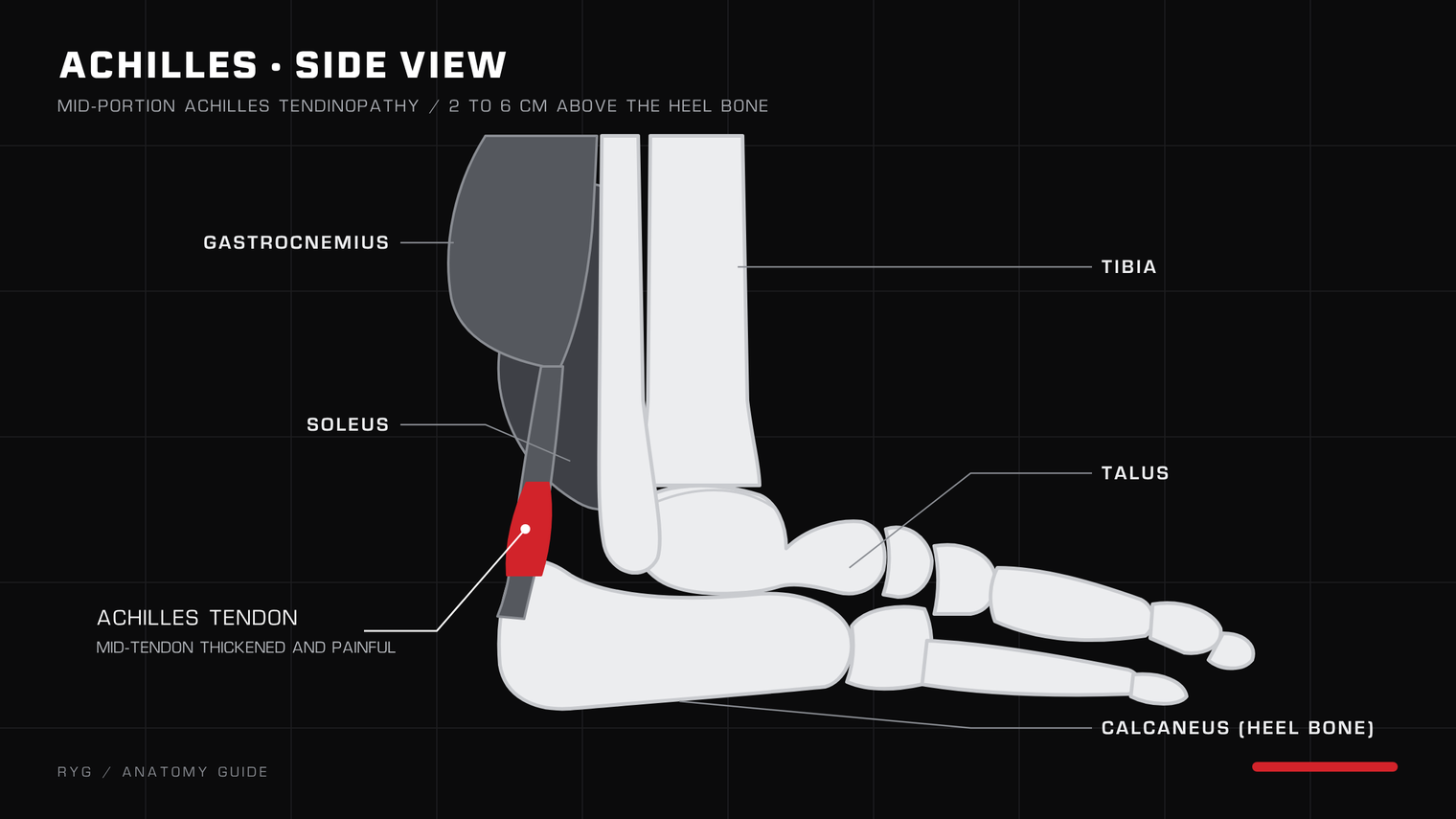
Achilles pain has a signature schedule. The tendon is stiff and sore for the first minutes of the morning, loosens as you move, tolerates practice reasonably well, then aches again that evening and shouts the next morning. That pattern is Achilles tendinopathy, an overload condition where the tendon's internal structure gets behind on maintenance. It usually sits a few centimeters above the heel.
What's actually going on
The Achilles is your sprint spring. Every stride stores and releases energy through it at loads several times body weight, and cutting and jump stops push that higher. The tendon adapts well to gradual increases, but lacrosse seasons are anything but gradual: winter training indoors, then a March explosion of outdoor sprint volume, then summer tournaments with four games in a weekend. Tendon cells remodel on a timescale of weeks, and when load jumps faster than remodeling, pain follows.
This is not an inflammation that rest will cure. Players who shut down for three weeks feel better, return, and flare within days, because the tendon detrained while they waited.
What the research says
- About 1 in 20 recreational runners develops Achilles tendinopathy during a race build-up, and having had Achilles pain in the previous 12 months raises the odds of a new episode more than 6-fold, the strongest risk factor identified1.
- Roughly a third of runners with a new episode still had symptoms a year later, which is why early loading-based rehab matters2.
- Athletes who kept running and jumping with pain monitored and capped during rehab improved just as much at 12 months as those who stopped for 6 weeks, with no harm to the tendon3. The rule: pain up to 5 out of 10 during and after exercise is acceptable, it should settle by the next morning, and it should not be getting worse week over week4.
- Heavy slow resistance training and eccentric heel drops gave equally good results that lasted a year, but heavy slow resistance had 92% session adherence versus 78% and 100% patient satisfaction at 12 weeks versus 80%; twelve weeks of loading also reduced tendon thickness and abnormal blood vessel growth on imaging5.
- Exercise is the first-line treatment and should be given at least 3 months before other options are considered; recovery can take up to a year and recurrence is common during the return-to-sport phase6.
- The APTA guideline frames the condition around three findings: pain, stiffness and calf muscle power deficits7. For a complete rupture, surgery lowers re-rupture risk from 3.9% to 2.3% but raises complication risk from 1.6% to 4.9%, and with early-motion rehab the re-rupture difference disappears8.
What we do about it
Set the starting dose. We measure calf strength and single-leg heel raise capacity, then pick a load that keeps pain inside the monitoring rule rather than at zero4.
Keep playing, within limits. Sprint volume gets trimmed and rebuilt, not eliminated, because the continued-activity group did just as well3.
Heavy slow calf raises. Straight-knee and bent-knee versions, three times a week, loaded heavier every week, with isometric holds on high-pain days. We choose the heavy slow approach for the adherence and satisfaction numbers5.
Rebuild the spring. Pogo hops, then sprint progressions, with next-morning stiffness as the gauge of whether yesterday's dose was right. This is the progression we run in the clinic, with a test at every phase before you move on.
When to get it looked at
- A sudden pop in the back of the ankle with immediate weakness, which is a rupture until proven otherwise and needs urgent evaluation8.
- Pain right at the heel bone rather than above it, which behaves differently and dislikes stretching.
- Morning stiffness that is getting worse week over week despite sensible loading4.
- Achilles pain in a growing athlete, where the heel growth plate may be the real source.
Bottom line
A cranky Achilles in a lacrosse player is a load-management problem, and the evidence says the fix is progressive heavy loading with pain monitored, not rest. Expect meaningful improvement inside a month and full resilience over a few months of consistent work. An in-person evaluation helps you find your starting dose.
References
- Lagas IF, Fokkema T, Verhaar JAN, et al. Incidence of Achilles tendinopathy and associated risk factors in recreational runners: A large prospective cohort study. J Sci Med Sport. 2020;23(5):448-452. PubMed
- Lagas IF, Fokkema T, Bierma-Zeinstra SMA, et al. How many runners with new-onset Achilles tendinopathy develop persisting symptoms? A large prospective cohort study. Scand J Med Sci Sports. 2020;30(10):1939-1948. PubMed
- Silbernagel KG, Thomeé R, Eriksson BI, et al. Continued sports activity, using a pain-monitoring model, during rehabilitation in patients with Achilles tendinopathy: a randomized controlled study. Am J Sports Med. 2007;35(6):897-906. PubMed
- Silbernagel KG, Thomeé R, Eriksson BI, et al. Continued sports activity, using a pain-monitoring model, during rehabilitation in patients with Achilles tendinopathy: a randomized controlled study. Am J Sports Med. 2007;35(6):897-906. PubMed
- Beyer R, Kongsgaard M, Hougs Kjær B, et al. Heavy Slow Resistance Versus Eccentric Training as Treatment for Achilles Tendinopathy: A Randomized Controlled Trial. Am J Sports Med. 2015;43(7):1704-1711. PubMed
- Silbernagel KG, Crossley KM. A Proposed Return-to-Sport Program for Patients With Midportion Achilles Tendinopathy: Rationale and Implementation. J Orthop Sports Phys Ther. 2015;45(11):876-886. PubMed
- Martin RL, Chimenti R, Cuddeford T, et al. Achilles Pain, Stiffness, and Muscle Power Deficits: Midportion Achilles Tendinopathy Revision 2018. J Orthop Sports Phys Ther. 2018;48(5):A1-A38. PubMed
- Ochen Y, Beks RB, van Heijl M, et al. Operative treatment versus nonoperative treatment of Achilles tendon ruptures: systematic review and meta-analysis. BMJ. 2019;364:k5120. PubMed
Alex does amazing work and had me feeling better in no time! I had alot of tightness in my hamstrings and calves and used needles and a lot of soft tissue work to loosen them up!
Alex is awesome. He's responsive to ongoing issues, and he works to formulate a plan to help you achieve your end-goals.
I had been having calf issues for years that went misdiagnosed or undiagnosed through by other providers. Now, he's clearly properly diagnosed the issue and helped me implement a plan that has kept the issue from coming back. Highly recommend!
This article is for education and does not replace an evaluation. If you're dealing with an active injury, see a licensed medical provider.