
Ankle Sprains in Lacrosse: Why the Most Common Injury in the Sport Deserves Better Than a Week of Rest
 Lacrosse
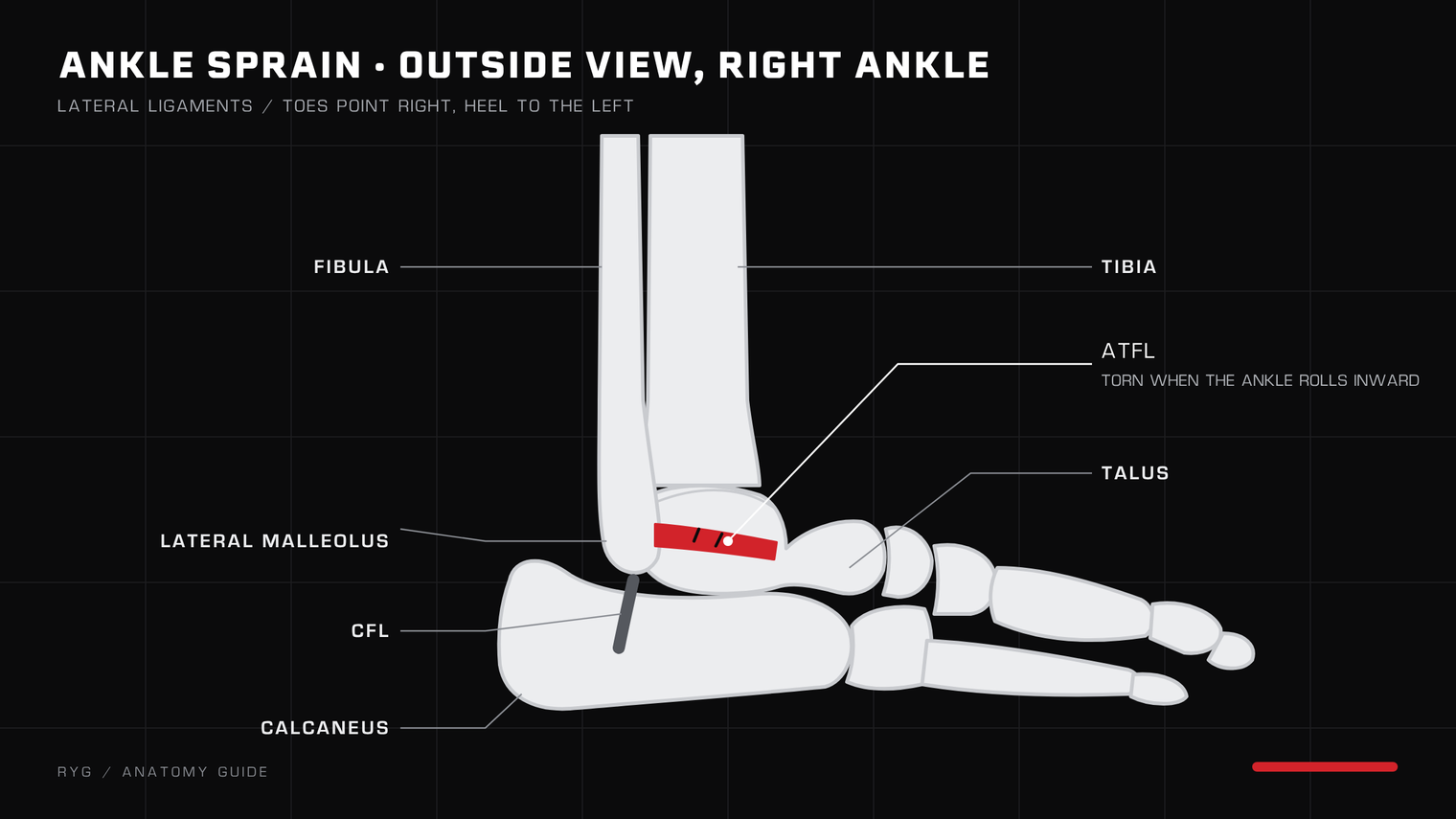
Ask any lacrosse athletic trainer what injury they see most and the answer is the ankle sprain. Cutting on turf and grass, landing in traffic on a draw or faceoff, stepping on another player's foot in a ground ball scrum, all roads lead to the classic inversion sprain, where the foot rolls inward and the ligaments on the outside of the ankle overstretch or tear. Because it is so common, it gets treated like a minor event. That casualness has a cost.
What's actually going on
An ankle sprain damages more than ligament. It damages the tiny sensors in the ligaments that tell your brain where your foot is in space, a sense called proprioception, and it slows the muscles on the outside of the shin that catch the foot when it starts to roll. Rest heals the pain but does not retrain the sensors, so the athlete returns with a blind spot in their balance system, and the next awkward step finds it.
What the research says
- Across 16 years and 182,000 NCAA injuries in 15 sports, ankle sprains alone made up 15% of injuries, the single most common injury in college sport1. In high school lacrosse, the lower leg, ankle and foot were the second most injured region in competition, behind only the head and face2.
- Female athletes sprain ankles at roughly twice the rate of males (13.6 versus 6.9 per 1,000 exposures), and children and adolescents sprain more often than adults3.
- Under usual care, about 1 in 3 athletes re-sprains the same ankle within a year; adding an 8-week home balance program cut that to 22%, a 35% reduction, with the biggest benefit in athletes whose original sprain had never been treated4.
- Up to 40% of people who sprain an ankle for the first time develop chronic ankle instability, with repeated sprains, giving way and lingering symptoms more than a year later5.
- Early movement beats rest. People who started exercise in the first week after a sprain had better function at weeks 1 and 2 than those who rested, iced, compressed and elevated, with the same 4% re-injury rate6. Current guidelines favor a brace or tape plus a supervised exercise program over rest and passive treatments7,8.
- The severity of a sprain is judged most reliably by a hands-on exam 4 to 5 days after injury, once the initial swelling has settled7. Being unable to do a single-leg drop landing or a drop jump 2 weeks after a first sprain predicts who will go on to chronic instability9.
What we do about it
Protect briefly, then move. A short window with a brace or tape and progressive weight bearing, which carries the guideline's strongest grade, with early range-of-motion work in the first days7,6.
Rebuild strength in every direction. Calf raises, banded work for the muscles along the outer shin, and single-leg loading.
Retrain the sensors. Single-leg balance progressing from stable ground to foam to catching a ball, because the balance program is what cut re-sprains by a third4.
Test before you cut. Single-leg drop landings and hop tests at two weeks and again before full return, since those are the tests that flag the ankles headed for chronic trouble9. This is the progression we run in the clinic, with a test at every phase before you move on.
When to get it looked at
- Inability to bear weight for four steps right after the injury, or tenderness on the bony points of the ankle or the base of the little toe, which call for an X-ray.
- Pain higher up the shin or between the two shin bones, which can mean a high ankle sprain with its own longer timeline10.
- Numbness, or a foot that looks deformed.
- A sprain that still feels unstable or cannot manage a single-leg hop two weeks later9.
Bottom line
The most common injury in lacrosse is also one of the most trainable. Rest alone leaves a third of athletes re-spraining within a year and up to 40% chronically unstable, while a few weeks of balance and strength work changes those odds. An in-person evaluation gives you the day-by-day plan.
References
- Hootman JM, Dick R, Agel J. Epidemiology of collegiate injuries for 15 sports: summary and recommendations for injury prevention initiatives. J Athl Train. 2007;42(2):311-319. PubMed
- Xiang J, Collins CL, Liu D, et al. Lacrosse injuries among high school boys and girls in the United States: academic years 2008-2009 through 2011-2012. Am J Sports Med. 2014;42(9):2082-2088. PubMed
- Doherty C, Delahunt E, Caulfield B, et al. The incidence and prevalence of ankle sprain injury: a systematic review and meta-analysis of prospective epidemiological studies. Sports Med. 2014;44(1):123-140. PubMed
- Hupperets MD, Verhagen EA, van Mechelen W. Effect of unsupervised home based proprioceptive training on recurrences of ankle sprain: randomised controlled trial. BMJ. 2009;339:b2684. PubMed
- Hertel J, Corbett RO. An Updated Model of Chronic Ankle Instability. J Athl Train. 2019;54(6):572-588. PubMed
- Bleakley CM, O'Connor SR, Tully MA, et al. Effect of accelerated rehabilitation on function after ankle sprain: randomised controlled trial. BMJ. 2010;340:c1964. PubMed
- Vuurberg G, Hoorntje A, Wink LM, et al. Diagnosis, treatment and prevention of ankle sprains: update of an evidence-based clinical guideline. Br J Sports Med. 2018;52(15):956. PubMed
- Doherty C, Bleakley C, Delahunt E, et al. Treatment and prevention of acute and recurrent ankle sprain: an overview of systematic reviews with meta-analysis. Br J Sports Med. 2017;51(2):113-125. PubMed
- Doherty C, Bleakley C, Hertel J, et al. Recovery From a First-Time Lateral Ankle Sprain and the Predictors of Chronic Ankle Instability: A Prospective Cohort Analysis. Am J Sports Med. 2016;44(4):995-1003. PubMed
- Mauntel TC, Wikstrom EA, Roos KG, et al. The Epidemiology of High Ankle Sprains in National Collegiate Athletic Association Sports. Am J Sports Med. 2017;45(9):2156-2163. PubMed
Alex worked with our son on his ankle after a bad sprain and was able to help him strengthen his ankle to be back on the field in a shorter time frame. Alex was great at communication with our family and his coaching staff throughout the whole process. Definitely recommend.
We had a great experience with Alex and Regain Your Game. My son had a high ankle sprain and we worked with Alex and had a quick recovery. We particularly valued his availability, flexibility, and professionalism.
This article is for education and does not replace an evaluation. If you're dealing with an active injury, see a licensed medical provider.