
Achilles Tendon Pain in Runners: The Complete Guide to a Tendon That Demands Respect
 Track & Running
Your Achilles is the strongest tendon you own, and running is the reason it exists in the form it does. Every stride, it stores and releases energy like a spring. Achilles pain, that morning stiffness and pinch above the heel that loosens as you walk, then reappears after runs, sits near the top of every running injury list. And it has a defining trait: ignored early Achilles pain has a habit of becoming a year-long problem, while early smart management usually resolves it.
Even a rupture does not end a career anymore. Kevin Durant tore his Achilles completely in the NBA Finals and returned to all-star level play on the back of long, progressive loading. The same principle, load rather than rest, is what fixes the far more common tendinopathy.
What's actually going on
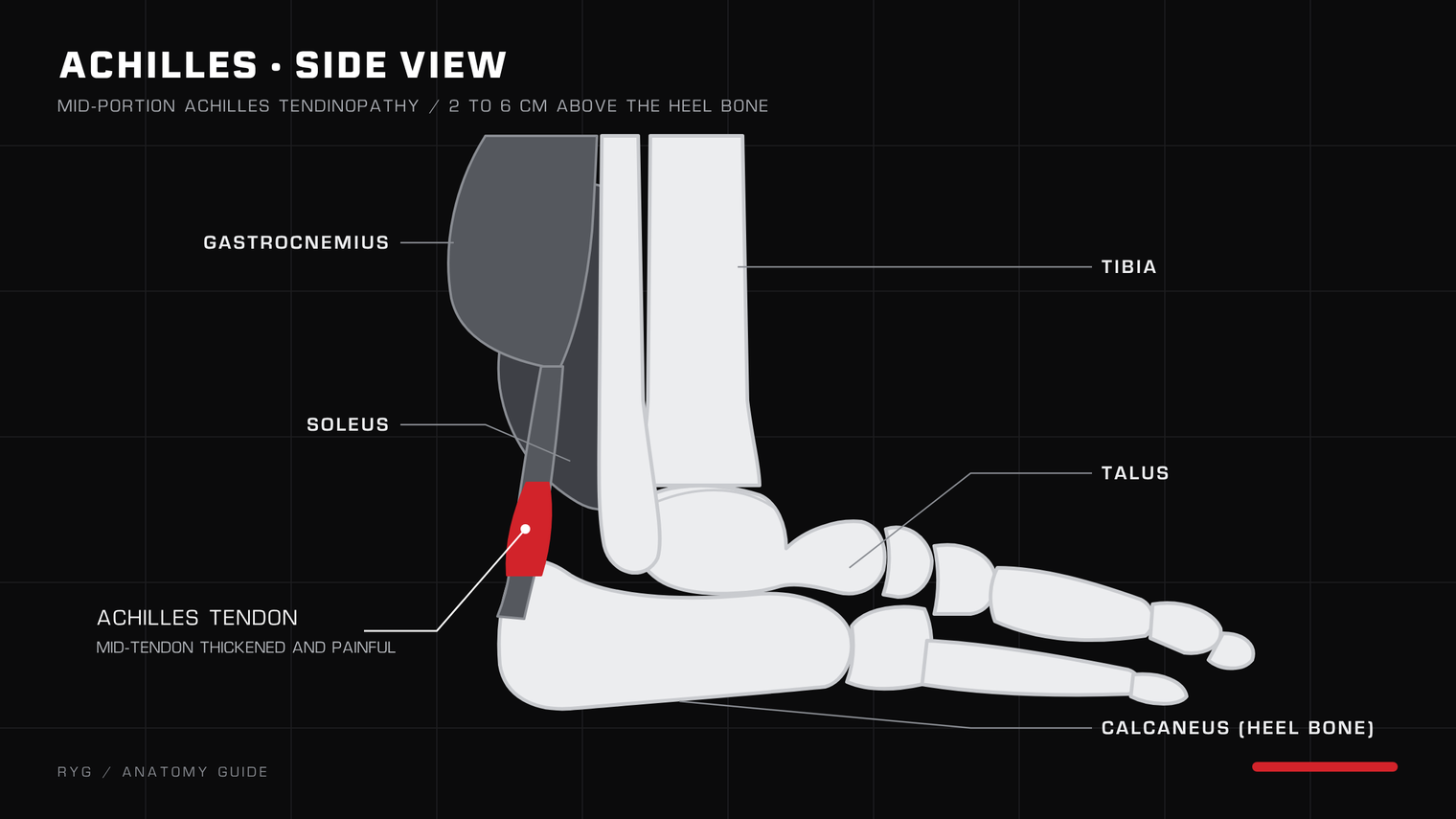
First, know your type, because it changes the plan. Midportion Achilles pain lives a few centimeters above the heel bone, in the springy middle of the tendon, and it is the common one. Insertional Achilles pain sits right at the heel bone itself, and it has a quirk: the tendon gets compressed against the heel when your ankle bends far upward, so calf stretching and uphill running often make insertional cases worse.
Tendon pain here is not simple inflammation. It is a tendon whose structure has started to disorganize under more load than it could adapt to. Rest feels better but rebuilds nothing, which is why the pain returns the first week back. The guideline frames the condition around three findings: pain, stiffness and calf muscle power deficits1.
What the research says
- About 1 in 20 recreational runners develops Achilles tendinopathy during a race build-up, and marathon registrants have the highest rate at 7.4%2.
- Having had Achilles pain in the previous 12 months raises the odds of a new episode more than 6-fold, the strongest risk factor identified2.
- Roughly a third of runners with a new episode still have symptoms a year later, which is why early loading-based rehab matters3.
- You do not have to stop. Athletes who kept running and jumping under a pain-monitoring model during rehab improved just as much at 12 months as those who stopped for 6 weeks, with no harm to the tendon4.
- Heavy slow resistance training and eccentric heel drops give equally good results that last a year, but heavy slow resistance had 92% session adherence versus 78% and 100% patient satisfaction at 12 weeks versus 80%. Twelve weeks of loading also reduced tendon thickness and abnormal blood vessel growth on imaging5.
- For a complete rupture, surgery lowers re-rupture risk from 3.9% to 2.3% but raises complication risk from 1.6% to 4.9%, and with early-motion functional rehab the re-rupture difference disappears. Nearly 1 in 3 professional athletes never returned to play after a surgically repaired rupture6,7.
What we do about it
The cure is progressive loading. We start with isometric calf holds, which tend to settle pain, then move to heavy slow calf raises, straight-knee and bent-knee, that get heavier over weeks and teach the tendon to remodel. Then faster loading: hopping, skipping and bounding, because a tendon has to tolerate spring, not just slow strength. Then speed and hills.
Running continues throughout, on the pain-monitoring model the trial used: keep the dose at a level where pain stays mild and settles by the next morning, and trim speed and hills first since they load the tendon most. For insertional cases, we skip the stretches and keep the heel slightly raised early on. Plan on a 12-week block as the minimum, because that is the length of the programs that produced lasting results. This is the progression we run in the clinic, with a test at every phase before you move on.
When to get it looked at
- A sudden pop at the back of the ankle with inability to push off or stand on your toes, which can be a rupture and needs same-day care
- Morning stiffness that has lasted more than a month, since the persistence data says it rarely leaves on its own
- A lump in the tendon that is growing, or pain that is constant rather than load-related
- Achilles pain in both legs at once, or alongside a new medication, which is worth a physician's review
Bottom line
The Achilles has one language, load, and the research is unusually clear that heavy, slow, progressive loading over about 12 weeks is what fixes it, with running continued under a pain rule rather than stopped. Start loading now. An in-person evaluation can give you the first three weeks of exercises and the rule for how much running is safe.
References
- Martin RL, Chimenti R, Cuddeford T, et al. Achilles Pain, Stiffness, and Muscle Power Deficits: Midportion Achilles Tendinopathy Revision 2018. J Orthop Sports Phys Ther. 2018;48(5):A1-A38. PubMed
- Lagas IF, Fokkema T, Verhaar JAN, et al. Incidence of Achilles tendinopathy and associated risk factors in recreational runners: A large prospective cohort study. J Sci Med Sport. 2020;23(5):448-452. PubMed
- Lagas IF, Fokkema T, Bierma-Zeinstra SMA, et al. How many runners with new-onset Achilles tendinopathy develop persisting symptoms? A large prospective cohort study. Scand J Med Sci Sports. 2020;30(10):1939-1948. PubMed
- Silbernagel KG, Thomeé R, Eriksson BI, et al. Continued sports activity, using a pain-monitoring model, during rehabilitation in patients with Achilles tendinopathy: a randomized controlled study. Am J Sports Med. 2007;35(6):897-906. PubMed
- Beyer R, Kongsgaard M, Hougs Kjær B, et al. Heavy Slow Resistance Versus Eccentric Training as Treatment for Achilles Tendinopathy: A Randomized Controlled Trial. Am J Sports Med. 2015;43(7):1704-1711. PubMed
- Ochen Y, Beks RB, van Heijl M, et al. Operative treatment versus nonoperative treatment of Achilles tendon ruptures: systematic review and meta-analysis. BMJ. 2019;364:k5120. PubMed
- Trofa DP, Miller JC, Jang ES, et al. Professional Athletes' Return to Play and Performance After Operative Repair of an Achilles Tendon Rupture. Am J Sports Med. 2017;45(12):2864-2871. PubMed
I'm a runner, and I came in with Achilles and hip pain. Alex worked with me to figure out how to rebalance my strength on both sides. Most importantly, he listened. Each time we met, he tailored my training plan based on my actual progress and how I was feeling about the various exercises. Each session felt meaningful and worth my time and money. If you are dealing with an injury that is holding you back from your fitness goals, I highly recommend Regain Your Game to get back on track and set a new standard for yourself.
Alex does amazing work and had me feeling better in no time! I had alot of tightness in my hamstrings and calves and used needles and a lot of soft tissue work to loosen them up!
This article is for education and does not replace an evaluation. If you're dealing with an active injury, see a licensed medical provider.