
Ankle Sprains in Runners: Why Walking It Off Is the Worst Advice in Sports
 Track & Running
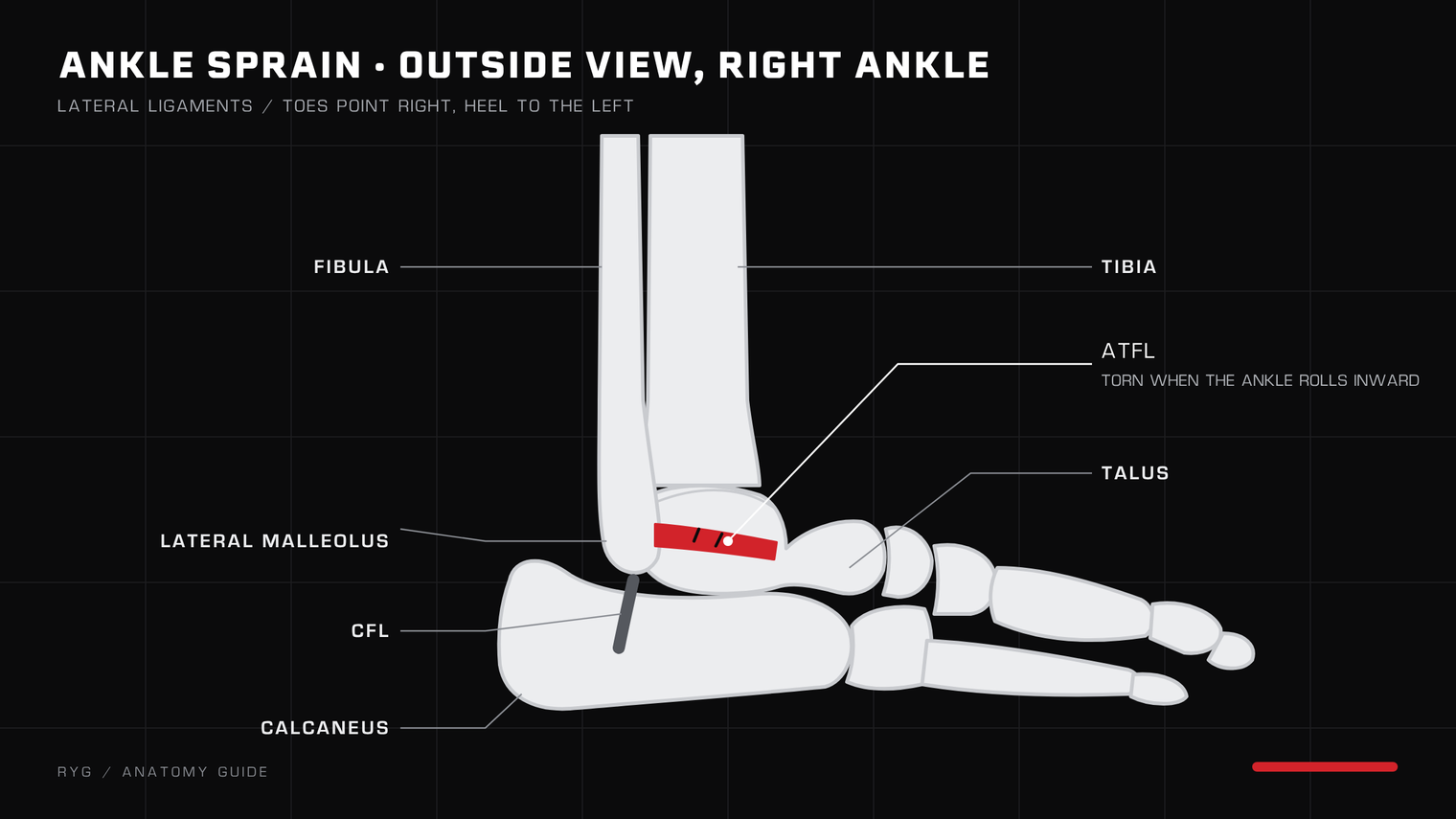
Every runner eventually meets the curb, root or pothole that rolls their ankle. The classic sprain turns your foot inward and overstretches or tears the ligaments on the outside of the ankle, most often the anterior talofibular ligament. Swelling and bruising can look dramatic, but the look of an ankle is a poor guide to its severity. Some ugly ankles are mild sprains and some modest-looking ones hide bigger tears.
The problem with walk-it-off culture is not the walking. It is what gets skipped afterward. The research is clear that a sprain treated with nothing has a very high chance of becoming the next sprain.
What's actually going on
Ligaments do more than hold bones together. They are packed with sensors that tell your brain exactly where your foot is in space. When a ligament tears, you do not just lose some structural support, you lose position sense. The ligament heals, the wiring does not recover on its own, and the ankle keeps making small position errors on every uneven step until one of them becomes the next sprain. That is the mechanism behind the recurrence numbers, and it is also why the fix is balance and reaction training, not just time.
What the research says
- Under usual care, about 1 in 3 athletes re-sprains the same ankle within a year. Adding an 8-week home balance program cut that to 22%, a 35% reduction, in a 522-athlete randomized trial1.
- Current guidelines favor a brace or tape plus a supervised exercise program over rest and passive treatments, with surgery reserved for sprains that fail thorough rehab2,3.
- Across 46 systematic reviews, bracing has strong evidence and neuromuscular training moderate evidence for preventing a repeat sprain, and early mobilization has strong evidence for pain, swelling and function after an acute sprain3.
- The severity of a sprain is judged most reliably by a hands-on exam 4 to 5 days after injury, once the initial swelling has settled. NSAIDs ease pain and swelling, but the guideline cautions they may suppress the natural healing process2.
- Being unable to do a single-leg drop landing or a drop jump 2 weeks after a first sprain predicts who will go on to chronic ankle instability, and at 6 months poorer reach on a balance test and lower self-reported function predicted it with 85% accuracy4.
- Female athletes sprain ankles at roughly twice the rate of males, children and adolescents sprain more often than adults, and indoor court sports carry the highest rate of any category, about 7 per 1,000 exposures5.
What we do about it
The first days are simple: protect it, keep the swelling moving with elevation and gentle motion, and get walking as normally as possible as soon as pain allows. Early movement beats strict rest. A brace or tape in that window lets you move without rolling it again. We grade the sprain at the delayed exam, not on day one.
The rehab that prevents round two is balance and strength work: single-leg stands progressing to unstable surfaces, hops and landings, plus calf and outer-ankle strengthening, continued for weeks after pain is gone. We test the drop landing and single-leg balance at two weeks and again later, because those are the measures that flag who is heading toward instability. The 2021 APTA clinical practice guideline on lateral ankle sprain is the reference we work from6. Trail running returns last, and a brace for the first season back is a reasonable, evidence-backed call. This is the progression we run in the clinic, with a test at every phase before you move on.
When to get it looked at
- You cannot put weight on it and walk right after the injury, or there is bone tenderness at the ankle bones or the outer midfoot, which are the standard reasons to rule out a fracture
- Numbness in the foot, or a foot that looks deformed
- Pain above the ankle between the shin bones that is worse pushing off, which can be a high ankle sprain and takes longer
- An ankle that still gives way or swells weeks later
Bottom line
An ankle sprain heals on its own. An ankle sprain that does not re-sprain takes work, and the research says balance training and bracing are what deliver it. If you rolled your ankle on a run, an in-person evaluation can tell you exactly what to do starting today.
References
- Hupperets MD, Verhagen EA, van Mechelen W. Effect of unsupervised home based proprioceptive training on recurrences of ankle sprain: randomised controlled trial. BMJ. 2009;339:b2684. PubMed
- Vuurberg G, Hoorntje A, Wink LM, et al. Diagnosis, treatment and prevention of ankle sprains: update of an evidence-based clinical guideline. Br J Sports Med. 2018;52(15):956. PubMed
- Doherty C, Bleakley C, Delahunt E, et al. Treatment and prevention of acute and recurrent ankle sprain: an overview of systematic reviews with meta-analysis. Br J Sports Med. 2017;51(2):113-125. PubMed
- Doherty C, Bleakley C, Hertel J, et al. Recovery From a First-Time Lateral Ankle Sprain and the Predictors of Chronic Ankle Instability: A Prospective Cohort Analysis. Am J Sports Med. 2016;44(4):995-1003. PubMed
- Doherty C, Delahunt E, Caulfield B, et al. The incidence and prevalence of ankle sprain injury: a systematic review and meta-analysis of prospective epidemiological studies. Sports Med. 2014;44(1):123-140. PubMed
- Martin RL, Davenport TE, Fraser JJ, et al. Ankle Stability and Movement Coordination Impairments: Lateral Ankle Ligament Sprains Revision 2021. J Orthop Sports Phys Ther. 2021;51(4):CPG1-CPG80. PubMed
Alex is truly the best. He spends quality time with you listening and assessing the situation intently. He's very knowledgeable. He's helped me with a bum ankle and dry needling on a chronically bad back. He even came in on a Sumday on 12 hours notice to help my son with a hip flex, who was in the middle of track season. The best!
Our son broke his ankle in a hockey game. With his goal of being ready for spring TO’s we were on the hunt for a PT that knew the game and expectations of a hockey player. We were referred to Alex by a coach.
After meeting with/ Alex our son , wife and I were 100% this is the right guy to help our son. Alex put multiple pt plans together along with on ice plans to reintroduce skating. Most of all our son trusts and listens to Alex about the recovery process. Our son is ahead of schedule!
Pretty much the best experience we’ve ever had with a doctor.
Thank you
Lessner’s
This article is for education and does not replace an evaluation. If you're dealing with an active injury, see a licensed medical provider.