
Knee Prehab for Runners: Building Knees That Can Handle Your Ambitions
 Track & Running
Knee pain is the number one reason runners end up in clinics, and here is the pattern behind most of it. It is rarely one bad step. It is weeks of training load quietly outrunning the strength of the muscles that protect the knee, until the joint or a tendon starts sending invoices. Which means most running knee pain is less an accident than an arithmetic problem, and arithmetic problems can be solved in advance.
The research on this is better than for almost any other prevention strategy in sport, and it comes with a bonus: the strength you build in the gym shows up on the climbs.
What's actually going on
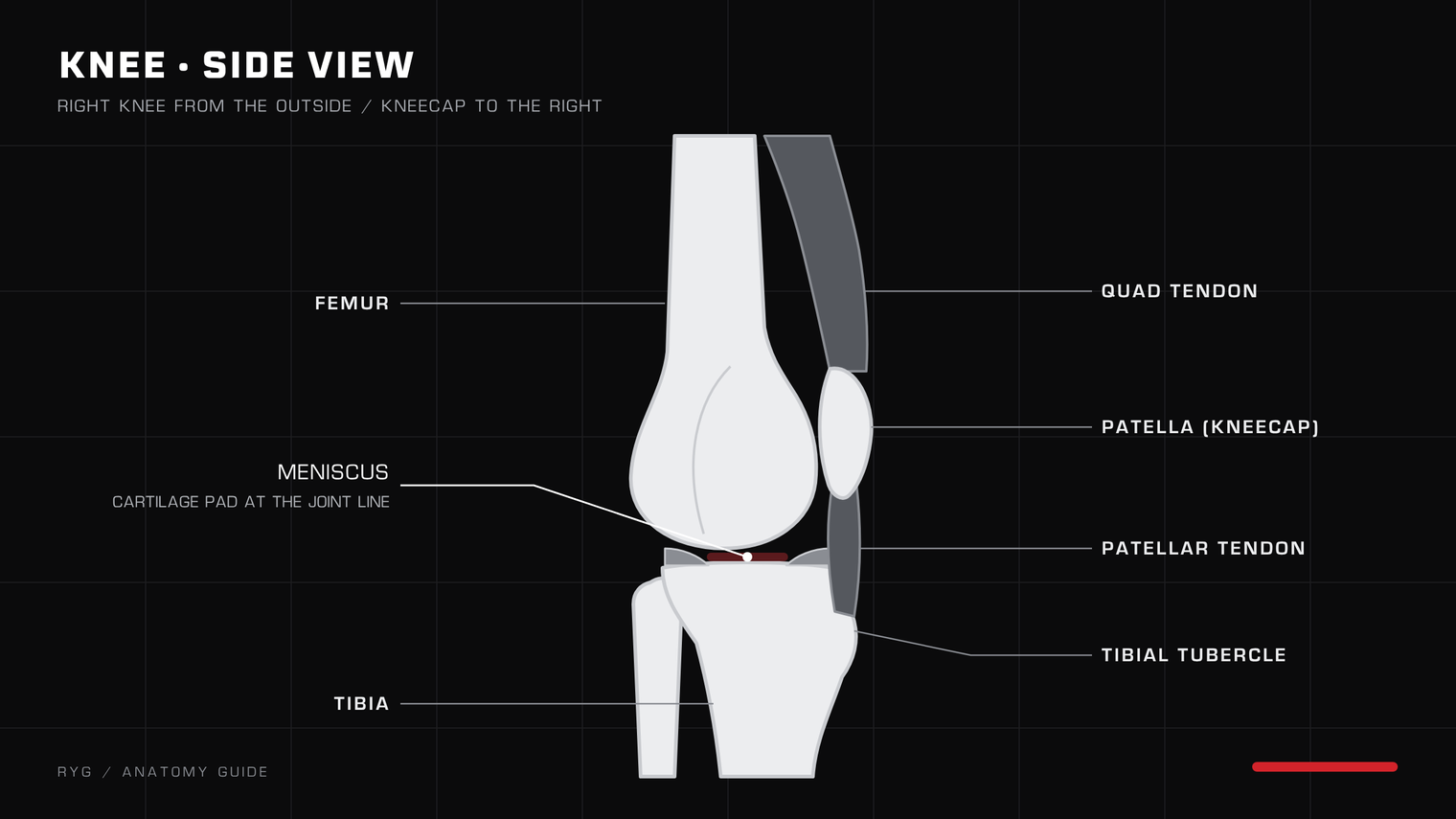
Two mechanisms make knee prehab work. First, muscles are shock absorbers. When your quad is strong, it lengthens under load at each landing and soaks up force before it reaches the kneecap joint and cartilage. A weak quad transfers that job to the joint itself. Second, alignment under fatigue. Your knee is a hinge stuck between two ball joints, the hip and the foot, and when hip muscles tire, the thigh drifts inward on each landing, concentrating kneecap pressure onto a smaller area. Strong hips keep force spread wide late in runs, which is exactly when most knee pain shows up.
What the research says
- Between 19% and 79% of long-distance runners get injured in a year, and the knee is the most common site. A previous injury and high weekly mileage are the strongest predictors, while a gradual increase in weekly distance was actually protective for the knee1.
- Strength training is the best-supported prevention tool there is. Pooled across 25 randomized trials and 26,610 athletes, it reduced sports injuries to less than one-third and overuse injuries by almost half, while stretching had no protective effect at all2.
- The effect is dose-dependent: every 10% increase in strength training volume reduced injury risk by more than 4 percentage points, and the programs were safe with high compliance3.
- Quadriceps weakness is a proven risk factor for future kneecap pain, while age, height, weight, BMI and Q-angle are not4.
- Novice runners with higher eccentric hip abduction (glute) strength were less likely to develop kneecap pain in their first 50 km of running5.
- Running does not wear out knees. Recreational runners have a 3.5% rate of hip and knee arthritis compared with 10.2% in sedentary people and 13.3% in elite competitive runners, and fewer than 15 years of running was associated with 40% lower odds of hip or knee arthritis6.
What we do about it
The routine is short and unglamorous, about 15 minutes twice a week, and it maps directly onto the two mechanisms. A knee-bending strength staple: split squats or step-downs done slow, building to added weight, because quad strength is the risk factor the data names. A hip strength staple: side-plank leg lifts or banded lateral walks plus single-leg glute bridges, because eccentric hip strength protected the novices in the cohort study. Slow step-downs from a low box for control, the single best bang-for-buck knee exercise we know for runners.
And a small dose of hopping or low box jumps for tendon spring, because tendons need fast load to stay resilient, not just slow strength. The dose-response finding is the reason we progress it: more volume, more protection, as long as it is added gradually. Runners who lift consistently also tend to find that hills stop feeling like a threat. This is the progression we run in the clinic, with a test at every phase before you move on.
When to get it looked at
- Knee pain that keeps returning at the same point in your training plan, which usually means a strength gap rather than bad luck
- Swelling, locking or giving way, which point to something inside the joint
- A pinpoint ache at the bottom of the kneecap that lingers the morning after jumping or hills
- Knee pain in a growing athlete that is changing how they run
- A history of knee injury before a big mileage jump or first marathon, when a baseline strength test is worth doing
Bottom line
Strength training is the best-supported injury prevention tool in running, and the research says it cuts injury risk by more than half and that running itself is good for your knees. If your knees have a history, or you are eyeing a mileage jump, a race build or your first marathon, this is the cheapest insurance available. An in-person evaluation can lay out every exercise with the right progressions.
References
- van Gent RN, Siem D, van Middelkoop M, et al. Incidence and determinants of lower extremity running injuries in long distance runners: a systematic review. Br J Sports Med. 2007;41(8):469-480. PubMed
- Lauersen JB, Bertelsen DM, Andersen LB. The effectiveness of exercise interventions to prevent sports injuries: a systematic review and meta-analysis of randomised controlled trials. Br J Sports Med. 2014;48(11):871-877. PubMed
- Lauersen JB, Andersen TE, Andersen LB. Strength training as superior, dose-dependent and safe prevention of acute and overuse sports injuries: a systematic review, qualitative analysis and meta-analysis. Br J Sports Med. 2018;52(24):1557-1563. PubMed
- Neal BS, Lack SD, Lankhorst NE, et al. Risk factors for patellofemoral pain: a systematic review and meta-analysis. Br J Sports Med. 2019;53(5):270-281. PubMed
- Ramskov D, Barton C, Nielsen RO, et al. High eccentric hip abduction strength reduces the risk of developing patellofemoral pain among novice runners initiating a self-structured running program: a 1-year observational study. J Orthop Sports Phys Ther. 2015;45(3):153-161. PubMed
- Alentorn-Geli E, Samuelsson K, Musahl V, et al. The Association of Recreational and Competitive Running With Hip and Knee Osteoarthritis: A Systematic Review and Meta-analysis. J Orthop Sports Phys Ther. 2017;47(6):373-390. PubMed
I HIGHLY recommend Dr Alex Shuchuk for anyone requiring post-surgical rehab! I tore my ACL and medial meniscus in February 2024 while skiing in Telluride. After surgery I went to my insurance-driven PT and found it to be very “cookie cutter” and not well tailored to my specific needs. These services simply saw me as a 53 year old male with very basic, sedentary needs. In fact, I am a very active biker, runner, skier etc. I felt I needed more than what group exercises could offer. I sought Alex’s expertise after seeing him working with young athletes while my son was training at Total Athlete Performance. In a span of nine months I am at a pre-injury level of knee health and am close to a pre-injury fitness level. I am biking 20-50 miles per session, running 4-7 miles per session and plan on skiing in the coming winter. Kudos to Dr Shuchuk and his science-driven and custom tailored plan for me to “Regain My Game”!
I fully tore my PCL and didn’t know where to go. I fight professionally and needed somewhere that would help me get back to competition. I was recommended by a friend and from day one Alex gave me confidence and a clear plan on what we needed to do to get back in the cage. In 3 months I was able to return to training 100% by following his programming and checking in with him regularly about my knee. I highly recommend Regain Your Game to any athlete looking for a PT that they can put faith into.
This article is for education and does not replace an evaluation. If you're dealing with an active injury, see a licensed medical provider.