
Achilles Tendon Pain in Soccer: Load It Right or Fight It All Season
 Soccer
The Achilles is the strongest tendon in your body, transmitting forces of several times bodyweight every time you push off, and soccer asks it to do that thousands of times per match across sprints, jumps and constant repositioning. When training load rises faster than the tendon can adapt, it develops tendinopathy, a state where the tissue remodels in a disorganized way and becomes painful. The signature pattern is morning stiffness that eases as you move, pain at the start of a run that warms up during play, and payback that evening or the next day.
That warm up effect is the trap. Because the pain fades mid session, players keep training at full volume, and the tendon slides further behind. Rest is the opposite trap. Weeks off calm the pain but shrink the tendon's capacity, so symptoms return with the first hard week back.
What's actually going on
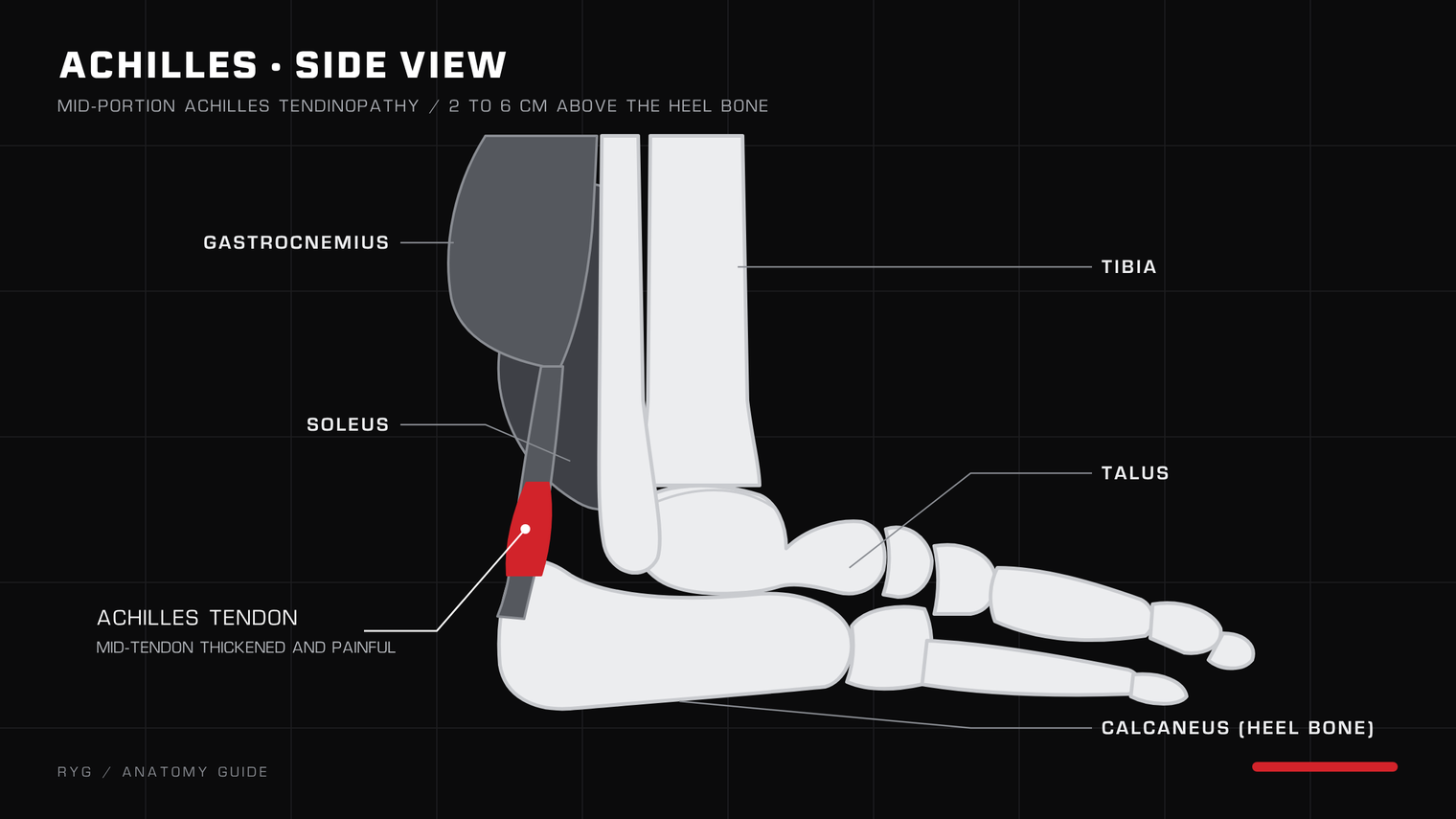
The APTA/JOSPT guideline frames midportion Achilles tendinopathy around three findings: pain, stiffness and calf muscle power deficits1. That last one matters. The tendon only ever sees the load the calf sends through it, and a calf that has lost strength and spring leaves the tendon absorbing more than its share. Location matters too. Pain in the middle of the tendon follows the standard loading plan, while pain right at the heel bone dislikes deep stretching and uphill work early on, because those positions compress the tendon against the bone. Firm ground and thin, aggressive cleats add load, so footwear and surface choices during the rebuild are worth attention.
What the research says
- Among 1,929 recreational runners, 5.2 percent developed Achilles tendinopathy during a race build-up, and having had it in the previous 12 months raised the odds of a new episode more than 6-fold, the strongest risk factor found2.
- Roughly a third of runners with a new episode still had symptoms a year later, which is why early loading-based rehab matters3.
- Athletes who kept running and jumping with pain monitored and capped during rehab improved just as much at 12 months as those who stopped for 6 weeks, with no harm to the tendon4.
- The pain-monitoring rule from that trial: pain up to 5 out of 10 during and after exercise is acceptable, it should settle by the next morning, and it should not be getting worse week over week5.
- Heavy slow resistance training and eccentric heel drops gave equally good results that lasted a year, but heavy slow resistance had 92 percent session adherence versus 78 percent and 100 percent patient satisfaction at 12 weeks versus 80 percent6.
- Twelve weeks of tendon loading not only reduced pain and improved function but also reduced tendon thickness and abnormal blood vessel growth on imaging6.
- For a complete rupture, surgery lowered re-rupture risk from 3.9 to 2.3 percent but raised complication risk from 1.6 to 4.9 percent, and nearly 1 in 3 professional athletes never returned to play after a surgically repaired rupture7,8.
What we do about it
The way out is managed loading: keep the tendon working at a level it tolerates and raise that level progressively. Exercise is the first-line treatment and deserves at least 3 months before other options are considered, because recovery can take up to a year9.
Settle and keep moving. Isometric calf holds for pain relief, training volume trimmed but not stopped, using the 5 out of 10 pain rule to set the dose5.
Heavy and slow. Loaded heel raises, straight and bent knee, progressed to heavy slow resistance three times a week, the approach with the best adherence and satisfaction in the head-to-head trial6. Insertional pain gets a modified version that avoids deep dorsiflexion early.
Restore the spring. Hopping and plyometric progressions, then graded running and sprinting, then full match loads. This is the progression we run in the clinic, with a test at every phase before you move on.
When to get it looked at
- A sudden pop or the feeling of being kicked in the heel with immediate weakness pushing off. That is a possible rupture and needs same-day assessment.
- Heel pain in a growing athlete, which may be the growth plate rather than the tendon.
- Tendon pain with redness, warmth or swelling that is not related to load.
- Morning stiffness and pain that have not changed after 12 weeks of properly progressed loading.
Bottom line
The Achilles does not get better by resting and it does not get better by pushing through at full volume. It gets better with monitored, progressive, heavy loading over months, and the research says you can keep playing while you do it. If your tendon has been stiff every morning for weeks, an in-person evaluation can gauge how irritable it is and where the loading should start.
References
- Martin RL, Chimenti R, Cuddeford T, et al. Achilles Pain, Stiffness, and Muscle Power Deficits: Midportion Achilles Tendinopathy Revision 2018. J Orthop Sports Phys Ther. 2018;48(5):A1-A38. PubMed
- Lagas IF, Fokkema T, Verhaar JAN, et al. Incidence of Achilles tendinopathy and associated risk factors in recreational runners: A large prospective cohort study. J Sci Med Sport. 2020;23(5):448-452. PubMed
- Lagas IF, Fokkema T, Bierma-Zeinstra SMA, et al. How many runners with new-onset Achilles tendinopathy develop persisting symptoms? A large prospective cohort study. Scand J Med Sci Sports. 2020;30(10):1939-1948. PubMed
- Silbernagel KG, Thomeé R, Eriksson BI, et al. Continued sports activity, using a pain-monitoring model, during rehabilitation in patients with Achilles tendinopathy: a randomized controlled study. Am J Sports Med. 2007;35(6):897-906. PubMed
- Silbernagel KG, Thomeé R, Eriksson BI, et al. Continued sports activity, using a pain-monitoring model, during rehabilitation in patients with Achilles tendinopathy: a randomized controlled study. Am J Sports Med. 2007;35(6):897-906. PubMed
- Beyer R, Kongsgaard M, Hougs Kjær B, et al. Heavy Slow Resistance Versus Eccentric Training as Treatment for Achilles Tendinopathy: A Randomized Controlled Trial. Am J Sports Med. 2015;43(7):1704-1711. PubMed
- Ochen Y, Beks RB, van Heijl M, et al. Operative treatment versus nonoperative treatment of Achilles tendon ruptures: systematic review and meta-analysis. BMJ. 2019;364:k5120. PubMed
- Trofa DP, Miller JC, Jang ES, et al. Professional Athletes' Return to Play and Performance After Operative Repair of an Achilles Tendon Rupture. Am J Sports Med. 2017;45(12):2864-2871. PubMed
- Silbernagel KG, Crossley KM. A Proposed Return-to-Sport Program for Patients With Midportion Achilles Tendinopathy: Rationale and Implementation. J Orthop Sports Phys Ther. 2015;45(11):876-886. PubMed
Alex does amazing work and had me feeling better in no time! I had alot of tightness in my hamstrings and calves and used needles and a lot of soft tissue work to loosen them up!
Alex is awesome. He's responsive to ongoing issues, and he works to formulate a plan to help you achieve your end-goals.
I had been having calf issues for years that went misdiagnosed or undiagnosed through by other providers. Now, he's clearly properly diagnosed the issue and helped me implement a plan that has kept the issue from coming back. Highly recommend!
This article is for education and does not replace an evaluation. If you're dealing with an active injury, see a licensed medical provider.