
Ankle Sprains in Soccer: Why Walking It Off Is the Most Expensive Advice in Sports
 Soccer
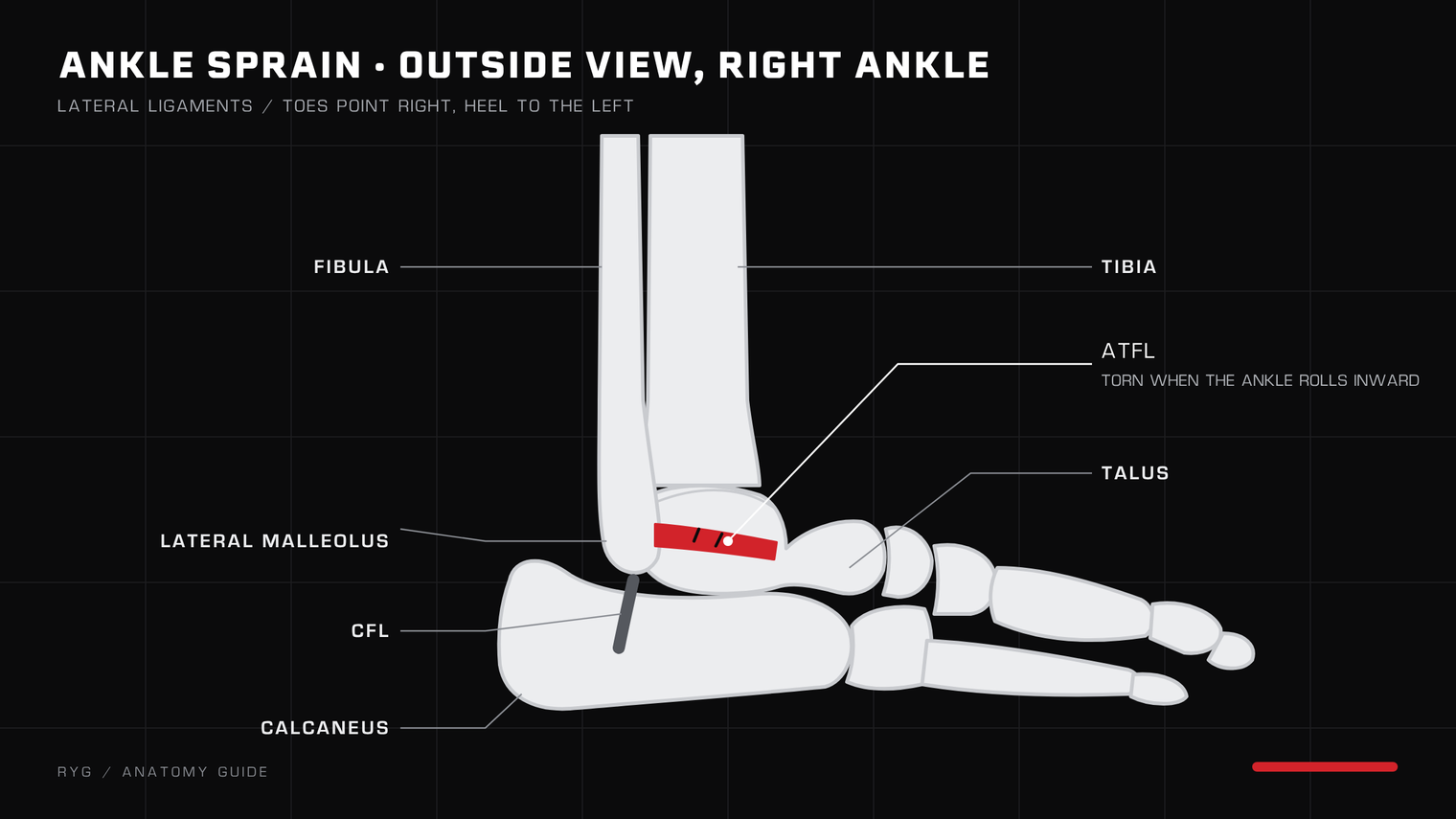
The rolled ankle is soccer's most familiar injury. A bad landing after a header, a foot caught in a tackle, an uneven patch of grass, and the ankle rolls inward, stretching or tearing the ligaments on the outside. Most players have seen it so many times that the standard response is ice, a compression sleeve, and walk it off. That casual response is exactly why ankle sprains cause so much long-term trouble.
The research puts a number on it: roughly 1 in 3 athletes re-sprains within a year under usual care, and a short balance program cuts that by about a third. Walking it off is the expensive option.
What's actually going on
The lateral ligaments are the usual victims because the ankle's bony anatomy leaves that direction least protected. Beyond the ligament, those tissues are packed with sensors that tell your brain where your foot is in space. When they tear, that signal gets fuzzy, and your split second corrections on uneven ground get slower. The ligament heals over weeks, but the sensing and the reflexive muscle control do not come back on their own. That is why ankles that were never retrained keep rolling, and why repeated sprains can snowball into chronic instability.
What the research says
- Female athletes sprain ankles at roughly twice the rate of males, 13.6 versus 6.9 per 1,000 exposures, and children and adolescents sprain more often than adults1.
- Under usual care, 33 percent of athletes re-sprained the same ankle within a year; adding an 8 week home balance program cut that to 22 percent, a 35 percent reduction, with the biggest benefit in athletes whose original sprain was never treated2.
- Current guidelines favor a brace or tape plus a supervised exercise program over rest and passive treatment, with surgery reserved for sprains that fail thorough rehab3,4.
- Bracing has strong evidence and neuromuscular training moderate evidence for preventing a repeat sprain4.
- The severity of a sprain is judged most reliably by a hands-on exam 4 to 5 days after injury, once the initial swelling has settled3.
- People who started exercise in the first week after a sprain had better function at weeks 1 and 2 than those who rested, iced, compressed and elevated, with the same 4 percent reinjury rate5.
- Being unable to do a single leg drop landing or a drop jump 2 weeks after a first sprain predicted who would go on to chronic ankle instability6.
What we do about it
Good rehab is not complicated but it is specific, and the JOSPT guideline gives its strongest grade to progressive weight bearing and structured exercise while ice gets only a Grade C7.
Week 1. Protected movement beats strict rest. Early weight bearing, range of motion and gentle loading, with a brace or tape for support, and a proper severity exam a few days in3.
Build. Strength for the muscles that guard the ankle, especially the peroneals along the outside of the shin, progressed to heavy, slow calf and ankle work. Balance training that sharpens the position sense, from stable to unstable to unpredictable2.
Return the reflexes. Hopping, cutting and landing drills that restore reaction speed, tested with single leg landings and drop jumps before cutting returns, because those tests at 2 weeks predict who becomes chronically unstable6. A lace-up brace or tape during the return window is well supported while the system rebuilds4. This is the progression we run in the clinic, with a test at every phase before you move on.
When to get it looked at
- Inability to bear weight for four steps right after the injury, or bone tenderness at the back edge of either ankle bone, the base of the fifth metatarsal or the navicular, which need an X-ray.
- Pain above the ankle joint that is worse with twisting or pushing off, which may be a high ankle sprain and takes longer.
- Numbness, coldness or a foot that looks deformed.
- An ankle that is still giving way or swelling weeks after the sprain.
- A second sprain of the same ankle within a year.
Bottom line
An ankle sprain heals, but an untrained ankle rolls again. The evidence favors early movement, strength, balance training and a brace during the return window, and it says a few weeks of that work cuts re-sprains by a third. An in-person evaluation can help you judge whether your ankle is actually ready for a match or just no longer sore.
References
- Doherty C, Delahunt E, Caulfield B, et al. The incidence and prevalence of ankle sprain injury: a systematic review and meta-analysis of prospective epidemiological studies. Sports Med. 2014;44(1):123-140. PubMed
- Hupperets MD, Verhagen EA, van Mechelen W. Effect of unsupervised home based proprioceptive training on recurrences of ankle sprain: randomised controlled trial. BMJ. 2009;339:b2684. PubMed
- Vuurberg G, Hoorntje A, Wink LM, et al. Diagnosis, treatment and prevention of ankle sprains: update of an evidence-based clinical guideline. Br J Sports Med. 2018;52(15):956. PubMed
- Doherty C, Bleakley C, Delahunt E, et al. Treatment and prevention of acute and recurrent ankle sprain: an overview of systematic reviews with meta-analysis. Br J Sports Med. 2017;51(2):113-125. PubMed
- Bleakley CM, O'Connor SR, Tully MA, et al. Effect of accelerated rehabilitation on function after ankle sprain: randomised controlled trial. BMJ. 2010;340:c1964. PubMed
- Doherty C, Bleakley C, Hertel J, et al. Recovery From a First-Time Lateral Ankle Sprain and the Predictors of Chronic Ankle Instability: A Prospective Cohort Analysis. Am J Sports Med. 2016;44(4):995-1003. PubMed
- Martin RL, Davenport TE, Fraser JJ, et al. Ankle Stability and Movement Coordination Impairments: Lateral Ankle Ligament Sprains Revision 2021. J Orthop Sports Phys Ther. 2021;51(4):CPG1-CPG80. PubMed
Over the years I’ve been going to see Alex he has not only helped me quickly and efficiently get back to normal, but coming back stronger. He’s helped me with my knees and hips so that they are no longer any issue and my ankle when I sprained it. Highly recommended.
We had a great experience with Alex and Regain Your Game. My son had a high ankle sprain and we worked with Alex and had a quick recovery. We particularly valued his availability, flexibility, and professionalism.
This article is for education and does not replace an evaluation. If you're dealing with an active injury, see a licensed medical provider.